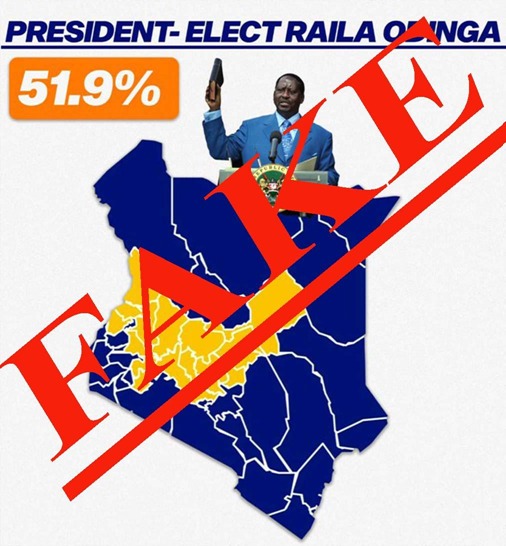
The image above was included in the tweet

The use of social media to spread false information and fake news has been a key issue in Kenya during the 2022 post-election period. Vote counting in Kenya’s August 9th 2022 election began after polls closed, and it was at this point that online communities took advantage of information gaps to publish false information. Announcement of election results is a duty exclusively reserved for the Independent Electoral and Boundaries Commission (IEBC). Leaders did not escape the effects of information disorder. Others distributed misleading information on purpose to give their supporters the impression that their preferred candidate was in the lead while, in reality, there was going to be a winner and a loser.
This tweet that was shared on 11th August 2022 and had 569 engagements claimed that the Azimio presidential candidate was the president-elect and that he was leading with a percentage of 51.9%. This contradicted the information later announced by IEBC Chairperson Wafula Chebukati where the Kenya Kwanza presidential candidate Dr. William Ruto was declared the winner of the presidential election held on 9th August 2022. A total of eight cases, have however been presented before the Supreme Court contesting the announcement of Dr William Ruto as president elect.
Another tweet, shared on 11th Aug 2022 by Martha Karua SC, who is the Azimio coalition running mate, shows her congratulating Wangu Ngirici for her election as Kirinyaga county governor. The tweet was flagged as misleading upon conclusion of vote counting, Anne Mumbi Waiguru was declared the winner having been re-elected as the Kirinyaga county governor for a second term.

The period before the announcement of the official presidential results created tension and uncertainty among citizens with citizens who supported different candidates claiming that their candidate had indeed won the elections. This tweet also claimed different presidential results from this Instagram post resulting in confusion and increased anxiety among members of the public.
Key stakeholders and financiers of presidential campaigns were also dragged into the spread of misinformation giving false hopes to citizens. Self-proclaimed returning officers who were campaign financers misled nationalists that their candidate was leading. Anyone supporting the candidate in the picture would raise hopes only for them to get squandered when the final presidential tally is released.
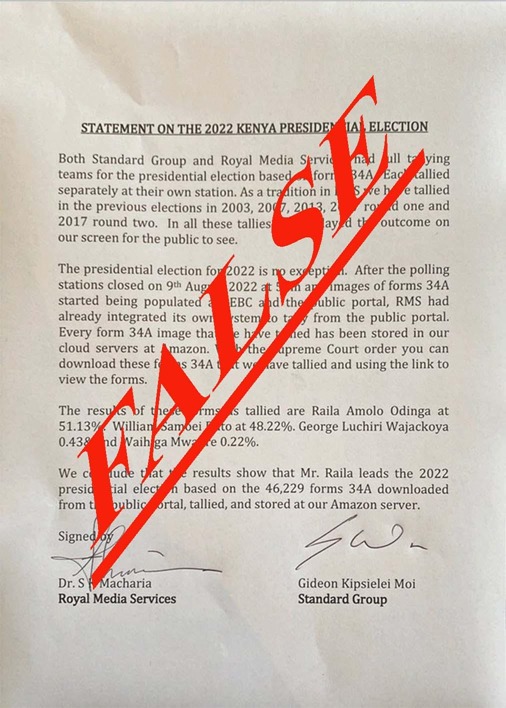
A press release, signed in the name of SK Macharia who owns Royal Media Services and who is reportedly a front liner for Azimio’s presidential candidate, surfaced online and sparked arguments among citizens. The statement was also signed in the name of Gideon Moi, who is known to have been a keen supporter of the Azimio coalition. However, upon fact checking the release turned out to be false.
 The use of social media has significantly changed how people communicate in the modern world, as well as how political activists spread their messages. Misinformation that has come as a result of the proliferation of social media has planted seeds of suspicion in the public mind about institutions, like the electoral commission, and increasingly intentionally influences consumers of social media to embrace erroneous beliefs that favor and advance particular agendas. Fake news harms people and society.
In the future, the Independent Electoral and Boundaries Commission should establish a committee to dispel rumors about the nation’s elections, including both general elections and by-elections.
This story was produced with the support of the Baraza Media Lab, CRECO & Africa Uncensored as a result of attending Misinformation Masterclass.
Similar Posts by The Mt Kenya Times:
- Mt Kenya Times ePAPER October 23, 2026
- Ruto’s parting COMESA call: Remove the barriers, honour the commitments
- Direct hospital access to KEMSA cuts drug delays, says PS
- Africa can’t wait: Continent seeks $1 trillion for climate adaptation
- Ruto passes the baton as Africa’s trade bloc faces a fragmenting world
About the Author