ICPAK Launches Pathway to Enhanced Sustainability Reporting under IFRS Standards
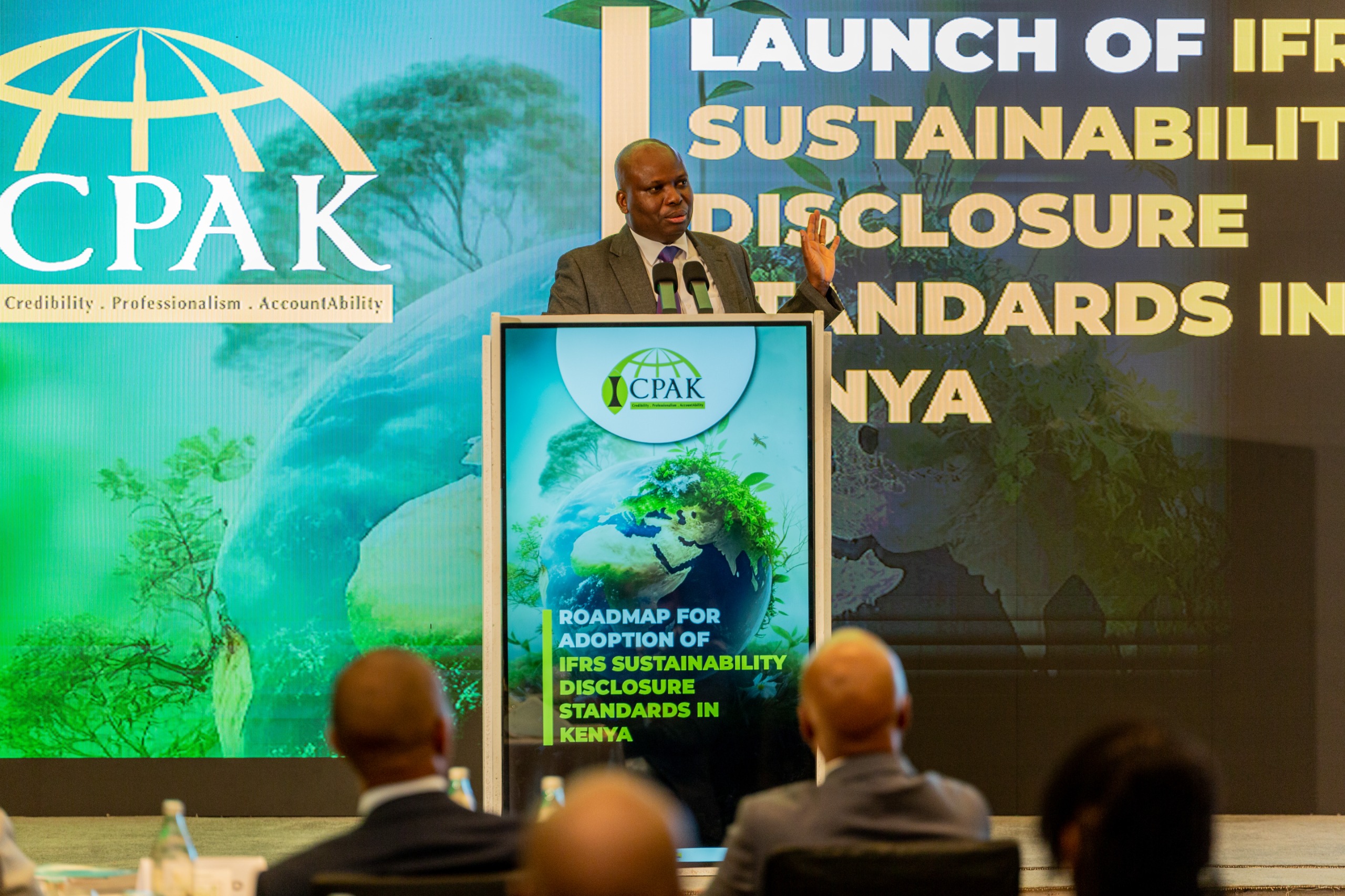
In picture, ICPAK Chairman CPA Philip Kakai making his remarks during the launch of the roadmap to sustainability reporting
By Aoma Keziah,

In a landmark development for Kenya’s financial sector, the Institute of Certified Public Accountants of Kenya (ICPAK) launched its Roadmap for the adoption of the International Financial Reporting Standards (IFRS) Sustainability Disclosure Standards. This initiative, represents a significant step toward enhancing transparency, accountability, and sustainability in corporate reporting across Kenya.
The event saw participation from regulators, corporate representatives, and key international stakeholders, including the Pan African Federation of Accountants (PAFA), African Union, International Sustainability Standards Board (ISSB), and the IFRS Foundation.
Established in 1978 under the Accountants Act No. 15 of 2008, ICPAK plays a pivotal role in setting and regulating accounting standards in Kenya. As a member of PAFA and the International Federation of Accountants (IFAC), ICPAK aims to uphold high standards of financial and non-financial reporting. Through the adoption of IFRS Sustainability Disclosure Standards specifically IFRS S1 (for sustainability-related financial information) and IFRS S2 (for climate-related disclosures) ICPAK seeks to streamline and improve sustainability reporting frameworks, positioning Kenya as a leader in sustainable business practices within Africa.
In his opening remarks, ICPAK chairman Philip Kaikai highlight that Sustainability has transitioned from a peripheral concern to a central element in the strategic framework of contemporary business.
“It is essential for the future success and resilience of economies, enterprises, and communities alike. Expectations for businesses now encompass not only the delivery of financial returns but also the active contribution to societal and environmental objectives. The importance of environmental responsibility, social impact, and corporate governance is more pronounced than ever.” He said.
Kaikai further stated that Kenya is on the verge of a new era in corporate governance and financial reporting. The adoption of the International Financial Reporting Standards (IFRS) Sustainability Disclosure Standards will help formalize sustainability disclosures, ensuring that companies provide relevant, reliable, and comparable data on the environmental, social, and governance (ESG) factors that are crucial for investors, consumers, and the communities in which they operate.
“On 26 June 2023, the International Sustainability Standards Board (ISSB) released its first two International Sustainability Disclosure Standards (IFRS SDS or the Standards), which became effective for periods beginning on or after 1 January 2024. As earlier mentioned, the inaugural event of adopting the IFRS S1 and S2 standards was in Kenya on 5 September 2023.” Kaikai added.

Grace Kamau , CEO ICPAK, said that sustainability is no longer a buzzword; it has become an imperative for businesses, investors, and governments.
“As we all know, the global economy is undergoing profound transformations, driven by technological innovation and increasing awareness of the need to address environmental, social, and governance (ESG) challenges. From climate change to social inequality, the world faces complex issues that demand coordinated and transparent action from all sectors of society.” She said
She also added that as the professional body representing accountants, auditors, and financial professionals in Kenya, ICPAK recognizes their crucial role in this transformation.
“ We are committed to fostering an environment where our members have the knowledge, tools, and support to help businesses integrate sustainability considerations into their financial reporting frameworks. This is why the launch of the Roadmap for the Adoption of IFRS Sustainability Standards is such a significant event for us it reflects our collective responsibility to ensure that Kenya is not only keeping pace with global trends but also leading the way in adopting internationally recognized standards for sustainability.” Urged Kamau.
The IFRS Sustainability Standards will provide a comprehensive framework for Kenyan organizations to monitor, manage, and disclose their sustainability impacts and climate risks. According to ICPAK, adopting these standards will improve comparability, reduce fragmented reporting, and align Kenya’s reporting framework with global best practices, benefitting both businesses and stakeholders.
Addressing Fragmentation in Reporting, Kenyan organizations face a complex landscape of multiple sustainability frameworks, including the Nairobi Securities Exchange Environmental, Social, and Governance (ESG) Disclosure Guidance and guidelines from the Capital Markets Authority and Central Bank of Kenya. While these initiatives have driven some progress, the absence of a unified approach has hindered effective comparability.
ICPAK’s partnership with ISSB aims to establish a global baseline for sustainability disclosures, providing consistent and comparable data for investors and other market participants.
To facilitate the smooth adoption of IFRS Sustainability Standards, ICPAK has set up a Multi-Stakeholder Sustainability and Climate Change Reporting Committee. This committee, in collaboration with the Professional Standards Committee and other subcommittees, will focus on enhancing preparer and user capacity for sustainability-related financial disclosures, providing guidance on interpreting and communicating climate-related information and managing the phased adoption of IFRS standards, ensuring smooth transitions for organizations across sectors.
ICPAK urged Kenyan businesses to actively prepare for the new standards by building Internal Capacity; Invest in staff training, data collection, and sustainability reporting systems, foster understanding and support for sustainability initiatives among investors, customers, employees, and other stakeholders and take advantage of the training programs, guidance materials, and tools ICPAK offers to aid the transition. Through ongoing training, guidance, and advocacy, the organisation is dedicated to making this shift toward sustainability both seamless and impactful for Kenyan businesses.
Similar Posts by Aoma Keziah:
- Nationwide Youth Business Drive Enters Last Lap With New Nyota Trainings
- Green Light From Washington Sets G42 On Fast Track to Build Region’s Most Powerful AI Network
- Safina Eyes Kariobangi North Seat in Intensified Push Before Poll Day
- KEBS Opens Talks With Manufacturers On New Standards Levy Order 2025
- Kenya, Uganda And South Sudan Chart Way Forward On East Africa Rail Corridor
About the Author


 The Mt Kenya Times