Parliamentary Finance Committee Collating Views On Various Proposed Tax And Business Laws
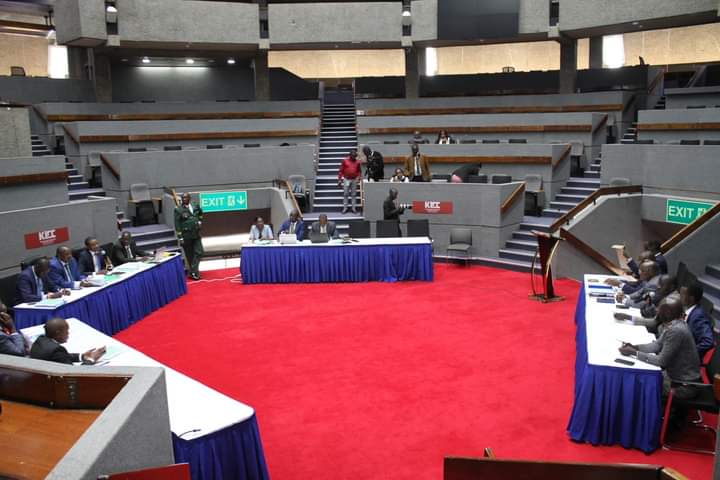
During yesterday's session

By PSCU
Worth Noting:
- A number of the stakeholders who appeared before the Committee endorsed some of the provisions contained in three Bills terming then progressive, while others proposed counter measures.
- Okoa Uchumi Campaign, a civil society platform working with stakeholders to redress Kenya’s public debt crisis, acknowledged that that a number of factors had formed the context for the introduction of the Tax Procedures (Amendment) Bill, 2024 and the Tax Laws (Amendment) Bill, 2024.
- “The recent reforms in tax policy and collection by the National Government, have come amidst and due to a number of factors including a limited fiscal space, its program with IMF and the historical under collection in revenue, among others”, Dr. Abraham Rugon representing the platform told the Committee.

The Departmental Committee on Finance and National Planning yesterday continued collating views on various Bills under consideration by the House.
The four-day engagement with stakeholders is geared towards getting viewpoints on the
The Tax Procedures (Amendment) (No 2) Bill National Assembly Bill No 46 of 2024), The Tax Laws (Amendment) Bill, (National Assembly Bill No. 47 of 2024) and the Business Laws (Amendment) Bill ( National Assembly Bill No. 48 of 2024).
Specifically, the Committee is subjecting the provisions relating to The Banking Act, Cap. 488; The Central Bank Act, Cap. 491; and The Microfinance Act, Cap. 493C, to public participation.
A number of the stakeholders who appeared before the Committee endorsed some of the provisions contained in three Bills terming then progressive, while others proposed counter measures.
Okoa Uchumi Campaign, a civil society platform working with stakeholders to redress Kenya’s public debt crisis, acknowledged that that a number of factors had formed the context for the introduction of the Tax Procedures (Amendment) Bill, 2024 and the Tax Laws (Amendment) Bill, 2024.
“The recent reforms in tax policy and collection by the National Government, have come amidst and due to a number of factors including a limited fiscal space, its program with IMF and the historical under collection in revenue, among others”, Dr. Abraham Rugon representing the platform told the Committee.
He however called on the government to focus more on rationalizing expenditures and addressing documented waste and corruption rather than press the focus on revenue raising, adding that efficiency gains of the former would create more resources than additional tax measures.
Commenting on the proposed imposition of Significant Economic Presence Tax, Okoa Uchumi posited that the change in the tax rates and base on digital transactions for non-residents is in line with both the government’s agenda under the Medium Term Revenue Strategy (MTRS) and the National Tax Policy 2024, and the international best practices through the Organization for Economic Co-operation and Development (OECD) model to grow revenues. They urged the Committee to adopt the proposal.
The Platform also supported the proposed payment by owners of digital marketplaces, noting that this measure would expand the tax base to include income earned from payments made by digital platform owners which is consistent with the National Tax Policy, 2024.
The Association of Gaming Operators however expressed concern that the proposed changes to the taxation regime on the sector could adversely affect investment in the sector.
“We note with concern the constant and dynamic changes that have been made to the taxation regime governing the betting and games sector. The unpredictability of the tax regime on the sector will result in a case where capital will not flow easily to the Kenyan Economy as multinational betting operators will look for alternative investment destination”, the organization’s chairman , Sasa Krneta submitted.
They instead proposed countermeasures which they observed would result to a more sustainable tax regime for the sector in Kenya.
On their part, the Kenya Private Sector Alliance (KEPSA) urged the Committee to define the scope and application of the “significant economic presence” arguing that the absence of a precise definition would create uncertainty regarding its interpretation.
“Tax authorities, businesses, and legal practitioners may have varying understandings of what constitutes a significant economic presence leading to inconsistent application of the tax law”, they submitted.
The Alliance also called for imposition of measures to enhance predictability in tax increment and changes through the adoption of a five-year excise duty schedule for products containing nicotine intended for inhalation without combustion or oral application.
They posited that this move would promote certainity and predictability of tax rates in line with the National Tax Policy while allowing cigarette consumers to switch to better alternatives.
Boniface Mwangangi from the Association of Pension Trustees and Administrators of Kenya told the Committee that fiscal discipline within the public sector, especially county governments requires immediate legislative and policy interventions.
He lauded the requirement to enforce the payment of statutory deductions by amending Section 109 of the Public Finance Management Act, for its potential to instill fiscal responsibility across the governance spectrum for remittance of statutory deductions.
The Committee chairperson, Kimani Kuria pledged that the Committee would incorporate the views of the stakeholders in its report to enrich the proposed laws.
The public engagement continues till Thursday this week.
Similar Posts by The Mt Kenya Times:
- Mt Kenya Times ePAPER September 28, 2026
- Kalonzo turns 40-year jibe into rule of law defence
- Roseline Njogu emerges as leading voice in Kenya’s diaspora and labour mobility agenda
- Ruto: Expansion of Mzima Springs water project to begin this year
- Linda Mwananchi settles on Sifuna as 2027 presidential flagbearer
About the Author