The USA-Rwanda Agreement on the DRC Conflict: A Diplomatic Breakthrough or a Strategic Gamble?
 The Mt Kenya Times
US Treasury secretary Scott Bessent and Ukrainian first deputy prime minister Yulia Svyrydenko after the deal signing this week © Yulia Svyrydenko via Facebook/Reuters
By: Silas Mwaudasheni Nande
Introduction
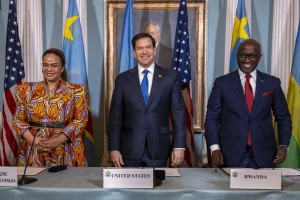
The recent USA-Rwanda agreement concerning the ongoing conflict in the Democratic Republic of Congo (DRC) marks a significant diplomatic intervention aimed at stabilizing the Great Lakes region. Signed in Washington, the agreement seeks to halt military support for armed groups, establish a joint security coordination mechanism, and pave the way for economic investment in the mineral-rich territories of eastern DRC. While hailed as a step toward peace, the agreement raises critical concerns regarding its long-term implications for Rwanda, Uganda, DRC, and Africa as a whole.
This article provides an in-depth analysis of the agreement, examining its key provisions, geopolitical motivations, and economic consequences. Additionally, it explores the potential risks associated with this deal, including sovereignty concerns, regional instability, and economic dependencies that could shape the future of the Great Lakes region.
Background: The Conflict in Eastern DRC

The conflict in eastern DRC has persisted for decades, fueled by ethnic tensions, rebel insurgencies, and competition over mineral resources. The presence of armed groups such as M23, the Democratic Forces for the Liberation of Rwanda (FDLR), and various militia factions has exacerbated instability, leading to mass displacement, human rights violations, and economic disruption.
Rwanda has long been accused of supporting M23 rebels, a claim it has repeatedly denied. Meanwhile, Uganda has also been implicated in cross-border military interventions, further complicating the security landscape. The USA’s involvement in brokering this agreement signals a renewed effort to de-escalate tensions, but the underlying geopolitical interests must be critically examined.
Key Provisions of the Agreement
The USA-Rwanda agreement outlines several core commitments, including:
- Cessation of Military Support for Armed Groups – Both Rwanda and DRC have pledged to refrain from providing state military assistance to non-state armed factions operating in eastern DRC.
- Joint Security Coordination Mechanism – A bilateral security framework will be established to monitor and counter armed groups, ensuring that both nations uphold their commitments.
- Economic Investment in Mineral-Rich Regions – The USA has committed to investing billions of dollars in DRC’s mining sector, with Rwanda also negotiating a separate minerals deal to enhance its economic prospects.
- Respect for Sovereignty and Territorial Integrity – Both nations have agreed to resolve disputes through diplomacy, rather than military force or hostile rhetoric.
- Monitoring and Compliance Measures – A follow-up committee, including representatives from the USA, Qatar, France, and the African Union, will oversee the implementation of the agreement.
While these provisions appear promising, the practical execution of the agreement remains uncertain, given the historical complexities of the conflict.
Geopolitical Implications
Impact on Rwanda
For Rwanda, the agreement presents both opportunities and risks. On one hand, it allows Kigali to strengthen diplomatic ties with Washington, securing economic investments and international legitimacy. However, the requirement to withdraw support for M23 rebels could weaken Rwanda’s strategic influence in eastern DRC, potentially exposing it to security threats from rival factions.
Impact on Uganda
Uganda, though not a direct signatory, will be affected by the shifting power dynamics in the region. If Rwanda reduces its military presence, Uganda may seek to expand its own influence, potentially leading to new territorial disputes. Additionally, Uganda’s economic interests in DRC’s mineral sector could be challenged by increased American investments, altering trade patterns.
Impact on DRC
For DRC, the agreement offers a pathway to stability, but at a high cost. The influx of foreign investments may boost economic recovery, yet it also raises concerns about resource sovereignty. If American firms dominate mineral extraction, DRC risks becoming economically dependent on external actors, limiting its ability to control its own wealth.
Impact on Africa at Large
The broader African implications of this agreement revolve around regional security and economic autonomy. While the USA’s involvement may reduce immediate violence, it also reinforces Western influence in African affairs. The reliance on foreign mediation rather than African-led solutions could undermine continental sovereignty, setting a precedent for external intervention in future conflicts.
Potential Negative Impacts
1. Sovereignty Concerns
The agreement places significant control over DRC’s mineral wealth in the hands of American investors, raising fears of economic neocolonialism. If DRC cannot independently regulate its resources, it risks becoming a supplier rather than a beneficiary of its own natural wealth.
2. Regional Instability
While the agreement aims to reduce armed conflict, the withdrawal of Rwandan military support could create power vacuums, allowing new rebel factions to emerge. Additionally, Uganda may seek to expand its influence, leading to new territorial disputes.
3. Economic Dependencies
The reliance on American investments could limit local economic development, as foreign firms control extraction, pricing, and trade policies. If Rwanda and DRC fail to negotiate equitable revenue-sharing agreements, they may struggle to benefit from their own resources.
4. Diplomatic Tensions
The agreement may strain relations between Rwanda and Uganda, as both nations compete for influence in DRC. Additionally, European stakeholders may feel sidelined, given the USA’s dominant role in shaping the region’s economic future.
5. Long-Term Uncertainty
Previous peace agreements in DRC have failed to produce lasting stability. If implementation challenges arise, the agreement may collapse, leading to renewed violence and economic setbacks.
Past Peace Agreements in the DRC and Why They Failed
The Democratic Republic of Congo (DRC) has been the epicenter of multiple peace agreements aimed at resolving its prolonged conflicts, yet many of these agreements have failed to bring lasting stability. The reasons for their failure often stem from political manipulation, lack of enforcement mechanisms, external interference, and deep-rooted economic interests tied to the region’s vast mineral wealth. Additionally, the role of foreign powers, including the United States, in African conflicts has often been controversial, raising concerns about neo-colonial influence rather than genuine peace-building efforts. This article explores past failed agreements in the DRC, the necessity of African-led solutions, and the question of Africa’s capability to resolve its own conflicts.
1. The Lusaka Agreement (1999)
The Lusaka Agreement, signed in 1999, was one of the earliest attempts to end the Second Congo War, involving multiple African nations. The agreement called for a ceasefire, withdrawal of foreign troops, and the deployment of UN peacekeepers. However, it failed due to:
- Lack of commitment from signatories, as rebel groups continued fighting despite the agreement.
- Weak enforcement mechanisms, with no clear consequences for violations.
- Foreign interference, as Rwanda and Uganda maintained military presence in eastern DRC, undermining the peace process.
2. The Sun City Agreement (2002-2003)
The Sun City Agreement, part of the Inter-Congolese Dialogue, aimed to establish a transitional government and integrate rebel factions into the political system. While it led to the formation of a power-sharing government, it failed because:
- Key rebel groups, such as RCD-Goma, were excluded, leading to continued insurgencies.
- Political elites manipulated the process, prioritizing personal gains over national stability.
- Lack of trust among factions, preventing genuine cooperation.
3. The Nairobi Agreement (2007)
The Nairobi Agreement was signed between DRC and Rwanda, focusing on disarming the FDLR (Democratic Forces for the Liberation of Rwanda), a rebel group operating in eastern DRC. It failed due to:
- Rwanda’s continued involvement in supporting other armed groups, undermining the agreement’s credibility.
- Weak implementation, as the FDLR remained active despite diplomatic efforts.
- Absence of regional consensus, with Uganda and Burundi pursuing separate interests.
4. The Addis Ababa Peace Framework (2013)
The Addis Ababa Framework Agreement, backed by the United Nations and African Union, sought to end rebel activities and promote regional cooperation. Despite initial optimism, it failed because:
- M23 rebels resumed fighting, showing the agreement lacked enforcement power.
- DRC’s weak governance, preventing effective implementation.
- Foreign economic interests, as mineral exploitation continued fueling conflict.
These agreements demonstrate that peace efforts in the DRC have repeatedly collapsed due to external interference, political manipulation, and economic exploitation. The failure of these agreements underscores the need for African-led solutions rather than foreign-imposed frameworks.
Why America Should Not Be a Peace-Breaker in African Conflicts
The United States has historically played a complex role in African conflicts, often intervening under the guise of peace-building while pursuing strategic economic and geopolitical interests. In the case of the DRC, American involvement has been both direct and indirect, influencing military operations, economic policies, and diplomatic negotiations. However, there are several reasons why America should not dictate peace processes in Africa:
1. Historical Interference and Unintended Consequences
The U.S. has a history of supporting factions in African conflicts, often fueling instability rather than resolving it. For example:
- During the Cold War, the U.S. backed Mobutu Sese Seko, whose corrupt regime contributed to DRC’s long-term instability.
- In Somalia, U.S. military interventions have often exacerbated tensions rather than stabilizing the region.
- In Libya, U.S.-led NATO operations led to the collapse of the state, triggering widespread chaos causing the killing of Libyan president, Muammard Qaddafi.
2. Economic Interests Over Genuine Peace
The DRC is rich in minerals, including cobalt, coltan, and gold, which are essential for global industries. American corporations have economic stakes in the region, raising concerns that U.S. involvement in peace agreements is driven by resource control rather than humanitarian concerns.
3. Undermining African Sovereignty
When foreign powers dictate peace agreements, African nations lose control over their own political and security decisions. This creates dependency on external actors, preventing Africa from developing independent conflict-resolution mechanisms.
4. The Risk of Neo-Colonialism
U.S. involvement in African conflicts often mirrors neo-colonial strategies, where interventions serve Western interests rather than African stability. This approach reinforces economic exploitation, leaving African nations vulnerable to external manipulation.
Instead of imposing solutions, the U.S. should support African-led initiatives, allowing regional organizations like the African Union (AU) and Southern African Development Community (SADC) to take the lead in peace-building efforts.
African Conflicts Need African Solutions
The idea that African conflicts require African solutions is rooted in the belief that local actors understand the complexities of their own challenges better than foreign powers. Africa has the capacity, institutions, and expertise to resolve conflicts, but external interference often undermines its ability to do so.
1. The Role of the African Union (AU)
The AU has established peacekeeping missions, such as:
- AMISOM in Somalia, which has helped stabilize the country.
- The African Standby Force, designed to respond to crises.
- Mediation efforts in Sudan and South Sudan, preventing further escalation.
2. Regional Organizations as Peace Brokers
Organizations like ECOWAS, SADC, and IGAD have successfully mediated conflicts, proving that African-led diplomacy works. For example:
- ECOWAS intervened in Liberia and Sierra Leone, leading to peace agreements.
- SADC played a role in Zimbabwe’s political transition, preventing civil unrest.
3. Cultural and Historical Understanding
African leaders and institutions understand the historical, ethnic, and socio-political dynamics of conflicts better than foreign actors. Western interventions often fail because they lack cultural context, leading to misguided policies.
4. Strengthening African Governance
Instead of relying on foreign mediation, Africa must strengthen its governance structures, ensuring that peace agreements are enforced by African institutions rather than external forces.
Is Africa Capable Enough to Solve Its Own Problems?
Africa is more than capable of solving its own conflicts, but several challenges hinder its ability to do so:
1. Weak Institutions and Governance
Many African nations struggle with corruption, weak governance, and political instability, making peace enforcement difficult. Strengthening institutions, rule of law, and democratic governance is essential for effective conflict resolution.
2. Economic Dependencies
Foreign economic control over African resources limits Africa’s ability to negotiate peace independently. African nations must develop self-sufficient economies to reduce reliance on external actors.
3. External Interference
Western nations often undermine African-led peace efforts, imposing their own solutions rather than allowing regional organizations to lead. Africa must assert its sovereignty in diplomatic negotiations.
4. Need for Stronger Regional Cooperation
African nations must strengthen regional alliances, ensuring that conflict resolution is a collective effort rather than individual state interventions.
Conclusion
The failure of past peace agreements in the DRC highlights the dangers of foreign-imposed solutions. While the USA and other Western nations claim to support peace, their involvement often serves economic and geopolitical interests rather than genuine stability. Africa has the institutions, expertise, and historical understanding to resolve its own conflicts, but it must strengthen governance, reduce economic dependencies, and assert diplomatic sovereignty.
The future of African peace-building lies in African-led solutions, where regional organizations, local leaders, and grassroots movements take charge of conflict resolution. If Africa is to break free from cycles of instability, it must reject external manipulation and embrace self-determined strategies for lasting peace.
The USA-Rwanda agreement represents a diplomatic milestone, but its long-term success depends on effective implementation. While it offers economic opportunities, it also raises critical concerns about sovereignty, regional stability, and economic dependencies.
For Rwanda, Uganda, and DRC, the challenge lies in balancing foreign investments with national interests, ensuring that economic growth does not come at the expense of autonomy. Africa, as a whole, must remain vigilant, advocating for African-led solutions rather than external interventions that may prioritize foreign agendas.
As the world watches, the question remains: Will this agreement bring lasting peace, or will it become another chapter in the cycle of conflict and foreign influence?
Similar Posts by The Mt Kenya Times:
- Mt Kenya Times ePAPER October 24-25, 2026
- Muturi calls on IEBC to keep election technology tender clean and on schedule
- Ruto meets UAE minister in push to deepen trade ties
- Gideon Moi breaks silence on Ruto fallout, cites broken promises
- The doctor who refused to abandon a sick Uganda
About the Author