THE SECOND YOKE: How Aid Became the Architecture of a New Colonialism
 The Mt Kenya Times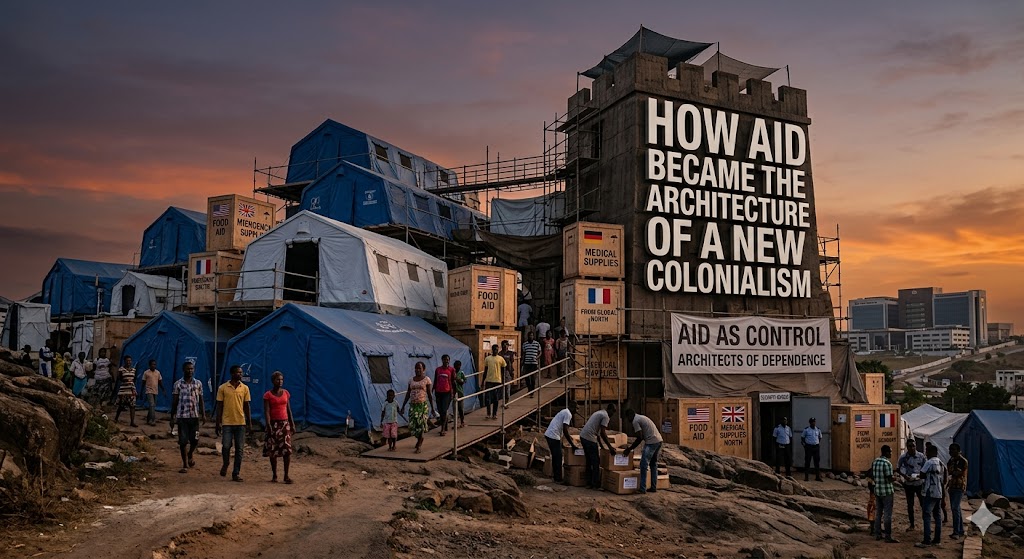
By Silas Mwaudasheni Nande
In 1965, Kwame Nkrumah warned that a state could be juridically independent, fly its own flag, sing its own anthem, and still be governed from outside through economic and political systems controlled from abroad. Sixty-one years later, that warning reads less like prophecy and more like description. The flags of the Global South fly freely. The anthems are sung without permission. Yet the architecture of decision-making in health, food, technology, education, security, and even thought itself still bends toward Washington, Brussels, London, and the boardrooms of multilateral lenders headquartered far from the people whose lives those decisions shape.
This is not a call to romanticise the pre-colonial past or to deny the real and continuing value of solidarity between nations. It is a call to look honestly at a structure: aid, in its present form, has become one of the principal instruments through which the Global North maintains relevance, leverage, and presence in the Global South, at a cost far higher than the headline figures suggest. The South does not lack the capacity to recognise this. What it has lacked, until recently, is the institutional courage to act on that recognition.
From the Flag to the Ledger
Classical colonialism required soldiers, settlers, and administrators. It needed to physically occupy land, extract minerals, and police bodies. That model became too expensive, too visible, and too morally indefensible after two world wars exposed the hypocrisy of empires fighting fascism abroad while practising racial domination in their colonies. Independence movements, from Ghana in 1957 to Namibia in 1990, dismantled the formal apparatus of occupation across most of the continent.
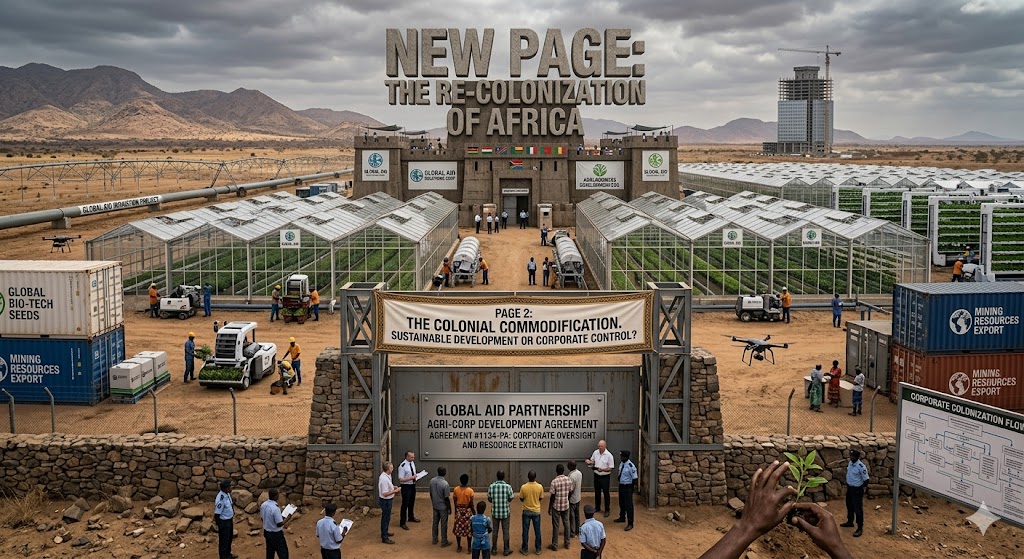
But capital does not retreat merely because flags change. It adapts. Nkrumah’s term for the adaptation was neo-colonialism: a condition in which a state has, in theory, international sovereignty, while in practice its economic system and political policy are directed from outside. The mechanisms shifted from garrisons to ledgers, from governors to consultants, from gunboats to loan covenants. Aid, in this light, is not the opposite of colonialism. It is colonialism’s most successful rebranding.
This is a provocative claim, and it deserves to be tested against evidence rather than rhetoric, because not all aid is identical, and not all assistance is exploitative by design. Humanitarian relief after an earthquake is not equivalent to a structural adjustment programme. The distinction matters. But across the major categories of contemporary “aid” — financial, military, medical and pharmaceutical, technological, human capital, food, educational, and infrastructural— a consistent pattern recurs: assistance arrives bundled with conditions, dependencies, and asymmetries that outlast the assistance itself, and that reproduce the donor’s relevance in the recipient’s affairs long after the original justification for help has faded.
It is worth recalling how recent this entire arrangement is. The Berlin Conference of 1884 to 1885, at which European powers partitioned Africa among themselves without a single African representative present, drew borders to avoid hostilities among the colonisers rather than to reflect the people who would live within them. For close to a century thereafter, the continent’s resources, labour, and governance were organised around the needs of distant capitals. When formal independence arrived, from Ghana’s in 1957 through Namibia’s in 1990, the expectation, at least rhetorically, was that political sovereignty would translate into economic and intellectual sovereignty as well. What occurred instead, across most of the post-colonial period, was the substitution of one mechanism of external direction for another: garrisons gave way to grant conditions, and the formal apparatus of empire gave way to an informal apparatus of financial and institutional dependency that has proven, in some respects, more durable than the empires it replaced, precisely because it does not look like domination. It arrives smiling, with a cheque, a press release, and a photograph of a handshake.
The Debt Ledger: Financial Aid as Leverage
Begin with money, because money is the oldest and still the most consequential lever.
By 2023, the African Development Bank estimated the continent’s total external debt at roughly 1.152 trillion United States dollars, with annual debt service payments having risen from 61 billion dollars in 2010 to 163 billion dollars in 2024. Total debt service payments for the continent reached approximately 74 billion dollars in 2024 alone, more than four times the 17 billion dollars paid in 2010, with 40 billion dollars of that flowing to private creditors. According to a Heinrich Böll Stiftung analysis published in 2025, twenty-five African countries now spend more servicing debt than they spend on education, and thirty-two spend more on debt than on healthcare. Angola alone allocates an estimated 66 percent of government revenue to debt repayment, the highest proportion on the continent.
These are not abstractions. They are the arithmetic explanation for crumbling clinics, unpaid teachers, and overcrowded classrooms across the Global South. A UNDP working paper published in August 2025 noted that approximately 3.4 billion people globally live in countries that spend more on interest payments than on either education or health combined. When a nation’s fiscal space is consumed by debt service before a single child is taught or a single patient is treated, sovereignty becomes notional. The government still governs, but it governs within parameters set elsewhere.
The International Monetary Fund and the World Bank have, since the 1980s, attached conditions to financing through Structural Adjustment Programmes and their successors: privatisation of state assets, currency liberalisation, subsidy removal, and fiscal austerity. Scholarly analysis of Kenya, Zambia, and Ghana has traced how these conditionalities constrained domestic policy autonomy, weakened nascent local industries, and entrenched a reliance on foreign capital that reinforced rather than resolved asymmetrical power between lender and borrower. Zambia’s external debt rose by an extraordinary 1,100 percent between 2011 and 2019, from one billion to twelve billion dollars, with debt service consuming 16 percent of the national budget by the end of that period, up from just 2 percent in 2011. When the pandemic shock arrived, Zambia became the first country of that era to default, and was compelled once again to return to the very institution whose earlier prescriptions had helped produce the fragility in the first place.
There is a structural irony worth naming plainly: the institutions most often called upon to rescue African economies from debt distress are frequently the same institutions, or close cousins of the same institutions, whose policy advice shaped the conditions that produced the distress. This is not a conspiracy. It is simply what happens when a continent’s fiscal architecture is designed, financed, and adjudicated almost entirely from outside that continent.
It would be dishonest to lay this entirely at the feet of traditional Western lenders. The composition of African debt has shifted substantially. China has become the continent’s largest bilateral creditor, holding close to 9 percent of Africa’s external debt by 2024, and private creditors now hold 42 percent of the total, often at higher interest rates, shorter maturities, and with considerably less transparency than the old Paris Club arrangements they have displaced. The lesson is not that one creditor is virtuous and another is not. The lesson is that dependency on external capital, regardless of the creditor’s flag, produces vulnerability to externally imposed terms.
Nor is the debt burden distributed evenly enough to be dismissed as a general inconvenience. As of late 2025, ten African countries remained heavily indebted to the IMF, with Egypt, Kenya, and Ghana among the largest debtors on the continent. Zambia’s three-year, 1.7 billion dollar Extended Credit Facility, agreed in 2022, has required repeated extensions, most recently to January 2026, with 1.55 billion dollars disbursed and reforms widely described as slow. The pattern is instructive: the loan arrives to solve a crisis, the conditions attached to the loan reshape domestic policy for years, and the eventual repayment, when it comes, is frequently followed by a new borrowing cycle, because the underlying structural weaknesses that produced the first crisis were never addressed by the conditionalities, only managed by them. Some projections suggest Africa’s total debt service burden may ease somewhat by 2029 as maturity schedules shift, but even the more optimistic of these forecasts depend on assumptions of uninterrupted growth and benign global conditions that the past two decades, marked by a global financial crisis, a pandemic, and a major European war, have shown little tendency to honour.
 The Withdrawal That Proved the Point
If proof were needed that aid functions as leverage rather than charity, the events of 2025 supplied it inadvertently.
On the day of his second inauguration, 20 January 2025, the President of the United States froze foreign aid pending a ninety-day review. By early May, only 891 of 6,256 operating USAID programmes remained active, representing a fall in committed funding from 120 billion to 69 billion dollars. Across all Development Assistance Committee donor countries, cumulative official development assistance fell by 7.1 percent in 2024 compared with the previous year, the first such decline after five consecutive years of growth. Germany, Africa’s second-largest bilateral donor, cut its budget for African assistance by 3.1 billion dollars, a reduction of 10.5 percent, between 2023 and 2025.
The human consequence was immediate and measurable. Within weeks of the freeze, researchers estimated 2,000 new and entirely preventable HIV infections among adults in the regions affected. UNAIDS projected that a permanent halt to PEPFAR, the United States’ flagship HIV programme, could result in an additional 6.3 million AIDS-related deaths, 3.4 million AIDS orphans, and 8.7 million new adult infections by 2029.
Consider the asymmetry embedded in that single fact. United States foreign aid, at roughly 72 billion dollars annually, constitutes less than one percent of that country’s gross domestic product. It is a rounding error in Washington’s budget and a matter of life and death in Lilongwe, Maseru, and Windhoek. This is precisely the architecture of dependency at its starkest: a policy lever so marginal to the donor that it can be pulled on a presidential whim, yet so central to the recipient that pulling it kills people within weeks. A relationship in which one party can walk away at negligible cost while the other party cannot survive the walking away is not a partnership. It is a hierarchy wearing the language of partnership.
To be fair to the data, the Center for Global Development found that for forty-two of forty-four African countries with available figures, the 2025 USAID cuts amounted to less than one percent of gross national income; only Liberia and Somalia exceeded that threshold. This finding is genuinely important, and it cuts against any narrative of total continental collapse. But it cuts both ways. If the fiscal weight of aid is, for most countries, this marginal, then the question becomes sharper rather than softer: why has so much policy deference, so much diplomatic posture, and so much institutional energy been organised around relationships whose financial substance is this small relative to the sovereignty they have been allowed to constrain? The mind has been colonised to value aid far beyond its measurable weight.
There is also a longer trend beneath the 2025 shock that deserves attention, because a single dramatic policy reversal can obscure a slower and arguably more important pattern: the populations of donor nations are themselves losing conviction in the premise that underwrote decades of aid spending, the belief that the donor’s future prosperity and the recipient’s future prosperity were bound together. That premise is fraying in domestic politics across Europe and North America, for reasons that have little to do with the Global South and much to do with internal economic anxiety, migration politics, and a general retreat from multilateral commitment. Whatever its causes, the effect on the Global South is the same: a structure of dependency built over sixty years can be partially withdrawn in a single election cycle, with no mechanism by which the dependent party can appeal, negotiate, or compensate for the loss in the short term. This, in the starkest possible terms, is what it means to lack sovereignty over one’s own development trajectory.
Medicine, Military, and the Manufacture of Necessity
Pharmaceutical and health aid illustrate the same pattern in sharper relief because the stakes are immediate and visible. Sub-Saharan Africa’s reliance on externally funded and externally manufactured medical interventions has produced genuine, life-saving gains over two decades. It has also produced a structural fragility in which a single election result eight thousand kilometres away can reopen a path to mass death. A health system that cannot manufacture its own essential medicines, train and retain its own specialists, or fund its own disease surveillance without external grants is not merely under-resourced. It is institutionally dependent in a manner indistinguishable, in its practical effects, from the resource extraction of the colonial era, except that what is being extracted now is policy autonomy rather than raw minerals.
Military aid follows a closely related logic. Security assistance, training missions, and weapons transfers create durable relationships of influence that frequently outlast the stated security justification, embedding foreign strategic interests into national defence postures, basing arrangements, and procurement decisions for decades. The recipient gains capability; the donor gains a foothold and a client relationship that shapes diplomatic alignment on votes at the United Nations, access to ports and airspace, and the contours of regional security architecture.
Technology aid, the newest and perhaps most consequential category, deserves particular attention because it operates on a longer time horizon than money or medicine. Digital infrastructure, cloud services, telecommunications equipment, and the platforms through which an increasing share of African commerce, education, and civic life now occur are, in large part, designed, owned, and governed by firms and standards bodies headquartered in the Global North or, increasingly, in China. When the very rails on which a nation’s economy and discourse run are owned elsewhere, the colonisation is no longer of land. It is of infrastructure, of data, and, ultimately, of the categories through which people come to think about their own societies. This is the mechanism by which the framing of “occupation of the mind” finds its most literal contemporary expression: a generation that learns, banks, organises, and debates on platforms whose rules, algorithms, and commercial incentives are set in Mountain View, Shenzhen, or Brussels is a generation whose civic imagination is, in a meaningful sense, hosted rather than owned.
The Quiet Extraction: Human Capital and the Brain Drain
No category of “aid” exposes the contradiction more starkly than the relationship between educational support and the migration of skilled professionals it indirectly subsidises.
The African Union estimates that approximately 70,000 skilled professionals leave the continent annually, one of the highest rates of skilled emigration in the world. The World Health Organization reported in 2023 that forty of fifty-five African countries face critical shortages of healthcare professionals, with the continent needing an additional 4.2 million health workers to meet minimum effective-delivery thresholds. More than 135,000 African-trained physicians and 40,000 nurses currently practise in OECD countries, professionals whose training was substantially financed by the public purses of the nations that can least afford to lose them. An estimated 10,000 engineers leave the continent annually. Between 2010 and 2020, total African emigration rose by 30 percent over the preceding decade, amounting to roughly forty million people, while academic research output remained at just 2.6 percent of the global total, a figure depressed in no small part by the same outward flow of researchers.
Here is the structural cruelty of the arrangement: the Global North funds scholarships, training programmes, and “human capital development” initiatives in the Global South, and is then the principal destination for the very capital it helped develop. The donor nation gets a doctor trained at someone else’s expense. The donor nation’s universities recruit African academics trained in African public institutions, depleting precisely the faculties needed to train the next generation at home. Remittances, which reached roughly 80 billion dollars in 2022 and now support more than 200 million African family members, are real and valuable, but they are compensation for loss, not a substitute for institutional capacity. A nation cannot build a tertiary hospital system, a research university, or a defence industrial base on remittances alone. What looks like generosity, when examined as a circulating system rather than a single transaction, functions as a transfer of human capital from poorer nations to richer ones, dressed in the language of opportunity and merit.
The push factors behind this migration are themselves instructive, because they are rarely a simple matter of higher salaries abroad. Research on the emigration of West African physicians has identified insufficient employment opportunities, poor working conditions, inadequate infrastructure, limited professional recognition, and, in some cases, repressive governance as the dominant drivers, with the wage differential operating as an amplifier rather than the root cause. This matters for the policy response. A government that responds to brain drain solely with patriotic appeals or exit restrictions misdiagnoses the problem; a government that responds by rebuilding the conditions under which skilled work feels possible and respected addresses the actual mechanism. The fact that most African migration remains intra-continental rather than intercontinental, even as the absolute numbers leaving the continent altogether have grown, suggests that opportunity, not geography or culture, is the operative variable, and opportunity is precisely the thing institutional reform can change.
Food, Education, and Infrastructure: The Familiar Pattern, Repeated
Food aid follows a structurally similar pattern when it displaces, rather than supplements, local agricultural development. Decades of subsidised grain imports and donated surplus have, in numerous documented cases, undercut local farmers’ prices, discouraged investment in domestic agricultural value chains, and entrenched a cycle in which countries with vast arable land and favourable climates remain net food importers. The emergency justification for food aid is often genuine in the moment of crisis. The long-term effect, absent a deliberate strategy to wean recipient agriculture toward self-sufficiency, is the conversion of a temporary humanitarian response into a permanent commercial relationship that favours the donor’s agribusiness sector.
Educational support aid, similarly, often arrives bundled with curricula, accreditation standards, language requirements, and pedagogical assumptions designed elsewhere, for different societies, different labour markets, and different epistemic traditions. Infrastructure aid, particularly when tied to the donor’s own construction firms, equipment suppliers, and engineering standards, frequently leaves the recipient nation with assets it cannot independently maintain, spare parts it cannot independently source, and contracts it cannot independently renegotiate. In each category, the structure recurs: assistance creates a standard; the standard creates a dependency; and the dependency creates leverage that persists long after the original need has been addressed or even forgotten.
Occupying the Mind: The Subtlest Colonialism
The material costs documented above are severe and quantifiable. The cost that concerns this essay most, however, resists a single line item because it is not measured in dollars but in default settings of thought.
Mental colonisation operates through the quiet assumption, absorbed across generations of schooling, media consumption, and professional formation, that legitimacy, rigour, and modernity originate elsewhere and must be imported, validated, or approved by institutions headquartered in the Global North before they can be trusted at home. It is visible when national policy debates are organised around what the IMF, the World Bank, or a Western university’s ranking system will say rather than around what local conditions, local data, and local priorities require. It is visible when a continent’s own most capable graduates believe, with some empirical justification given the brain drain figures above, that achievement is most fully realised by leaving rather than building. It is visible when development is measured by metrics designed in Washington and Geneva, applied uniformly across societies with radically different histories, ecologies, and social structures, as though one calibration could honestly fit them all.
This is the deepest meaning of “occupation of the mind”: not that people in the Global South are incapable of independent thought, but that the architecture surrounding them — the funding structures, the publication systems, the technology platforms, the credentialing bodies, the diplomatic incentive structures — has been engineered, gradually and rarely with explicit malice, to make dependence feel natural and self-reliance feel risky. Colonialism’s most durable achievement was never the occupation of land. It was the cultivation of doubt about one’s own capacity to govern, to heal, to build, and to think without external validation. Aid, where it reinforces that doubt rather than dissolving it, completes the work that the colonial administrators began.
 The Counter-Argument, Honestly Stated
A serious essay owes its strongest opposing case a fair hearing, not a caricature.
It is true that aid has financed extraordinary, measurable gains: HIV treatment programmes that have saved millions of lives, vaccination campaigns that have eradicated or nearly eradicated diseases that once killed children by the hundreds of thousands annually, and emergency response systems that have prevented famine from becoming genocide by neglect. It is true that some donor relationships have been genuinely structured around partnership rather than control, and that blanket condemnation of all assistance as colonial in disguise risks discarding tools that have demonstrably saved lives, simply because the broader system surrounding those tools is flawed. It is true, too, that the Global South’s own elites bear responsibility for corruption, mismanagement, and the misallocation of both aid and domestically generated revenue, and that an analysis focused entirely on external actors risks excusing internal governance failures that are just as consequential.
These are legitimate cautions, and they should temper triumphalist rhetoric on either side of this debate. But they do not refute the central claim. The existence of beneficial aid programmes does not negate the existence of a broader structural pattern in which assistance, debt, and technological dependence collectively constrain the policy space of the Global South far beyond what the dollar value of that assistance would suggest. A system can save lives and constrain sovereignty simultaneously. Recognising the first does not require denying the second.
The Revolutionary Button: What Activation Actually Requires
If the diagnosis is structural, the remedy cannot be rhetorical. A “Global Revolutionary Button” is not a slogan to be chanted; it is a set of institutional choices that already has working precedents, however incomplete, across the Global South.
Regional integration over bilateral dependency. The African Continental Free Trade Area, the largest free trade area in the world by number of participating states, is projected to increase intra-African trade by more than 52 percent by 2030, creating millions of jobs and reducing the structural incentive to orient national economic policy primarily toward external donors and creditors. Every percentage point of intra-regional trade that replaces a bilateral aid relationship is a percentage point of leverage repatriated.
Domestic resource mobilisation. The 2025 Ibrahim Governance Weekend in Marrakech, convened explicitly under the theme “Financing the Africa We Want,” reflected a growing recognition among African leaders that the declining reliability of traditional donor commitments is not solely a crisis; it is also an opening to rebuild fiscal systems around domestic taxation, sovereign wealth instruments, and regional development finance institutions that are accountable to their own citizens rather than to foreign electorates who can, and recently did, vote to defund them overnight.
Talent retention through opportunity creation, not appeals to loyalty. Digital platforms that connect skilled professionals to opportunities without requiring physical emigration, alongside deliberate investment in regional centres of medical, engineering, and scientific training with built-in retention incentives, offer a more durable answer to brain drain than moral exhortation. A doctor will not stay because she is told to love her country more. She will stay if the hospital has equipment, the salary is dignified, and the research infrastructure exists to make her work matter.
Selective, sovereign engagement with all external partners, including new ones. The diversification of African creditors to include China and private capital markets is not, in itself, liberation; as the debt composition data show, it has, in some respects, introduced new and less transparent risks. Genuine sovereignty does not mean swapping one external patron for another. It means building institutional capacity, audit systems, and negotiating leverage to engage every external partner, Western, Chinese, Gulf, or otherwise, on terms set primarily by the recipient’s own development strategy rather than by the partner’s commercial or strategic interest.
Reclaiming the architecture of knowledge. This includes investment in local publishing and research infrastructure so that African scholarship is not solely validated by Northern journals; investment in local technology infrastructure, including data sovereignty and domestic cloud and connectivity capacity, so that the platforms shaping civic life are not solely owned elsewhere; and, perhaps most importantly, a deliberate, unapologetic curricular emphasis, from primary school through doctoral training, on the proposition that rigorous thought, governance theory, and institutional design can originate in Accra, Lusaka, Windhoek, or Lagos with the same legitimacy as in London or Boston.
None of this requires hostility toward the Global North, nor a rejection of every form of international cooperation. It requires the same thing that every formerly colonised nation eventually had to summon to win its political independence: the conviction that dependency, however comfortable or however dressed in humanitarian language, is not destiny.
What the Global North Could Choose Instead
None of the foregoing is an argument that the Global North is monolithic, malicious, or incapable of change. Many individuals within donor institutions, including aid workers, diplomats, and researchers, genuinely seek a more equal relationship, and some donor governments have, at various points, taken steps toward untying aid from procurement requirements, cancelling debt, or supporting locally led development initiatives rather than externally designed ones. It is fair to ask what a less extractive version of international cooperation would actually look like, rather than simply demanding its absence.
It would look like financing instruments that do not require the recipient to purchase the donor’s goods, hire the donor’s contractors, or adopt the donor’s policy template as a condition of disbursement. It would look like debt relief structured around a nation’s actual capacity to invest in its people, rather than around the comfort of creditors. It would look like technology transfer that builds local manufacturing and maintenance capacity rather than permanent reliance on imported parts and licensed software. It would look like scholarship and training programmes explicitly designed with return-and-build incentives, rather than ones that function, however unintentionally, as recruitment pipelines for the donor’s own labour shortages. None of this is utopian. Each of these alternatives has been tried, somewhere, by some donor, at some point. The question is why they remain the exception rather than the rule, and the honest answer is that the current arrangement, whatever its costs to the recipient, serves the donor’s commercial, strategic, and diplomatic interests too well to be abandoned voluntarily. Which is precisely why the impetus for change cannot be expected to originate primarily from the Global North. It must originate, as every previous chapter of decolonisation did, from the South itself.
Conclusion: The Yoke Is Removable Because It Was Constructed
The yoke described in this essay was not handed down by history as an immovable fact of nature. It was built, deliberately and over time, through specific instruments: debt structures, conditional grants, technological dependency, and an education in deference that taught entire generations to look outward for permission to think, to govern, and to heal. What was constructed by policy can be dismantled by policy. What was taught can be unlearned and retaught differently.
The Global South does not need to declare war on the Global North to free itself from the second colonialism. It needs to do something far more difficult and far more durable: build the institutions, the regional markets, the universities, the health systems, and the technological infrastructure that make external validation unnecessary rather than indispensable. The revolutionary button, in the end, is not a moment of rupture, and it is certainly not a single dramatic gesture of defiance that severs every external relationship overnight; such a rupture, attempted without the institutional foundations to survive it, would visit immense suffering on the very populations it claims to liberate. It is, instead, the accumulated weight of a thousand institutional decisions, made consistently over a generation, to trust the Global South’s own capacity to govern itself, finance itself, heal itself, and think for itself.
That is not a fantasy, and it is not a rejection of cooperation with the rest of the world. It is, in the most literal sense, the unfinished business of independence: the recognition that the flag came down from the colonial governor’s residence sixty or seventy years ago, and it is past time for the rest of the architecture to follow it.
Similar Posts by The Mt Kenya Times:
- Trauma, Friendship, Love, and the Search for Self-Worth in Hanya Yanagihara’s A Little Life
- Kenya’s scouting laws face overhaul: Kiarie leads push to align movement with devolved governance
- Mt Kenya Times ePAPER September 19-20, 2026
- Kenya joins US and UK to put citizens on the terrorism frontline
- Kenya’s parliament races to tame the AI frontier
About the Author