THE UTILITY OF FORCE IN THE AGE OF PLUNDER: How Rupert Smith’s Theory of War amongst the People Explains the New Scramble for Africa and the Middle East
 The Mt Kenya Times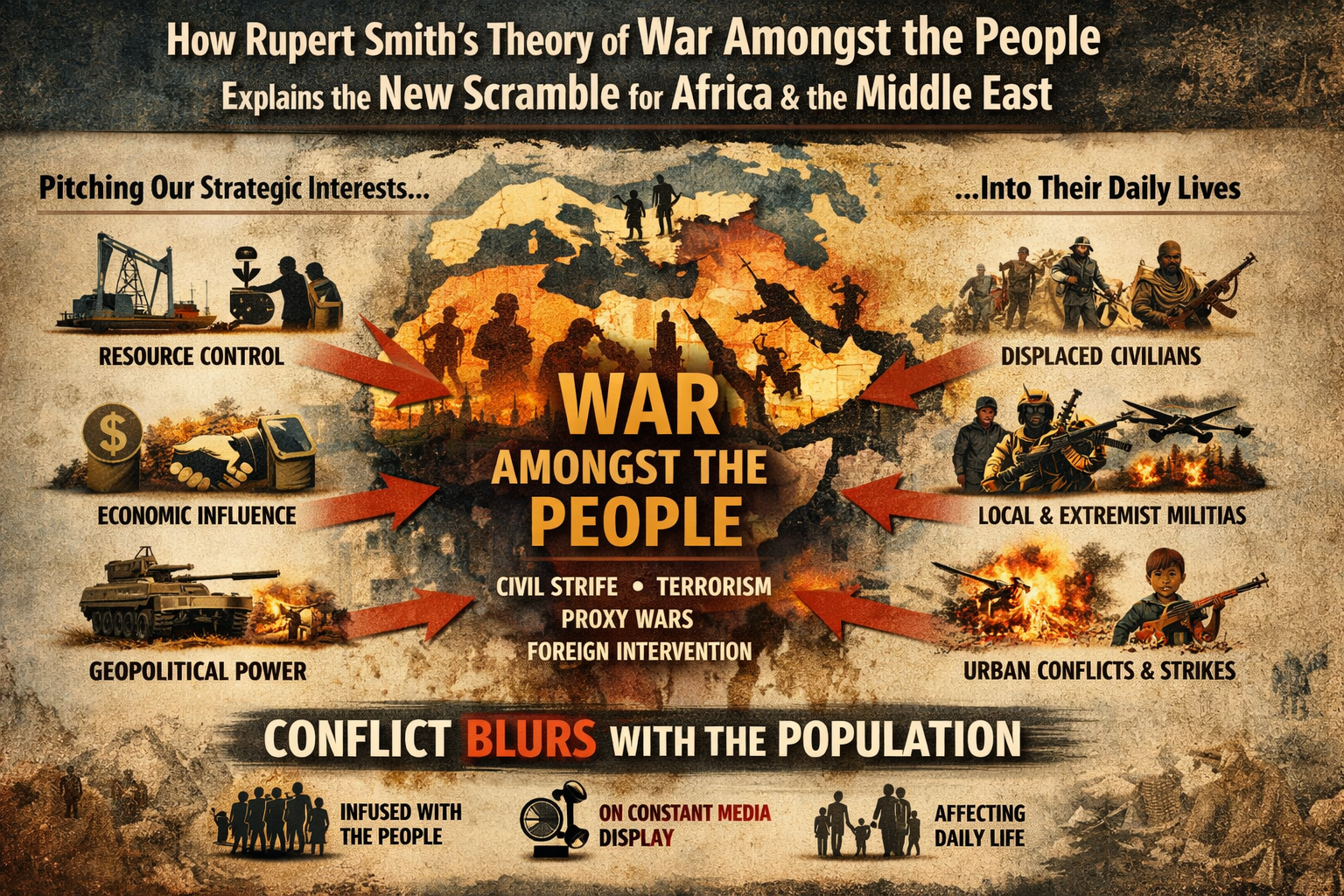
By Silas Mwaudasheni Nande
Introduction
In 2005, a retired British general published a book that quietly rewrote the grammar of modern conflict. General Sir Rupert Smith, a veteran commander of operations in Northern Ireland, the Gulf, Bosnia and Kosovo, argued in The Utility of Force: The Art of War in the Modern World that the kind of warfare which had defined the twentieth century, mass armies clashing on defined battlefields to achieve a decisive military victory, had ended. In its place had emerged a different paradigm, one he termed war amongst the people. Twenty years later, that paradigm has become the operating manual, whether consciously borrowed or independently rediscovered, for the manner in which powerful states pursue wealth and natural resources in Africa and the Middle East. From the cobalt mines of the eastern Democratic Republic of Congo to the gold fields of Mali, from the oilfields of northern Iraq to the shattered cities of Libya and Sudan, the pattern Smith described two decades ago has become the dominant method by which external powers extract value from fragile states without ever declaring war upon them. This article examines Smith theory in depth, traces its intellectual foundations, and demonstrates, with reference to documented and ongoing conflicts, how the United States, China, Russia, and a widening circle of regional powers apply its logic to secure minerals, energy and strategic position across two of the resource-richest regions on earth.
 Understanding Rupert Smith Theory of War Amongst the People
From Industrial War to a New Paradigm
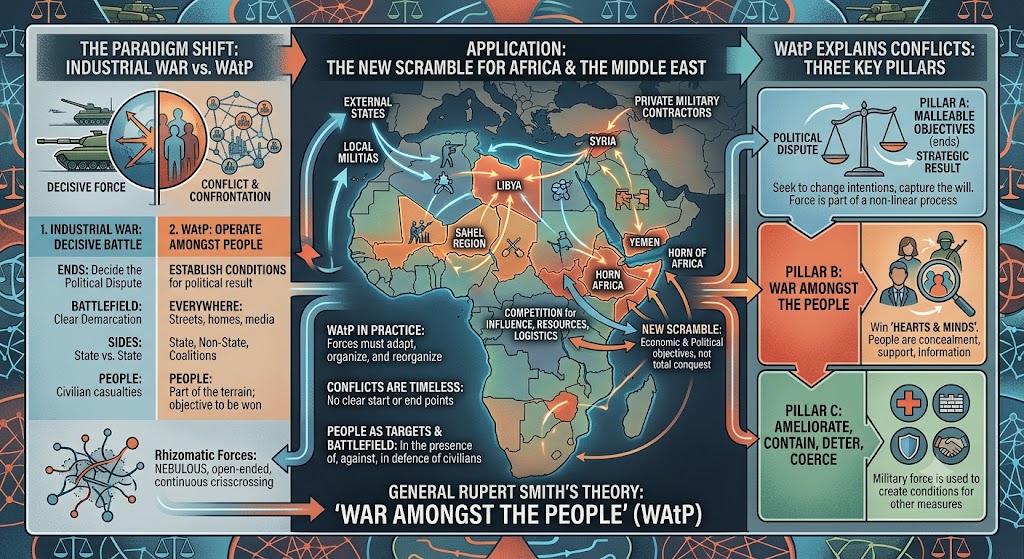
Smith divides the modern history of organised violence into two broad eras. The first, which he calls industrial war, began with the mass conscript armies of the Napoleonic period and reached its terrible maturity in the two World Wars. Industrial war was fought by states, through uniformed armies, for clearly defined political objectives, and it was decided through the destruction of an opposing army in battle. Victory in this era depended not only upon generalship but upon the industrial capacity of a nation, its factories, its population and its wealth, all of which were mobilised toward a single, total effort. The advent of nuclear weapons brought this era to a close, since a war capable of annihilating both sides ceased to be a rational instrument of policy between major powers.
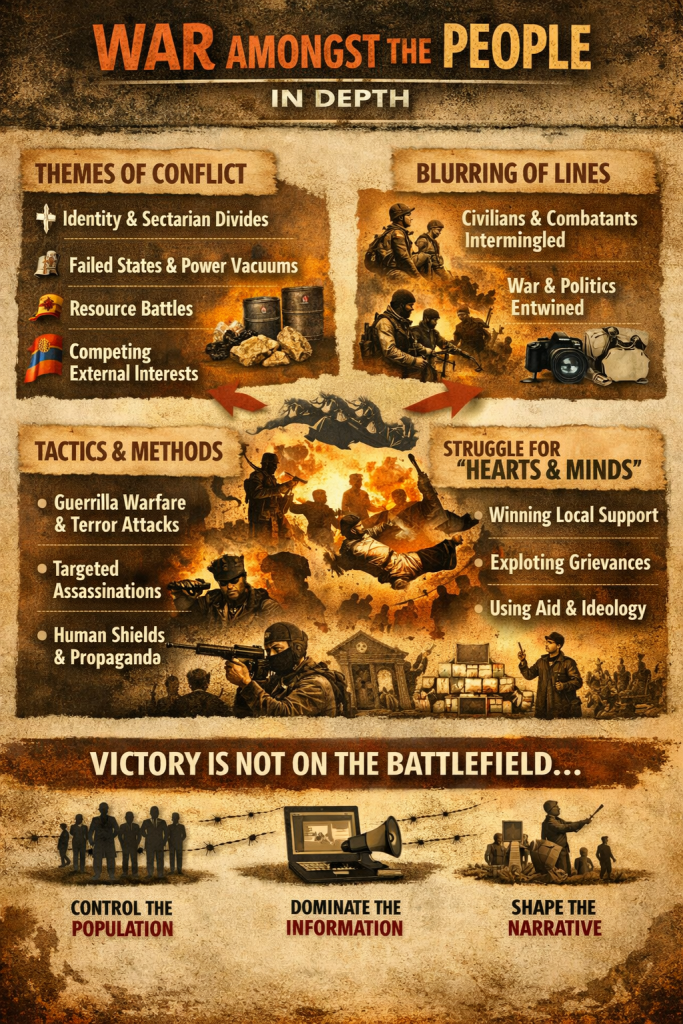
Since 1945, and with growing clarity since the end of the Cold War, a different paradigm has taken hold. Smith calls it war amongst the people, and it rests upon a set of characteristics markedly different from the industrial model. First, the objectives for which force is used have become more fluid and less absolute. Confrontation and conflict, in this model, become a continuous condition of policy rather than a discrete event bounded by declaration and armistice. Wars amongst the people, in other words, do not end. Second, conflict now occurs directly among civilian populations rather than upon a separated battlefield. There is no longer a clear zone of combat set apart from ordinary life, since the contest is waged for the loyalty, cooperation or acquiescence of the people themselves. Third, these conflicts tend to be open-ended, without a clear terminal point, and they are fought with a degree of restraint intended to preserve the force employed rather than expend it entirely in pursuit of the aim, since domestic and international audiences will not sustain heavy losses indefinitely. Fourth, the belligerents are frequently non-state actors, militias, insurgencies, private military companies and armed factions, operating alongside or instead of formal state militaries. Fifth, old industrial-era weapons are repurposed for new uses, since heavy armour and airpower designed for state-on-state battle are often irrelevant against a dispersed adversary. Sixth, and most significant for the purposes of this analysis, coalitions of external actors tend to intervene as loose, multinational groupings rather than as a single coherent force, each pursuing distinct national interests beneath a shared humanitarian, counter-terrorist or stabilising rationale.
The most quoted formulation of the theory captures its essence succinctly: the adversary hides among the population, and the object of using force, together with every other instrument of state power, becomes distinguishing that adversary from the wider population and winning the latter toward oneself. Smith memorably declared that war, in the sense understood by most people, war as a decisive clash between armies that settles a dispute between nations, no longer exists. What persists instead is a continuous condition of confrontation, conflict and combat that blurs into the fabric of everyday life for millions of people.
 Why the Paradigm Matters Beyond the Battlefield
Smith wrote primarily as a soldier reflecting upon operations in Northern Ireland, the Balkans and Iraq, concerned above all with how military commanders should adapt doctrine to a changed reality. Yet the deeper insight of his theory extends well beyond questions of tactics. If the object of modern conflict is the will of a population rather than the destruction of an opposing army, then military force becomes only one instrument among several, alongside economic pressure, information operations, diplomacy, development aid and covert support to proxies. Political and economic objectives that once required outright conquest can now be pursued through sustained, low-intensity engagement that never crosses the threshold of formally declared war. It is precisely this feature of the theory, the dissolution of the boundary between war and peace, between military and civilian instruments, and between state and non-state actors, that makes it so useful for understanding how twenty-first century powers pursue wealth beneath the surface of ongoing local conflicts.
Why War Amongst the People Suits the Extraction of Resources
A conventional, industrial-style invasion of a resource-rich state carries enormous costs. It requires a declaration of intent, invites international condemnation, triggers formal alliances of collective defence, and risks the kind of decisive military defeat that toppled colonial empires in the twentieth century. War amongst the people carries none of these costs, and this is precisely why it has proved so attractive to external powers seeking access to African and Middle Eastern wealth without assuming the political liability of conquest.
Consider Smith six characteristics as applied to resource extraction. Because the objectives of the intervening power are malleable rather than absolute, an external actor need not declare an intention to control a mine, an oilfield or a trade corridor. It can instead frame its involvement as counter-terrorism support, peacekeeping, stabilisation, or protection of civilians, objectives flexible enough to be redefined as circumstances demand, while resource access is secured as a quiet by-product. Because conflict occurs among the people rather than upon a defined battlefield, external powers can embed economic actors, mining companies, security contractors and infrastructure firms, directly within a conflict zone under the cover of reconstruction or development. Because these wars are effectively timeless, an external power gains sustained, renewable access rather than a single transaction, extracting wealth for years or decades under conditions of low-grade, tolerable instability rather than risking the finality of outright annexation. Because belligerents are frequently non-state actors, a sponsoring power can achieve its aims through proxies, whether private military companies, allied militias or partisan army factions, while retaining what analysts term plausible deniability, denying formal responsibility for actions taken in its interest. And because interventions occur as loose multinational coalitions, several external powers can simultaneously extract different forms of value from the same conflict, security contracts, mining concessions, arms sales, infrastructure loans, without any single power bearing full responsibility for the resulting instability.
This is not a claim that Smith personally intended his theory as a manual for resource extraction; his own concern was the ethical and doctrinal use of force to protect populations and resolve conflict. Rather, it is an observation that the structural features he identified in modern conflict happen to align, almost precisely, with the operational requirements of covert or semi-covert resource acquisition. A theory built to describe how the will of a population becomes the true object of war has proven equally descriptive of how the wealth beneath that population land becomes the true object of intervention.
The Democratic Republic of Congo, a Textbook Case
Nowhere is the fusion of population-centred conflict and mineral extraction more starkly visible than in the eastern Democratic Republic of Congo. The country holds mineral wealth estimated by some analysts at roughly twenty-four trillion United States dollars, including the largest reserves of cobalt on earth, together with substantial deposits of coltan, copper, tin, tungsten, gold and rare earth elements essential to batteries, aerospace components and consumer electronics. For more than three decades, armed militias operating in North Kivu, South Kivu and Ituri have financed their campaigns through the mining and cross-border smuggling of these minerals, sustaining what has become one of the deadliest and most protracted conflicts since the Second World War.
In January 2025, the Rwandan-backed M23 rebel movement launched its most intense offensive in over a decade, capturing the major cities of Goma and Bukavu within a matter of weeks and displacing millions of people. United Nations investigators have documented the systematic smuggling of coltan, tin and gold from Congolese territory into Rwanda, from where these minerals enter international supply chains under falsified certification. The M23 seized control of the Rubaya mining site, among the largest coltan deposits in the world, reportedly earning several hundred thousand United States dollars each month through taxation of the site alone. Analysts caution, correctly, that the conflict cannot be reduced to a simple contest for minerals; longstanding ethnic tensions between Congolese Tutsi communities and other groups, rooted in the aftermath of the 1994 Rwandan genocide, remain a central driver of the violence, and mineral wealth alone did not initiate the current offensive. Yet resource control has become deeply entangled with the conduct and financing of the war, whatever its original causes, and this entanglement is precisely the pattern Smith theory anticipates: conflict without a clear terminal point, waged amongst a civilian population of many millions, in which external actors extract sustained value while never formally declaring themselves belligerents.
The involvement of great powers in this dynamic has intensified rather than diminished since 2025. As global demand for electric vehicle batteries and renewable energy technology has driven a race for what policymakers now openly term critical minerals, both Washington and Beijing have moved to secure their position. Chinese firms already control the majority of foreign-owned cobalt, copper and uranium mining assets in the country, a position built through a minerals-for-infrastructure agreement signed with Kinshasa in 2007 and reinforced through subsequent investment. Congolese army units have reportedly been deployed to protect Chinese-owned mining sites in the east of the country. The United States, for its part, has pursued a parallel strategy, with the Congolese president offering American companies preferential mineral access in exchange for security assistance against the M23 advance, and Washington reportedly supporting restrictions on cobalt exports to China as a means of limiting Beijing dominance of the battery supply chain. Neither Washington nor Beijing has deployed conventional armies to fight for these minerals. Both instead compete through investment, security assistance, diplomatic pressure and, in the American case, a proposed minerals-for-security arrangement explicitly linking access to Congolese wealth with continued American backing against Rwandan-supported forces. This is war amongst the people conducted by proxy and by contract rather than by declared invasion, precisely the paradigm Smith described two decades before it reached its current form in the Kivu provinces.
 The Sahel and the Privatisation of Resource War
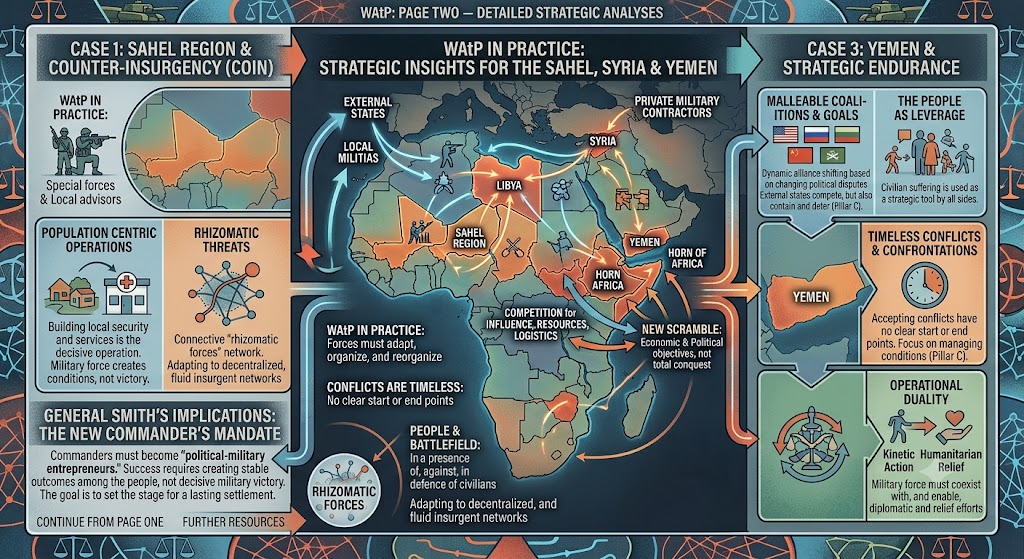
If the Congo illustrates how established great powers pursue minerals through diplomacy and corporate investment layered atop a proxy war, the Sahel illustrates a more direct and increasingly militarised variant of the same paradigm, the use of private and quasi-state paramilitary forces to secure resource access in exchange for regime protection.
Following the withdrawal of French counter-terrorism forces from Mali in 2022, and the collapse of a decade-long Western-led stabilisation effort, the ruling military junta in Bamako turned to Russia for security support. The Wagner Group, a private military company with longstanding ties to the Russian state, deployed several thousand personnel to Mali under an arrangement reportedly costing the junta around ten million United States dollars each month. Wagner forces fought alongside the Malian army against Tuareg separatists and Islamist insurgents, and in February 2024 seized control of the Intahaka gold mining site in the Gao region, among the largest artisanal gold operations on the continent, reportedly charging local miners an access fee to work the site. Mali holds an estimated eight hundred and eighty tonnes of gold reserves across roughly three hundred artisanal mining sites, an industry upon which more than ten per cent of the population depends for its livelihood, and gold has become the dominant export commodity of the Malian economy.
Following the reorganisation of Wagner under direct control of the Russian Ministry of Defence, a successor formation known as the Africa Corps assumed responsibility for Russian operations in Mali by mid-2025, alongside expanding deployments to Burkina Faso, Niger, the Central African Republic, Equatorial Guinea, Sudan and Libya. Investigators tracking these deployments describe a consistent transactional pattern, security assistance to embattled juntas and presidential regimes offered in exchange for preferential access to mining concessions, timber, and other extractive assets, an arrangement one investigative body characterised as Russia strategy for power and resource extraction across the continent. In Niger, Russian forces arrived in 2024 to fill the vacuum left by the withdrawal of more than one thousand American troops, expelled under pressure from the ruling junta, and by early 2026 had reportedly helped repel an attack on the capital international airport. In the Central African Republic, Russian-linked security personnel have provided close protection to the presidential leadership through a re-election secured after the removal of constitutional term limits, while affiliated commercial entities remain active across mining, timber and other sectors of the domestic economy.
What makes this dynamic so precisely illustrative of Smith theory is the explicit rejection, by the actors themselves, of any resemblance to conventional interstate war. There has been no declaration of hostilities between Russia and any Sahelian state, no formal annexation of territory, and no acknowledgement by Moscow that its forces are fighting for resource access rather than counter-terrorism. Instead, a continuous, open-ended condition of low-intensity conflict persists across a population of tens of millions, waged through proxies operating beneath the threshold of formal war, in which the ultimate prize, gold, uranium, bauxite, timber and political influence, is secured incrementally rather than through a single decisive campaign. Even the failures of this approach, and the record in Mali has been decidedly mixed, with continuing insurgent attacks and reports of atrocities against civilians documented by independent investigators, reinforce Smith central observation that in this paradigm, force alone rarely resolves the underlying contest; it merely sustains the conditions under which the contest continues indefinitely.
The Middle East, Energy Corridors and the Reordering of Borders
The application of war amongst the people to the Middle East follows a related but distinct logic, one centred less upon extractive minerals than upon control of energy infrastructure, transit corridors and the political architecture through which oil and gas move to global markets.
The region has been convulsed since early 2026 by a direct confrontation between the United States, Israel and Iran, following coordinated strikes in February against Iranian nuclear and military infrastructure. Yet even this conflict, more closely resembling conventional interstate war than most contemporary conflict, has been fought substantially through the proxy and population-centred methods Smith describes. Iranian-aligned militias in Iraq have struck at oil and energy infrastructure, including refineries and oilfields in the north of the country, together with bases hosting American and allied forces, without Tehran ever formally declaring war upon Washington or Baghdad. The Popular Mobilisation Forces, nominally integrated into the Iraqi state military yet retaining substantial operational autonomy from factions such as Kataib Hezbollah, illustrate precisely the blurred distinction between state and non-state belligerent that defines the paradigm. American retaliatory strikes have targeted these factions directly, even though they claim formal status within the Iraqi armed forces, exposing the incapacity of the Iraqi government to exercise a genuine monopoly on the use of force within its own territory, a condition Smith identifies as characteristic of war amongst the people.
Beyond the current Iran-focused confrontation, the broader reordering of the Middle East since the collapse of the Assad government in Syria has proceeded through precisely the same logic. Analysts tracking the region describe the current period as a transition from conventional interstate warfare toward sustained proxy competition and resource-driven unrest, in which control over the movement of gas, weapons, money and political influence, rather than territory in the traditional sense, has become the central object of contest. A weakened and fragmented Syria complicates Iranian efforts to sustain a land corridor toward the Mediterranean, while simultaneously offering external powers, Turkey prominent among them, additional points of leverage along that same corridor. Turkish forces have established what amounts to a permanent administrative presence in northern Syria and Iraq under the framing of a buffer zone, a formulation that avoids the language of annexation while achieving comparable strategic effect. Meanwhile, the resurgence of Islamic State remnants, exploiting the security vacuum left by the collapse of the Syrian state and the fracturing of Iraqi border control, has itself become entangled with the wider contest for the substantial weapons caches and territory left behind by the former regime.
Gulf states, which for years pursued a careful posture of strategic neutrality between Washington and Tehran following the 2019 attacks on Saudi oil facilities and the 2022 Houthi drone strikes on the United Arab Emirates, found that posture effectively dismantled by the events of 2026. The structural interconnection of proxy networks spanning Iran, Lebanon, Syria, Iraq, Yemen and the Gulf states meant that no state in the region could remain fully insulated from a confrontation nominally confined to Tehran and Washington. This is the essential character of war amongst the people at regional scale, a condition in which no formal front line exists, in which the population of an entire region becomes implicated in a contest waged through drone strikes, militia attacks, sanctions and energy infrastructure sabotage, and in which external powers pursue durable strategic position over oil, gas and transit corridors without ever fighting a conventional war against one another directly.
Sudan, the Gold War Bridging Two Regions
Sudan occupies a unique position in this analysis, since it sits geographically and politically at the hinge between the African and Middle Eastern theatres, and its ongoing civil war illustrates the gold-financed variant of war amongst the people with unusual clarity. Since fighting erupted in April 2023 between the Sudanese Armed Forces and the paramilitary Rapid Support Forces, the conflict has displaced millions of people and, following the fall of El Fasher in Darfur to the Rapid Support Forces in late October 2025, has entrenched a de facto partition of the country, with the army controlling the east and north around the interim capital of Port Sudan, and the paramilitaries dominant across much of the west.
Gold sits at the centre of the war economy sustaining both sides. Sudan ranks among the largest gold producers on the African continent, and the metal now accounts for more than seventy per cent of national revenue, functioning less as a national development asset than as a currency for the purchase of weapons and drones. The Rapid Support Forces control major mining operations across Darfur and Kordofan, extracting gold through industrial and artisanal sites and moving it along smuggling corridors through Chad, Libya and South Sudan, corridors that investigators note were established with early assistance from Russian mercenaries when the group known today as Africa Corps first entered Sudan around 2015. The United Arab Emirates has emerged, according to multiple independent investigations and United Nations panel reporting, as the principal destination for this smuggled gold, importing roughly ninety per cent of it either directly or through intermediary companies based in Dubai, even as Abu Dhabi maintains formal diplomatic and economic relations with the army-aligned government in Port Sudan and denies the accusations of backing the paramilitary faction levelled against it by Sudanese officials, accusations serious enough that Port Sudan has filed proceedings against the Emirates at the International Court of Justice.
The strategic logic here mirrors the Sahel and the Congo with striking precision. No outside power has declared war upon Sudan, or upon either faction within it. Instead, gold smuggled through porous desert corridors converts into the weapons, salaries and political alliances that allow both the army and the paramilitaries to sustain a war with no clear military resolution in sight, while external actors positioned along the supply chain, trading companies, refineries and gold markets in the Gulf, extract enormous value from a conflict they did not initiate and for which they claim no formal responsibility. Analysts increasingly describe the confrontation less as a purely domestic civil war than as a regional proxy contest, with the rivalry between the United Arab Emirates, Saudi Arabia and Egypt over influence in Port Sudan and Darfur reproducing, in miniature, the same pattern of externally sponsored, resource-financed, formally undeclared conflict visible from Bamako to Baghdad. It is, in the most literal sense available, a war fought amongst the Sudanese people for the value beneath Sudanese soil.
The Instruments of a Bloodless Conquest
Across both regions, a recognisable toolkit has emerged through which powerful states apply the logic Smith identified. Private military companies, whether the Russian Wagner Group and its Africa Corps successor or the constellation of Western security contractors operating across the Sahel and Middle East, provide the deniable military instrument. Security-for-resources agreements, whether formal, as with proposed American minerals-for-security arrangements in the Congo, or informal, as with Russian gold mining access in Mali, provide the economic mechanism. Information operations and strategic communication shape the perception of these interventions among domestic and international audiences, framing extraction as counter-terrorism, stabilisation or development. Arms sales and military training programmes bind local security forces to external patrons without requiring the deployment of the patron own conscript army. Sanctions, export restrictions and control of certification schemes, such as the contest between Washington and Beijing over cobalt export limits, function as an economic complement to the physical contest over mining sites. And multinational coalitions, whether formal alliances such as the counter-Islamic State coalition or looser, competing constellations of external patrons as seen in the Sahel, allow several powers to pursue distinct interests within a single theatre of conflict without direct confrontation between them.
It is worth noting that this toolkit is not the exclusive property of any single power or ideological bloc. Russia has pursued mineral and political access through the Africa Corps model in Mali, the Central African Republic and beyond. China has pursued comparable access through infrastructure financing, long-term mineral concessions and, increasingly, security cooperation with African militaries protecting Chinese-owned assets. The United States, whatever its stated commitment to democratic governance and the rules-based international order, has pursued a security-for-minerals arrangement in the Congo strikingly similar in structure to the arrangements Russia has pursued elsewhere, even as Washington frames its involvement in the language of counter-terrorism and strategic competition with Beijing. Gulf states, Turkey and other regional powers have pursued their own variants of the same approach across Libya, Sudan and the wider Sahel. War amongst the people, in this sense, has become less a description of how any single power behaves than a shared operating grammar available to any actor willing to accept a condition of sustained, low-intensity engagement in exchange for durable access to wealth.
Necessary Caution, Counter-Arguments and Local Agency
A rigorous analysis of this kind must resist the temptation to reduce every conflict in Africa and the Middle East to a simple morality tale of external powers manufacturing violence for the sake of plunder. Serious scholars of the Congo conflict caution against what they term economic determinism, the assumption that mineral wealth alone explains a war rooted equally, and arguably more fundamentally, in ethnic grievance, contested citizenship and the unresolved legacy of the 1994 Rwandan genocide. The M23 offensive of 2025 cannot be explained solely as a contest for coltan and cobalt, since the movement long predates its capture of major mining sites and draws much of its support from genuine communal grievance among Congolese Tutsi populations. Independent investigators examining Wagner operations in Mali have likewise documented a strategy that frequently failed on its own commercial terms, generating limited resource revenue relative to its cost, while inflicting severe harm upon Malian civilians and the broader counter-terrorism effort the junta initially sought.
Local African and Middle Eastern actors, moreover, are not merely passive victims within this framework. Congolese and Rwandan authorities pursue their own strategic and economic interests, Malian and Sahelian juntas invited Russian involvement deliberately as an alternative to Western partnership they regarded as insufficiently supportive of their sovereignty, and Gulf states have proven adept at extracting concessions from all the great powers competing for their favour rather than functioning as passive terrain upon which outside contests unfold. Any honest application of Smith theory to these regions must therefore hold two propositions together without contradiction: that external powers structure their engagement in ways which systematically favour resource access over durable peace, and that local elites, militaries and populations retain genuine agency, pursuing their own interests within and sometimes against the frameworks that outside powers construct. Critics of the resource-war framing argue, with some justification, that treating African and Middle Eastern conflicts primarily as a function of external plunder can itself repeat a colonial-era habit of denying meaningful political agency to the societies in question. The most defensible position recognises resource competition and local agency as operating simultaneously, each shaping and reinforcing the other, rather than treating either as the sole explanation.
Sovereignty, Resistance and the Path Beyond Perpetual Conflict
If war amongst the people has become the preferred method by which external powers secure African and Middle Eastern wealth beneath the threshold of formal conquest, then resistance to this pattern must operate at a comparable level of sophistication. Purely military responses, strengthening national armies alone, have repeatedly proven insufficient, since the paradigm Smith describes is designed precisely to exploit the limits of conventional military power. More promising avenues include regional institutions, such as the African Union and the Southern African Development Community, asserting genuine authority over mineral certification and cross-border trade in order to close the smuggling routes through which conflict minerals reach global markets. Transparent, competitively negotiated resource agreements, rather than opaque security-for-minerals arrangements struck under conditions of military duress, would allow African and Middle Eastern states to capture a greater share of the value extracted from their own territory. Diversified partnerships, in which states retain the ability to negotiate simultaneously with Washington, Beijing, Moscow, Ankara and Gulf capitals, offer a measure of leverage unavailable to any single client relationship, though this strategy carries its own risk of intensifying the very multinational, proxy-driven contest the theory describes. Ultimately, the resolution of war amongst the people, as Smith himself argued, depends less upon the destruction of an adversary force than upon establishing political and economic conditions that render continued conflict unattractive to all parties, a threshold that remains distant across much of the Sahel, the eastern Congo and the wider Middle East as this analysis is written.
Conclusion
Twenty years after its publication, Rupert Smith theory of war amongst the people offers something considerably more durable than a historical account of how conflict evolved during his own career as a soldier. It offers a precise and, in retrospect, prophetic account of how power would be exercised over resource-rich but militarily weaker states in an age when outright conquest had become politically and legally untenable. The mineral wealth of the eastern Congo, the gold of Mali, and the oil and gas corridors of the Middle East are being contested today not through the industrial-era clash of armies that Smith consigned to history, but through precisely the diffuse, population-centred, proxy-driven and formally undeclared confrontations his theory anticipated. Understanding this pattern does not, by itself, resolve the underlying conflicts or restore full sovereignty to the states affected by it. It does, however, equip African and Middle Eastern policymakers, and the international public that observes these conflicts largely through the distorting lens of counter-terrorism and humanitarian framing, with a clearer vocabulary for identifying what is actually taking place beneath the surface of the wars they read about. In an age in which war, in Smith own formulation, no longer exists in its old industrial form, the struggle for the wealth of Africa and the Middle East continues nonetheless, waged amongst the people, and largely at their expense.
Similar Posts by The Mt Kenya Times:
- Diaspora Times Global Oct 17 – Oct 23, 2026
- Is social media a blessing or a curse for university students?
- Light at last: How electricity is reshaping Nandi and Uasin Gishu
- The triple squeeze: how EPRA’s fuel price hike is reshaping the survival equation for the common mwananchi
- Zelenskyy accuses Trump of rewarding Putin as Pope pleads for peace from a hospital bed
About the Author