The Mt Kenya Times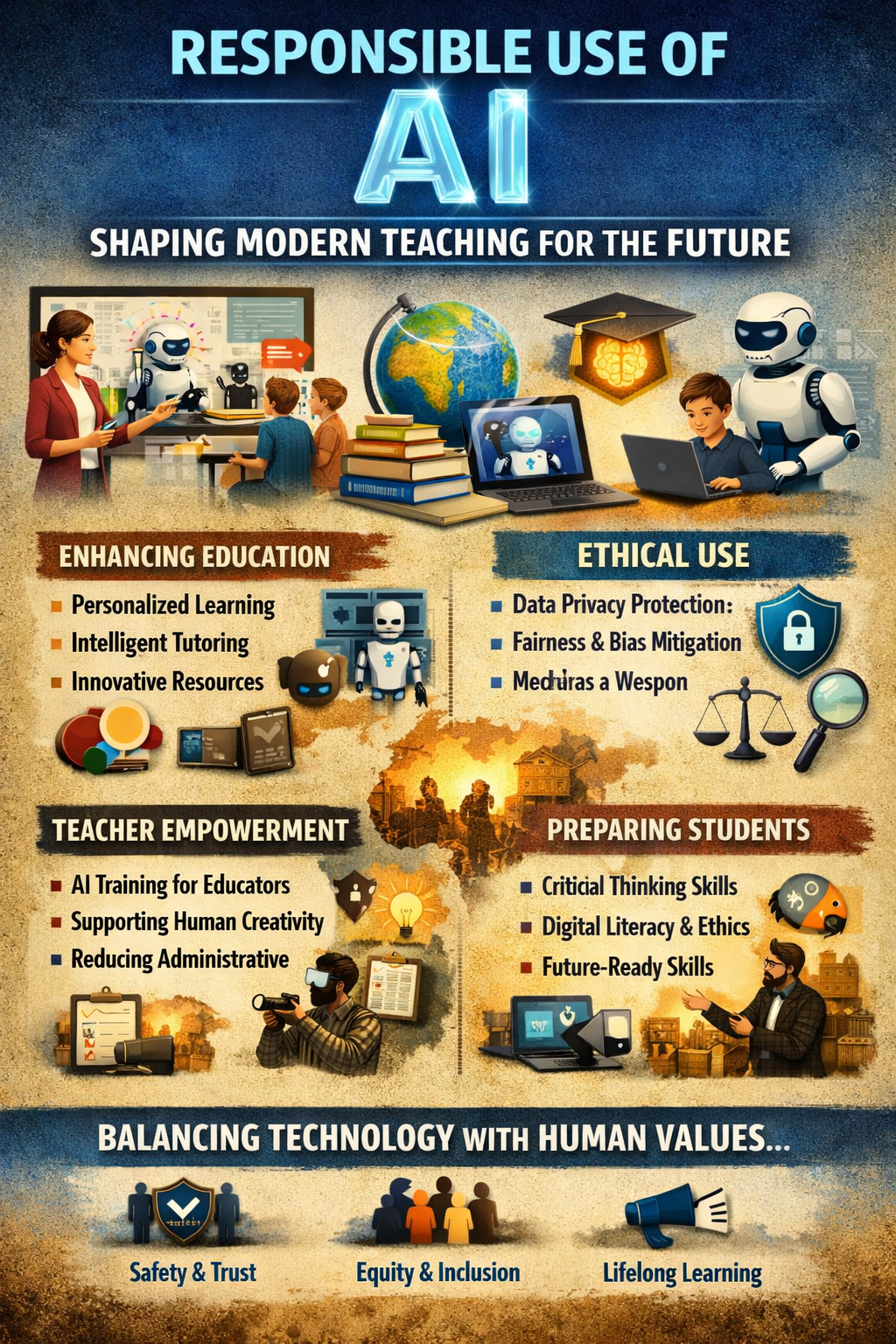
By Silas Mwaudasheni Nande
Introduction
Education has always evolved alongside the tools and technologies available to society. From the introduction of printed textbooks to the rise of digital classrooms, each shift has required educators to rethink how they deliver knowledge, engage students and assess progress. Today, artificial intelligence stands as the most transformative development yet, one that promises to redefine nearly every aspect of teaching and learning. Yet with this potential comes significant responsibility. The question facing educators today is no longer whether to adopt AI, but how to use it ethically, critically and effectively. This article argues that teachers must take ownership of this technology, integrating it responsibly into their practice to enhance learning outcomes, while also addressing its limitations, risks and broader implications for education.
The Changing Landscape of Education
To understand why responsible AI use matters, it is important to recognize the pressures and opportunities shaping modern education. Classrooms today serve a diverse range of learners, with varying abilities, backgrounds and needs. Teachers are often tasked with managing large groups, covering extensive curricula, providing personalised feedback, and keeping pace with rapidly expanding fields of knowledge, all within limited time and resources. For decades, this has led to a model that often favors standardized instruction over individual growth, leaving many students either unchallenged or unsupported.
Artificial intelligence offers a way to bridge these gaps. Modern AI systems can process vast amounts of information, generate content, analyze student work, and adapt learning materials to different paces and styles. What was once considered science fiction is now accessible: tools that create lesson plans, mark assignments, identify areas where students struggle, and even simulate conversations to reinforce concepts. However, technology itself is neutral. Its impact depends entirely on how it is applied. Without thoughtful guidance, AI risks reducing education to a transactional exchange of information, replacing human insight with automated outputs, and creating new divides between those who use it well and those who do not.
 The Benefits: Why Teachers Should Embrace AI
When used responsibly, AI serves as a powerful assistant rather than a replacement for the teacher. It frees educators from routine and time-consuming tasks, allowing them to focus on the core elements of teaching that machines cannot replicate. Administrative work such as grading multiple-choice assessments, organizing student records, or generating initial drafts of lesson materials can be automated, giving teachers more time to interact directly with students, listen to their concerns, and guide their intellectual development.
Personalized learning is perhaps the greatest advantage. Traditional teaching often follows a “one size fits all” approach, but AI can help tailor content to individual needs. For a student who finds mathematics difficult, the technology can provide additional examples, simpler explanations, and targeted exercises. For advanced learners, it can suggest more complex problems or supplementary reading. In this way, AI supports the principle that every student deserves an education suited to their potential.
Furthermore, AI expands access to knowledge and resources. It can translate materials into multiple languages, explain complex theories in simpler terms, and provide instant references across subjects. For teachers working in under-resourced schools or remote areas, these tools can level the playing field, bringing high-quality educational content within reach regardless of location or budget. Used well, AI becomes a multiplier of effort, allowing skilled teachers to extend their influence and improve outcomes across their entire classroom.
The Risks: Understanding the Limits and Dangers
However, the promise of AI comes with significant caveats, and this is where responsibility becomes essential. One of the most immediate concerns is accuracy and reliability. AI systems work by identifying patterns in large datasets, but they do not understand the content they produce. They can generate plausible-sounding but incorrect information, distort historical facts, or present biased interpretations drawn from the data they were trained on. If teachers rely blindly on AI-generated materials without reviewing and verifying them, they risk passing misinformation to students, undermining the very purpose of education.
Equally important is the risk to critical thinking and creativity. Education is not just about acquiring facts; it is about learning how to analyze, question, reason, and create original ideas. If students are encouraged to use AI to complete assignments without proper guidance, they may develop a habit of accepting ready-made answers instead of working through problems themselves. Over time, this can weaken their ability to think independently, a skill that remains essential in every field of work and life.
There are also ethical and privacy considerations. Many AI tools require input of personal data, including student performance, learning habits, and even demographic details. If not used in compliance with regulations and ethical standards, this data can be misused, shared without consent, or analyzed in ways that reinforce stereotypes or discriminate against certain groups. Additionally, there is the risk of widening the digital divide: schools and teachers with the resources and training to use AI effectively will likely produce better outcomes, while those without access may fall further behind.
The Teacher’s Role: Guidance, Not Substitution
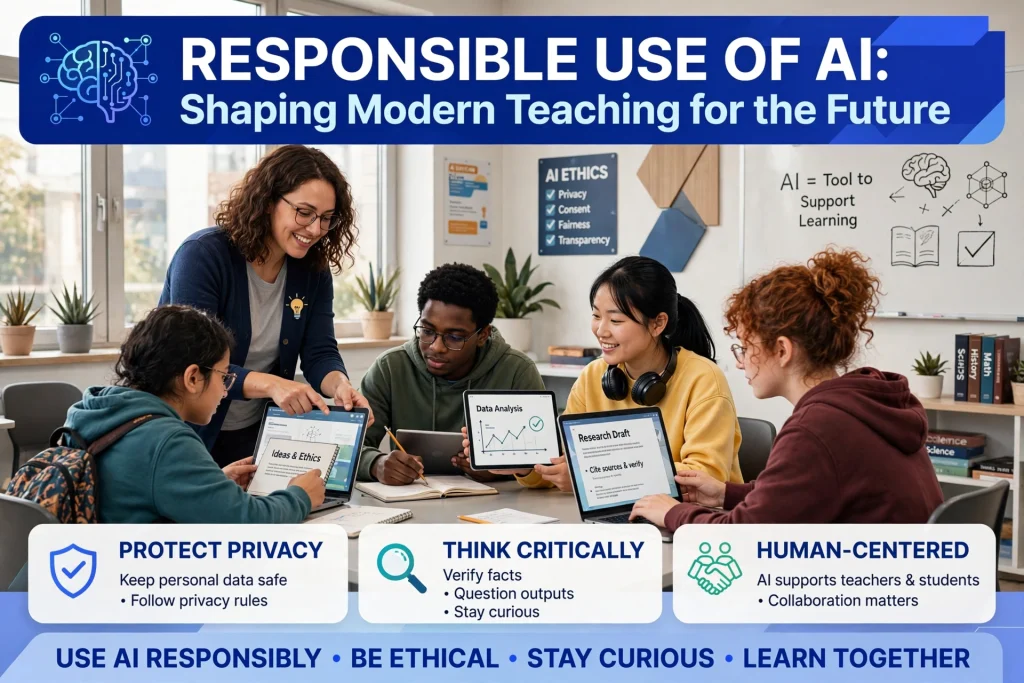
This brings us to the central argument: the responsible use of AI depends entirely on the judgment and professionalism of teachers. Technology cannot decide what values to teach, what moral frameworks to apply, or how to balance efficiency with depth. That remains the responsibility of the educator.
A responsible approach begins with clear purpose. Teachers must first define what they want their students to learn and achieve, and then decide how AI can support those goals, not the other way around. Instead of asking what AI can do, they should ask what it can help them do better. For example, AI can help draft questions for an essay assignment, but the teacher must decide the theme, assess the quality of the response, and guide the student in refining their argument. AI can provide feedback on grammar or structure, but only the teacher can evaluate the originality of thought, the depth of analysis, and the student’s personal growth.
Next comes verification and adaptation. No AI output should be used directly without review. Teachers must act as gatekeepers, checking facts, correcting errors, adjusting language to suit the age and level of their students, and ensuring that materials align with educational standards and ethical principles. This process also provides a valuable learning opportunity: by showing students how to evaluate and edit AI-generated work, teachers help them develop the critical thinking skills needed to use technology responsibly themselves.
Transparency is another key principle. Students should know when AI is being used, how it works, and what its limitations are. This helps demystify the technology and prevents it from becoming a crutch. Teachers can turn AI use into a lesson in itself, discussing how algorithms function, what biases might exist, and how to use the tool as a support rather than a substitute for one’s own abilities.
Finally, responsible use requires continuous learning. The field of artificial intelligence evolves rapidly, and teachers must keep their own knowledge up to date. Schools and education authorities have a role to play here by providing training, setting clear guidelines, and ensuring that all educators have access to safe, reliable, and appropriate tools. When teachers feel confident and informed, they can use AI to its full potential while minimizing its risks.
Interrogating the Debate: Between Fear and Blind Acceptance
Critics often argue that AI will erode the role of the teacher, reduce human interaction, and lead to a generation overly dependent on machines. These concerns are valid, but they are not inevitable outcomes. They are risks that arise from poor use, not from the technology itself. Throughout history, new tools have always raised similar worries. When calculators entered classrooms, many feared students would no longer learn mathematics; when the internet became widely available, concerns grew that research skills would decline. In each case, the result was not replacement but adaptation: the tools were integrated in ways that enhanced learning while preserving the core purpose of education.
On the other hand, those who view AI as a universal solution also risk missing its true value. To treat it as a shortcut or a replacement for planning, explanation, and interaction is to misunderstand what teaching is. The relationship between teacher and student remains central; it is through this relationship that trust, motivation, and character development are fostered. AI can support that relationship, but it cannot create it.
Thus, the path forward lies in balance. Teachers must neither reject AI out of fear nor embrace it without caution. Instead, they must engage with it critically, applying their professional judgment to determine where it adds value and where it falls short. This approach ensures that education remains human-centered, even as it becomes more technologically supported.
Conclusion
The arrival of artificial intelligence marks a turning point in education, presenting both unprecedented opportunities and complex challenges. The responsibility to guide this change rests primarily with teachers. By using AI responsibly, to save time, personalise learning, and expand access, they can create richer, more inclusive, and more effective educational experiences. At the same time, by understanding its limitations, verifying its outputs, and emphasizing critical thinking and human values, they ensure that technology serves education rather than defining it.
Ultimately, the goal of teaching remains unchanged: to help students become knowledgeable, thoughtful, ethical, and capable individuals. AI is simply a new instrument in service of that goal. When teachers take ownership of its use, they shape not only how technology is applied in classrooms today, but also the quality of learning and the future readiness of the next generation.
Similar Posts by The Mt Kenya Times:
- Diaspora Times Global Oct 17 – Oct 23, 2026
- Is social media a blessing or a curse for university students?
- Light at last: How electricity is reshaping Nandi and Uasin Gishu
- The triple squeeze: how EPRA’s fuel price hike is reshaping the survival equation for the common mwananchi
- Zelenskyy accuses Trump of rewarding Putin as Pope pleads for peace from a hospital bed
About the Author