The Mt Kenya Times
 By Jerameel Kevins Owuor Odhiambo
Here’s a puzzling reality that has defined Kenyan politics for decades: we are a nation that consistently elects individuals whose primary qualification is their ability to distribute handouts at funerals, weddings, and harambees, then we express genuine shock and outrage when these same people systematically loot public coffers with the kind of impunity that would make a seasoned thief blush. This pattern has repeated itself with clockwork precision, election after election, constituency after constituency, county after county. From the days of multi-party democracy in the early 1990s to the most recent general election, the script remains unchanged. We watch the same drama unfold, we know how it ends, and somehow we still act surprised when the curtain falls on another disappointing performance. What makes this even more perplexing is that we have all the information we need to make better choices newspapers document the corruption scandals, civil society organizations publish integrity reports, and our own lived experiences confirm what the data shows and still, we march to the polling stations to reward the very people who have consistently failed us.
Having a conversation with an average Kenyan voter will make you realize that we are far from achieving the ideal world depicted and enshrined in our constitution. The disconnect between our constitutional aspirations and our actual electoral behavior is not just wide; it’s a chasm of epic proportions. Our 2010 constitution is a beautiful document, carefully crafted with input from Kenyans across the country, promising a nation built on the values of human dignity, equity, social justice, inclusiveness, equality, human rights, non-discrimination, and protection of the marginalized.
We speak eloquently about these principles in public forums, we quote constitutional provisions with pride, and we invoke Chapter Six on leadership and integrity as though it were sacred scripture. Then we walk into voting booths and elect individuals who violate every single one of these principles. We choose leaders who have pending corruption cases, who have demonstrated ethnic chauvinism, who have no track record of public service, and who openly flaunt their wealth of questionable origin. It’s as though the constitution exists in one parallel universe while our voting patterns operate in another entirely separate reality, and never shall the two meet.
John Maxwell famously said that everything rises and falls based on leadership, and while this statement holds considerable truth, I dare say that our leadership is just a perfect reflection of the majority of the populace at best. This is perhaps the most uncomfortable truth we must confront as a nation. We cannot continue lamenting poor governance, complaining about corruption, and bemoaning the state of our public services while simultaneously rewarding incompetence, dishonesty, and mediocrity with electoral victory.
The leaders we see in our county assemblies, in the national assembly, in the senate, and in executive offices at both levels of government are not aliens who descended from another planet to torment us. They are products of our society, reflections of our values, and beneficiaries of our choices. If we prioritize wealth accumulation over ethical conduct in our personal lives, we shouldn’t be surprised when our representatives prioritize personal enrichment over public service. If we celebrate individuals who have become rich through dubious means, we cannot feign shock when those same individuals use public office to acquire even more wealth through equally dubious means. The harsh reality is that our leaders are us, just with more power and resources to act out the values we collectively hold.
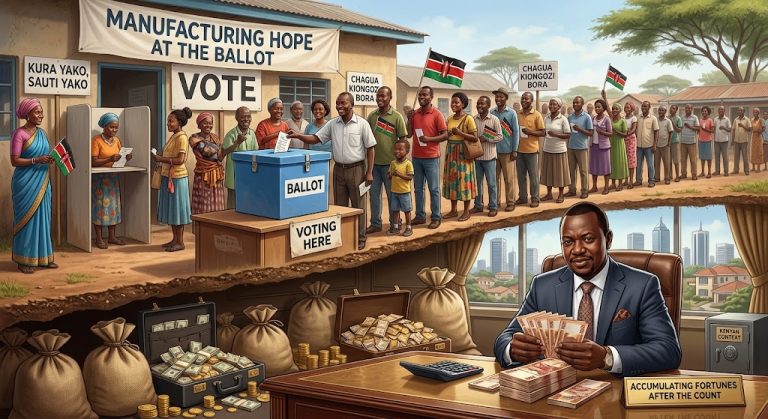
Voters elect persons based on their wealth and philanthropy they don’t care about their ideals, character, or fitness for office. This is the tragic reality of Kenyan electoral politics. A politician who throws money at weddings, contributes generously to church fundraisers, and ensures his face is on every community project banner receives more adulation than one who presents detailed policy proposals for improving education, healthcare, or infrastructure. We have reduced our democracy to a purely transactional arrangement where the highest bidder wins our loyalty, our votes, and our uncritical support. The question of whether someone has a coherent vision for economic development becomes irrelevant when compared to whether they showed up at a funeral with a generous contribution.
The issue of whether a candidate has any understanding of the legislative process matters less than whether they funded the local youth football tournament. We have created a political marketplace where votes are commodities to be bought and sold, and we wonder why our elected representatives treat public resources as personal property. After all, from their perspective, they purchased our votes fair and square, so why shouldn’t they recoup their investment once they get into office? We have normalized this corruption of the democratic process to the point where we don’t even recognize it as corruption anymore it’s just “how things are done.”
They just love their regional kingpins and follow them to the letter, whosoever they endorse, whatever they say, they defend to the letter, and in this blind allegiance, independent thinking has become an endangered species in Kenyan politics. What happened to the ability to critically evaluate a candidate based on their individual merit rather than their association with a particular ethnic chieftain? We have outsourced our political judgment to regional power brokers who have mastered the art of manipulating tribal loyalties for personal gain, and in doing so, we have abdicated our responsibility as citizens in a democracy. When a kingpin declares that “this is our time to eat,” his followers nod in agreement without asking whether there will be anything left for future generations.
When he endorses a candidate with a questionable past, his supporters fall in line without conducting even basic due diligence. Critical analysis of a candidate’s track record, examination of their policy positions, scrutiny of their integrity all of these become secondary, even irrelevant, compared to the singular question of whether “our person” has blessed their candidacy. This herd mentality has transformed our democracy into a system where ethnic arithmetic matters infinitely more than merit, where regional balance trumps competence, and where tribal affiliation determines electoral outcomes more reliably than any policy platform ever could. We have essentially created tribal voting blocs that can be delivered wholesale by kingpins, and these kingpins have figured out that they can negotiate for personal benefits in exchange for delivering these votes, turning citizens into pawns in a cynical game of ethnic politics.
If this continues to be the norm, if we persist in this pattern of choosing leaders based on wealth and tribal affiliation rather than character and competence, we will have nothing to write home about as Kenyans, honestly. Our development will remain perpetually stunted, trapped in a cycle where resources are stolen by one group of leaders, then stolen again by the next group that replaces them. Our institutions will continue weakening as they are populated by individuals chosen for their loyalty rather than their competence, leading to a civil service that cannot deliver services, a judiciary that cannot dispense justice efficiently, and a parliament that cannot legislate effectively.
Our children will inherit a nation where mediocrity is not just accepted but celebrated, where excellence is viewed with suspicion, and where the highest aspiration is not to build something meaningful but to get close enough to power to grab a share of the loot. The cycle of electing incompetent leaders, suffering under their misrule for five years, then repeating the exact same mistake in the next election is not just unsustainable it’s a form of collective madness. We are essentially writing our own story of national decline, one ballot at a time, one poor decision at a time, one compromised principle at a time. Future historians will look back at this period and wonder how a nation with so much potential, so many educated citizens, and such a clear constitutional framework could have chosen this path of self-destruction so consistently.
Voters just need to rethink what they want and stop crying foul once those rotten apples they elected come to bite them, because the responsibility for our political situation lies squarely with us, the electorate. The time for accountability begins at the polling station, not on social media after corruption scandals break, not in the streets during protests, and not in bar conversations where we lament how “these politicians have destroyed our country.” We must demand more from ourselves as an electorate before we can legitimately demand more from our leaders.
This means doing the hard work of researching candidates, asking tough questions at political rallies, rejecting handouts that are designed to buy our silence, and having the courage to vote against our tribal kingpins when they endorse unworthy candidates. Until we value character over cash, until we prioritize principles over patronage, until we choose competence over ethnic connections, we remain the architects of our own frustration. We are the ones who give power to these individuals, and we have the power to take it away. The constitution has given us the tools we need regular elections, recall provisions, public participation mechanisms we simply need the courage and integrity to use them. End of my rant, though perhaps it’s less of a rant and more of a plea for us to look in the mirror and acknowledge that the problem with Kenyan politics starts with the person staring back at us.
The writer is a legal researcher and scrivener
Similar Posts by The Mt Kenya Times:
- Trauma, Friendship, Love, and the Search for Self-Worth in Hanya Yanagihara’s A Little Life
- Kenya’s scouting laws face overhaul: Kiarie leads push to align movement with devolved governance
- Mt Kenya Times ePAPER September 19-20, 2026
- Kenya joins US and UK to put citizens on the terrorism frontline
- Kenya’s parliament races to tame the AI frontier
About the Author