The cost of living bites: Kenya’s inflation hits a 28-month high
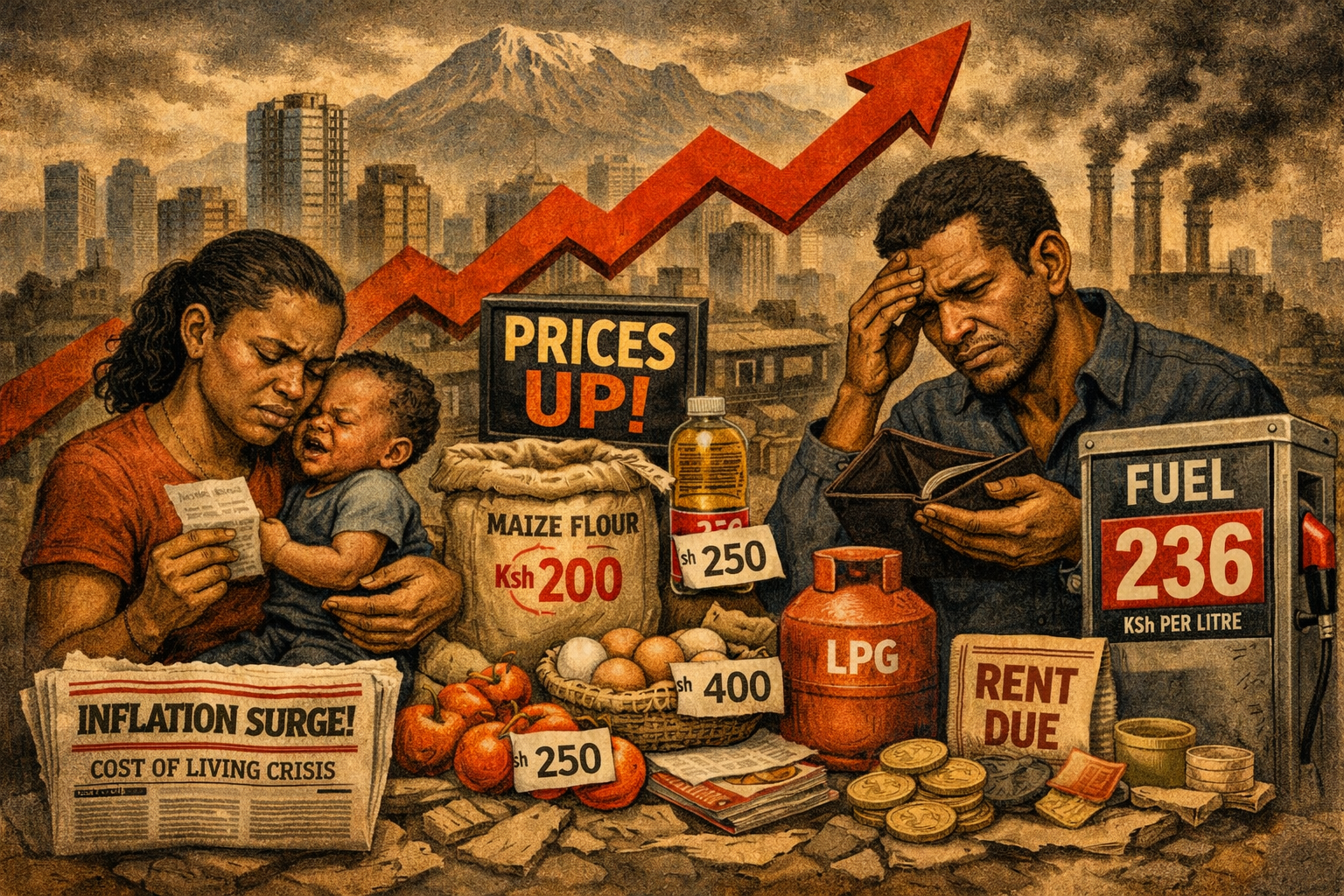
Fuel, food, and fares are squeezing Kenyan households — and the relief that economists hoped for is not coming fast enough.
By MKT Reporter
Kenya’s annual inflation rate surged to 6.7 percent in May 2026, its highest level in more than two years, driven by record fuel prices, soaring transport costs, and persistent pressure on food prices, the Kenya National Bureau of Statistics reported on Friday.
The number alone tells a story. But the story behind the number is being lived by millions of Kenyans every single day — at the fuel pump, at the market, on the morning commute, and at the dinner table where the portions have quietly grown smaller. Inflation surged to 6.7 percent in May from 5.6 percent in April, making it the highest rate recorded since January 2024, when it stood at 6.9 percent. It was the second consecutive monthly increase, a trend that has alarmed economists and households in equal measure.
 The rise was largely driven by increases in the prices of food and non-alcoholic beverages, transport, and housing-related costs — three categories that collectively account for more than 57 percent of household spending. The figures make for uncomfortable reading. Transport costs surged by 16.5 percent during the period, reflecting the impact of higher fuel prices across the economy. Food and non-alcoholic beverage prices increased by 9.4 percent, while housing, water, electricity, gas and other fuel costs rose by 3.4 percent.
These are not abstractions. Transport inflation of 16.5 percent means the matatu fare that cost a worker 50 shillings in May last year now costs significantly more. Food inflation of 9.4 percent means that the household shopping basket — already stretched by years of economic pressure — has become even harder to fill. For the millions of Kenyans who spend the majority of their income on these three categories alone, the data confirms what they have known for months: surviving in Kenya right now is expensive, and it is getting more expensive.
The primary culprit is fuel. Conflict-driven disruptions pushed the price of petrol to a record Sh214.25 per litre in Nairobi, while diesel and kerosene rose to Sh242.92 and Sh152.78 respectively. Kenya imports nearly all its petroleum products from the Middle East, making it acutely vulnerable to global supply shocks. According to EPRA data, diesel prices in Nairobi have risen more than 18 percent year-on-year while petrol prices are up over 10 percent. The government did intervene — cutting VAT on petroleum products from 16 percent to 13 percent and deploying approximately Ksh 6.2 billion from the Petroleum Development Levy Fund to stabilise pump prices — but the relief was partial at best. Without those measures, analysts warned, prices could have been far higher.
The fuel shock does not stay at the pump. It travels. It moves into the price of tomatoes at Toi Market and the cost of a bag of maize at a rural kiosk. It inflates the transport bill that a small business owner pays to move goods from Mombasa to Nairobi. It shows up in the electricity bill and the cost of running a generator. At Nairobi’s open-air markets, traders have watched customers grow increasingly frustrated at price rises that are not of the traders’ making. “Last week someone could come and buy one kilo of onions for one hundred shillings. Then this week, when you tell them the price has gone up to one hundred and twenty shillings, they get angry and think you are the one overcharging them,” said Nicholas Onyango, a fruit trader at Toi Market. His frustration captures a dynamic playing out across Kenya — ordinary people caught between global forces they cannot control and daily pressures they cannot escape.
The strain on businesses is equally visible. A recent Stanbic Bank Kenya Purchasing Managers’ Index showed Kenya’s private sector activity contracted for a second consecutive month in April as businesses struggled with rising fuel-related operational costs. Christopher Legilisho, an economist at Stanbic Bank Kenya, noted that concerns over higher transport costs and difficulty securing supplies from Asia and the Middle East were weighing heavily on businesses.
All eyes are now on the Central Bank of Kenya, whose Monetary Policy Committee is scheduled to announce its next interest rate decision on 9 June. The spike in energy costs is expected to reduce the Central Bank’s room for further cuts on the benchmark interest rate, potentially freezing the recent decline in lending rates. That would be a painful reversal. The CBK held its benchmark rate steady at 8.75 percent at its April meeting, noting that overall inflation remained below the midpoint of the target range, supported by stable core inflation, favourable weather conditions, and a broadly stable exchange rate. That assessment now looks considerably less comfortable in the light of May’s figures.
Kenya’s headline inflation is now pushing close to the upper limit of the government’s preferred range of 2.5 percent to 7.5 percent. Should it breach that ceiling, the central bank would face a difficult choice between protecting growth — which has held relatively firm, with the economy projected to expand by 5.5 percent this year — and bringing prices back under control through tighter monetary policy that would make borrowing more expensive for businesses and households already under strain.
The KNBS data is collected monthly through retail price surveys across 50 data collection zones in urban areas nationwide, conducted during the second and third weeks of each month. It is as rigorous a measure of the cost of living as Kenya produces. And what it measured in May 2026 was a country under pressure.
The question facing policymakers, businesses, and households is not whether inflation has risen — the numbers are unambiguous. It is whether the forces driving it are temporary or entrenched. If the conflict in the Middle East that has pushed fuel prices to record highs eases, some relief may follow. If it does not, Kenya faces the prospect of inflation remaining uncomfortably high through the second half of the year, eroding real wages, squeezing household budgets, and testing the resilience of an economy that has worked hard to stabilise itself after years of turbulence.
For now, the matatu still runs. The market still opens. The household still finds a way. But the margin for error is shrinking — and the cost of getting the policy response wrong has rarely been higher.
Similar Posts by The Mt Kenya Times:
- Mt Kenya Times ePAPER October 23, 2026
- Ruto’s parting COMESA call: Remove the barriers, honour the commitments
- Direct hospital access to KEMSA cuts drug delays, says PS
- Africa can’t wait: Continent seeks $1 trillion for climate adaptation
- Ruto passes the baton as Africa’s trade bloc faces a fragmenting world
About the Author