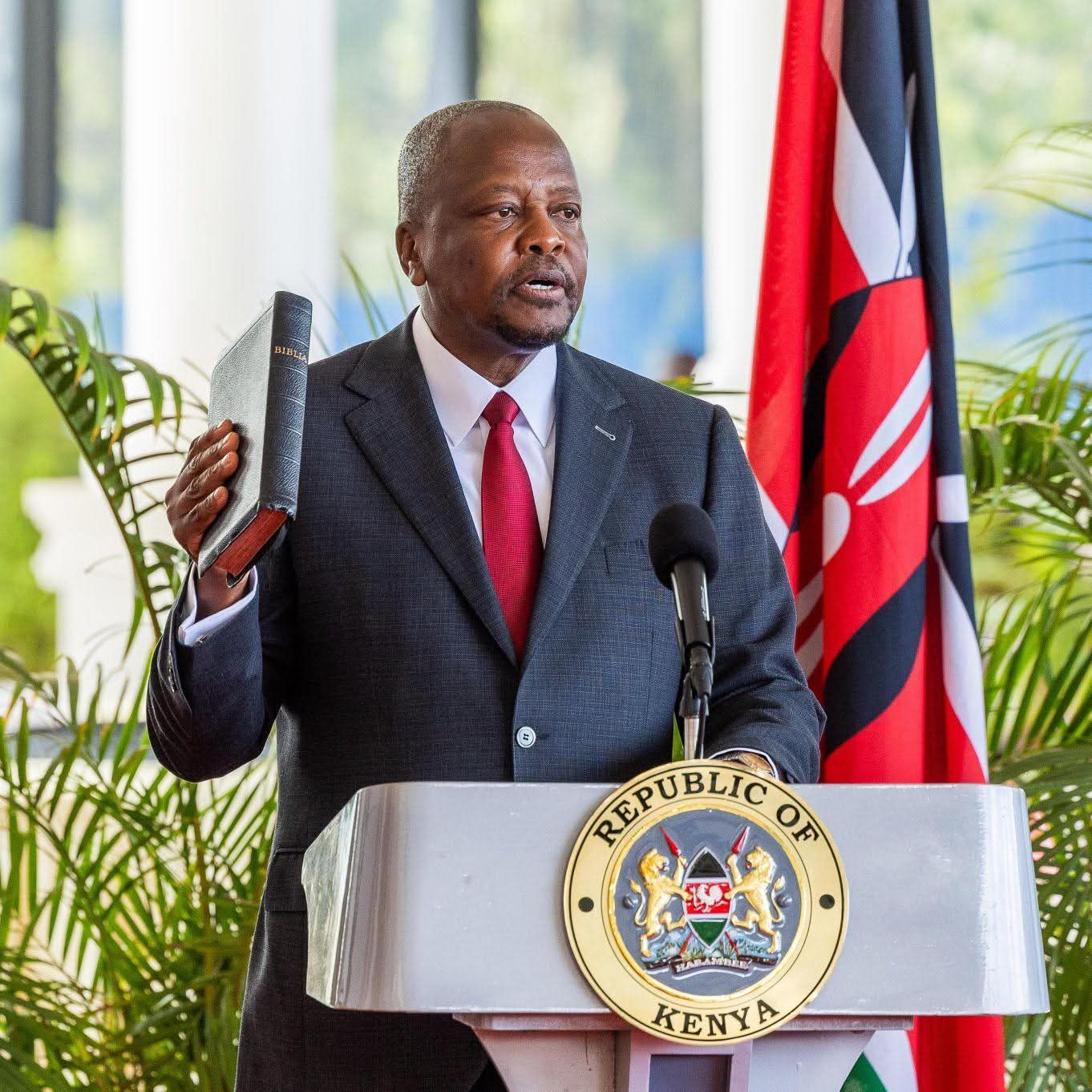
CS Mutahi Kagwe during the swearing in ceremony at State House last year. Photo/Courtesy
By WMW
Agriculture and Livestock Development Cabinet Secretary Mutahi Kagwe was ranked Kenya’s best-performing Cabinet Secretary in the latest KenyaTrack National Cabinet Performance Survey, with his stewardship of the country’s agriculture sector earning widespread public approval amid ongoing reforms to boost food production, improve farmer incomes and strengthen food security.
The survey conducted across all 290 constituencies assessed Cabinet Secretaries based on service delivery, policy implementation, leadership, responsiveness to public concerns and the impact of government programmes on the lives of ordinary Kenyans.
Kagwe topped the rankings with an approval rating of 86.5 per cent, ahead of Tourism and Wildlife Cabinet Secretary Rebecca Miano (84.7 per cent), Public Service and Human Capital Development Cabinet Secretary Geoffrey Ruku (82.7 per cent), Defence Cabinet Secretary Soipan Tuya (79.5 per cent), Lands, Public Works, Housing and Urban Development Cabinet Secretary Alice Wahome (79.0 per cent), Environment, Climate Change and Forestry Cabinet Secretary Deborah Barasa (78.3 per cent), National Treasury and Economic Planning Cabinet Secretary John Mbadi (78.0 per cent), Labour and Social Protection Cabinet Secretary Alfred Mutua (77.9 per cent), Prime Cabinet Secretary and Cabinet Secretary for Foreign and Diaspora Affairs Musalia Mudavadi (77.2 per cent), and Information, Communications and the Digital Economy Cabinet Secretary William Kabogo (76.8 per cent).
The recognition comes as the Ministry of Agriculture and Livestock Development continues implementing reforms under the government’s Bottom-Up Economic Transformation Agenda (BETA), which identifies agriculture as the backbone of Kenya’s economy and a key driver of employment, food security and export earnings.
Among the initiatives credited for the ministry’s strong performance is the expanded fertiliser subsidy programme, which has enabled millions of farmers to access affordable fertiliser, significantly lowering production costs and increasing crop yields.
The ministry that caters for the biggest GDP in the country has also intensified the distribution of certified seeds to improve productivity while promoting local production of key food crops to reduce dependence on imports and enhance national food security.
Kagwe has overseen the strengthening of agricultural extension services through increased deployment of extension officers, farmer training programmes and the adoption of modern farming technologies to improve productivity and resilience against climate change.
The ministry has also championed climate-smart agriculture by encouraging sustainable farming practices, efficient water use, conservation agriculture and improved seed varieties suited to changing weather patterns.
The coffee sector has undergone major reforms aimed at increasing farmers’ earnings through improved marketing systems, enhanced direct sales and better access to premium international markets. Tea reforms have similarly focused on improving returns to growers and strengthening the competitiveness of Kenya’s tea in global markets.
The dairy sector has benefited from programmes supporting better breeding, improved animal husbandry and disease control, while reforms in the sugar industry have sought to revive local factories, improve cane production and reduce reliance on imported sugar.
In horticulture, the ministry has continued supporting exporters through improved compliance with international quality standards while encouraging value addition to increase foreign exchange earnings.
The livestock subsector has also recorded significant progress through enhanced disease surveillance programmes, nationwide vaccination campaigns and improved breeding initiatives aimed at increasing meat and milk production.
The ministry has further promoted the establishment of strategic animal feed reserves and expanded livestock extension services to cushion farmers against recurring droughts and other climate-related shocks.
Other reforms undertaken under Kagwe’s leadership include improving market access for farmers, promoting value addition across agricultural value chains, supporting agribusiness development and encouraging the adoption of digital technologies to link producers with markets and extension services.
The ministry has also strengthened food security systems by enhancing crop monitoring, improving early warning mechanisms and coordinating responses to weather-related emergencies to safeguard national food supplies.
Speaking after the survey results were released, Kagwe attributed the recognition to the collective efforts of staff within the ministry, State agencies, county governments, development partners and millions of Kenyan farmers whose commitment continues to drive the transformation of the agriculture sector.
He reaffirmed the ministry’s commitment to making agriculture more profitable, increasing food production, creating employment opportunities for young people and ensuring every Kenyan has access to affordable, safe and nutritious food.
The latest survey suggests that the ministry’s reforms are resonating with the public, particularly at a time when agriculture remains central to Kenya’s economic growth, supporting more than 70 per cent of rural livelihoods and contributing significantly to the country’s export earnings and industrial development.
Similar Posts by The Mt Kenya Times:
- AI Curse or boon: The Future of Intelligence: Artificial or Emotional?
- Dr. Ekrah Ndung’u wins TVET advocacy award after 12 years
- Mt Kenya Times ePAPER October 17-18, 2026
- Ruto bets billions on Kerio Valley — with one eye on 2027
- Ruto’s health ministry kills Murang’a’s digital hospitals
About the Author