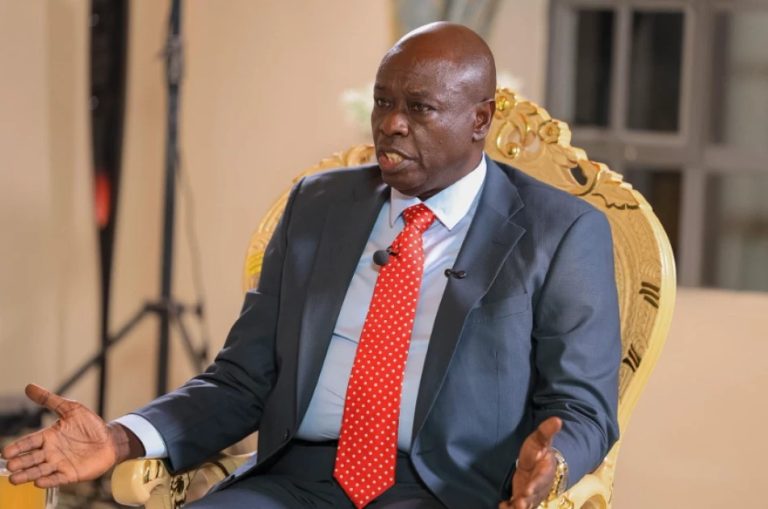
Former Deputy President Rigathi Gachagua
The High Court upholds the impeachment but orders the Senate to pay Ksh 50 million in damages — a ruling that vindicates Gachagua on process even as it closes the door on reinstatement
By MKT Reporter
Former Deputy President Rigathi Gachagua has lost his bid to be reinstated to office after the High Court dismissed his petition challenging the impeachment that removed him in October 2024, but the bench simultaneously found that the Senate violated his right to a fair trial and ordered it to pay him Ksh 50 million in constitutional damages — a finding that hands Gachagua both a defeat and a weapon.
The judgment, delivered yesterday by Justices Eric Ogolla, Anthony Mrima and Frida Mugambi, is a landmark ruling under Kenya’s 2010 Constitution — the first of its kind to award constitutional damages arising from an impeachment process. It is also a deeply ambiguous one. The court upheld the impeachment in its entirety while simultaneously declaring that the process by which it was conducted breached a fundamental constitutional right. That tension runs through every page of the ruling and will almost certainly define the legal battles to come.
On the central question of reinstatement, the bench was unequivocal. Gachagua’s allegations of bias against the Speaker of the National Assembly were dismissed as unsubstantiated, with the court finding that insufficient evidence had been placed before it to support the claims. The public participation process that preceded the impeachment was upheld, the bench holding that Parliament had provided adequate notice through advertisements in both English and Kiswahili newspapers and had offered citizens a genuine opportunity to engage. The approval of Deputy President Kithure Kindiki, conducted through televised and transparent proceedings, was found not to require public participation. Standing Order No. 64, which Gachagua’s team had sought to have declared unconstitutional, survived judicial scrutiny. The seven-day timeline it provides, the court held, is constitutional — though Parliament was noted to be free to revise it should it choose to do so.
And yet, on the question of fair trial rights, the court broke sharply in Gachagua’s favour. The bench issued a declaratory order finding that his constitutional rights were infringed when the Senate declined to grant an adjournment despite his absence from proceedings. The Ksh 50 million award that followed was framed explicitly as both compensation and deterrence. “The court awards constitutional damages of Kenya Shillings 50 million to His Excellency Gachagua payable by the Senate to vindicate the Constitution, restore the dignity of the affected party, and deter future violations,” the bench stated. It is a sentence that will be quoted for years.
The ruling also laid bare a significant gap in Kenya’s constitutional architecture. Acknowledging that Article 150 lacks a comprehensive statutory framework for the removal of a Deputy President, the bench urged Parliament to enact dedicated legislation urgently, warning that the absence of such a framework leaves fundamental procedural questions unresolved and undermines both institutional certainty and public confidence. That observation stops well short of invalidating the impeachment — the court was emphatic that proceedings conducted under Articles 144 and 145 remained constitutionally sound — but it is a structural criticism of the legal environment in which the impeachment took place, and one that Gachagua’s lawyers will not be slow to exploit.
On the question of timelines, the bench found that while Standing Order 78(2) prescribes a ten-day period for investigations by a special committee, neither the Constitution nor the Senate Standing Orders provide a specific timeline for impeachment proceedings in the Senate plenary. The Senate’s decision to adopt a ten-day timeline for plenary proceedings was therefore characterised as a procedural choice rather than a constitutional violation — a finding that Gachagua’s team contests and will likely revisit on appeal.
Gachagua has already indicated he will appeal, and the grounds his legal team is likely to advance are not difficult to anticipate. The finding that his fair trial rights were violated is the most potent instrument available to him. His lawyers will argue that a process tainted by a constitutional breach cannot be allowed to stand simply because other procedural requirements were satisfied. The infringement of the right to a fair hearing, they will contend, goes to the heart of the impeachment rather than its periphery, and the Ksh 50 million award — however welcome as a symbolic vindication — is a wholly inadequate remedy for the loss of constitutional office. That argument has genuine legal force, and the Court of Appeal will be required to engage with it seriously rather than dispose of it summarily.
Gachagua’s legal team is also expected to press the constitutional gap identified by the High Court itself. If Article 150 lacks the statutory framework necessary to govern the removal of a Deputy President, the argument runs, then proceedings conducted in the absence of that framework are inherently vulnerable to challenge — and the court’s reluctance to draw that conclusion at first instance does not bind the appellate bench. Whether that argument succeeds will depend on how broadly the Court of Appeal is willing to read the relationship between procedural fairness and constitutional validity. It is not a straightforward question, and it deserves a considered answer.
A further ground of appeal is likely to centre on the Senate’s refusal to grant an adjournment. The High Court found that this refusal violated Gachagua’s fair trial rights but declined to treat the violation as fatal to the impeachment. That reasoning — accepting the breach while preserving the outcome — is the jurisprudential heart of the ruling, and it is precisely the kind of reasoning that appellate courts are asked to scrutinise. Gachagua’s lawyers will argue that a constitutional violation of that character cannot be quarantined from its consequences, and that the only remedy proportionate to the breach is the quashing of the impeachment itself.
The shortfalls in the ruling are real and worth stating plainly. The court found a violation and awarded damages but stopped short of the logical consequence that many legal observers might have expected: a finding that the violation was sufficiently serious to invalidate the impeachment entirely. The bench drew a distinction between a flawed process and an invalid one — a distinction that Gachagua’s supporters regard as untenable and that his lawyers will characterise as the central error of the judgment. The Court of Appeal will now be invited to say whether that distinction holds.
Politically, Gachagua’s next move is already visible. He has made no secret of his ambitions ahead of the 2027 general election, and this ruling — partial victory framed as total defeat by the government, partial defeat framed as vindication by his camp — suits a narrative of persecution and resilience that travels well in Kenyan electoral politics. The Ksh 50 million damages finding gives him a court-endorsed grievance. The constitutional gap identified by the bench gives him a policy platform. The appeal gives him continued relevance in a political environment that moves quickly and forgets faster. Few politicians in Kenya’s recent history have demonstrated a greater capacity to convert legal adversity into political capital, and there is little reason to expect that to change now.
On pension and emoluments, the court made no findings, noting that Gachagua remained at liberty to pursue those claims before an appropriate forum. Each party was directed to bear its own costs, reflecting the public interest nature of the proceedings and the complexity of the constitutional questions raised.
The ruling does not end this story. It does not even come close. It confirms that the impeachment stands for now, that the Senate acted unconstitutionally in how it conducted the process, and that the courts will be asked to reconcile those two conclusions at the next level. For Gachagua, the courtroom fight continues. So does the political one. In Kenya, the two are rarely far apart.
Similar Posts by The Mt Kenya Times:
- A journey that began with Ixlos School
- Armenia’s ruling party claims victory in June parliamentary election
- Real Madrid elect Xabi Alonso as head coach to pave way for new era at Bernabéu
- Australian Man and South African woman claim victory in gruelling Durban ultramarathon
- Rigathi Gachagua’s impeachment case ruling in pictures
About the Author