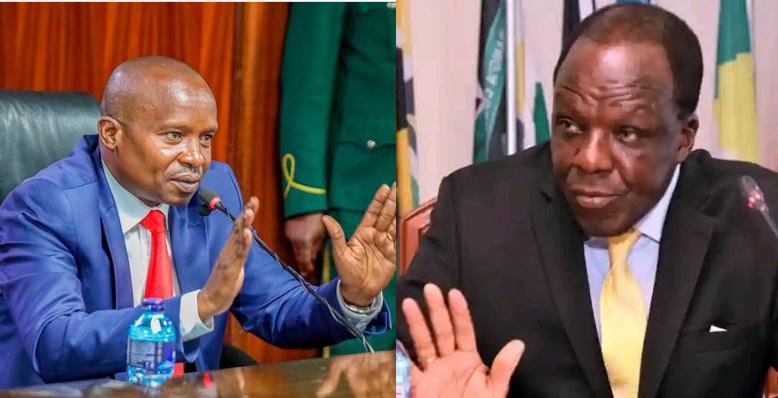
Deputy President Prof. Kithure Kindiki and Cooperatives and MSMEs Cabinet Secretary Wycliffe Oparanya.
As 2027 draws closer, a fierce contest over the deputy presidency is exposing the fault lines inside Kenya’s broad-based government — and the outcome will define the shape of the next election
By Brenda Atieno
A public power struggle has broken out inside Kenya’s broad-based government over who will run alongside President William Ruto in the 2027 general election, with the Orange Democratic Movement demanding the deputy presidency as the price of its continued support and UDA leaders rallying to defend the incumbent, Deputy President Kithure Kindiki.
The contest — conducted largely in public, in a mix of rallies, television studios and party gatherings — has moved faster than most political observers expected. What began as quiet coalition negotiations has become an open confrontation over one of the most consequential decisions any sitting president must make: who stands beside him when he asks the country for another five years.
ODM’s position has hardened noticeably in recent days. The party has made the deputy president’s slot a non-negotiable condition for backing Ruto’s re-election bid, demanding a 50-50 power-sharing arrangement with UDA as its irreducible minimum. “UDA should produce the president while ODM will produce the DP, and we will present Wycliffe Oparanya,” National Assembly Minority Leader Junet Mohamed said at a rally in Malava, Kakamega County. The statement was not a trial balloon. It was a declaration.
ODM Deputy Party Leader Simba Arati went further still at the party’s Turkana delegates meeting. “Since Ruto is on UDA vying for president in 2027, ODM will produce the Deputy President,” he said, framing the claim in language that left little room for ambiguity. Arati added that the only way Kindiki could remain in the position was if he left UDA and joined ODM — a condition nobody seriously expects to be met.
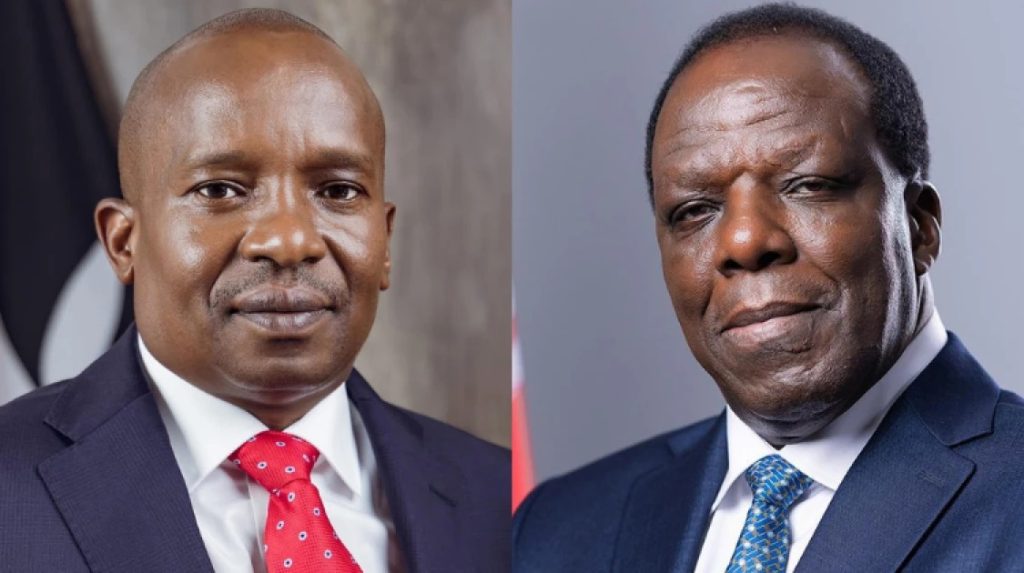
The ODM candidate of choice is Cooperatives and MSMEs Cabinet Secretary Wycliffe Oparanya, the former Kakamega Governor and one of the most senior surviving figures in Raila Odinga’s inner circle. Junet described Oparanya as “politically mature” and the most experienced option, citing his long-standing closeness to Raila and his experience as both governor and cabinet secretary. Oparanya himself has adopted a carefully calibrated posture — distancing himself from the lobbying while reaffirming his commitment to ODM and his support for President Ruto, conscious that as a sitting cabinet secretary he cannot openly campaign for a position still occupied by the Deputy President.
Beyond Oparanya, ODM has assembled a roster of alternatives. The party has also floated Homa Bay Governor Gladys Wanga and Mining Cabinet Secretary Ali Hassan Joho as potential candidates, with Coast-based leaders particularly vocal in their support for Joho. Some senior ODM figures have gone so far as to suggest that party leader Raila Odinga himself could be considered — a prospect that, if it materialised, would represent the most dramatic political reversal in Kenya’s post-independence history.
The arithmetic behind ODM’s demand is straightforward and not without logic. Western Kenya — the Mulembe nation of the Luhya community — delivered significant numbers in 2022, and its leaders argue those numbers must be reflected in any genuine coalition arrangement. Khwisero MP Christopher Aseka put it bluntly: “Let the votes be counted. Whoever has the most votes should put them on the table. As the Mulembe community, we have five million votes behind Wycliffe Oparanya.” Whether that figure is precise or aspirational, the underlying point is real: Western Kenya is a block that no winning coalition can afford to ignore.
The UDA response has been equally forceful. Public Service Cabinet Secretary Geoffrey Ruku said he does not support Oparanya’s bid, maintaining that Kindiki has delivered in the position and should be retained. Speaking in Embu County, Ruku acknowledged that while the final decision rests with President Ruto, the Mt Kenya region would back the President regardless — a statement that carried its own political message: that the mountain’s loyalty is to Ruto, not to Kindiki, but also that it would not be easily moved by ODM pressure.
Interior Cabinet Secretary Kipchumba Murkomen took a more pointed line, questioning why Kindiki — himself a son of the Mt Kenya region — was not receiving the same unconditional support that had been extended to others. “Is Prof Kindiki a child of a lesser Mt Kenya father and mother? Why should he not be given support?” Murkomen asked. It was a question directed as much at the politics of the moment as at the geography.
Taita Taveta MP John Bwire added his voice to the chorus of Kindiki defenders, describing the Deputy President as the President’s most steadfast ally. The sentiment is widely shared within Kenya Kwanza circles, where Kindiki is seen as having stabilised a position that became toxic under his predecessor, Rigathi Gachagua, who was impeached in October 2024.
The numbers, for now, support Kindiki. A July 2026 Infotrak survey placed him as the preferred running mate for President Ruto with a 34 per cent national rating — topping regional preferences including in Nyanza, where he attracted 28 per cent support, ahead of Homa Bay Governor Gladys Wanga’s 21 per cent. Over 37 per cent of respondents remained undecided, however, suggesting the race is far from settled.
Political analysts note that President Ruto may, paradoxically, benefit from keeping the question open. “Ruto needs Kindiki right now more than ever before,” Professor Gitile Naituli observed. “He can use him to promise everyone that position. He can use the Rigathi Gachagua example and say he can replace him. He can tell that to the Luos, Coast and Western residents.” It is a cold calculation, but in Kenyan politics, cold calculations tend to age better than warm promises.
What is clear is that the deputy presidency has become the central bargaining chip in Kenya’s pre-2027 negotiations — a position that concentrates, in a single office, all the competing pressures of region, party, ethnicity and ideology that have always defined how power is allocated in this country. ODM wants it as validation that its decision to enter the broad-based arrangement was not a surrender. UDA wants to retain it as proof that the alliance does not require the dismantling of its own architecture.
ODM and UDA have already appointed five-member technical teams that have begun drafting a joint manifesto, expected to be completed before the end of the year. The manifesto can be written. The running mate cannot be decided by committee. That decision belongs to one man — and William Ruto has not yet shown his hand.
When he does, the map of Kenyan politics in 2027 will become considerably clearer. Until then, the battle for his right hand will only intensify.
Similar Posts by The Mt Kenya Times:
- Mt Kenya Times ePAPER September 17, 2026
- Ruto and Uhuru: The rupture at the heart of Kenya’s 2027 election
- Gakoromone traders and rights group demand closure of sewage discharge
- Retirement is not disenfranchisement: Reclaiming the constitutional rights of Kenya’s former presidents
- Kenya’s 2027 election: Can technology strengthen democracy or manipulate voters?
About the Author