Opposition unity pact faces its biggest test: Who will lead the charge against Ruto?
United Alternative Government
As rival heavyweights sign a unity accord, the coalition’s most consequential question — who carries the ticket — remains unanswered
By Levis Wangamati
Kenya’s opposition has taken its clearest step yet toward confronting President William Ruto as a united force in the 2027 General Election. But the agreement reached this week has brought the coalition’s most difficult question into sharper focus: who will lead it?
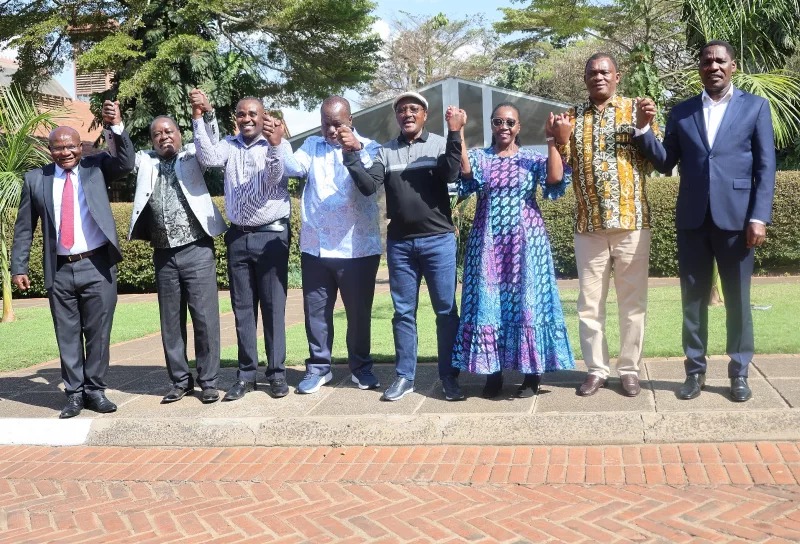
Principals meeting under the United Alternative Government umbrella signed a unity accord pledging to back a single presidential candidate, establish a credible selection process, and prevent individual leaders from sponsoring rival bids.
The pledge represents an explicit attempt to cure one of the long-standing weaknesses of Kenyan opposition politics: vote fragmentation driven by competing presidential ambitions.
The coalition brings together political heavyweights with formidable regional bases — among them Kalonzo Musyoka, Martha Karua, Fred Matiang’i, Eugene Wamalwa, Justin Muturi and Peter Munya — alongside former Deputy President Rigathi Gachagua’s Democracy for the Citizens Party.
Signing an agreement to support one candidate, however, is significantly easier than deciding who that candidate should be. That is where the coalition’s structural integrity will face its first real test.
Early friction
The fault lines are already visible.
While Gachagua’s party aligns with the broader push to unseat Ruto, his own political strategy has highlighted the coalition’s internal contradictions. Gachagua skipped Monday’s formal accord signing, sending his deputy party leader Cleophas Malala in his place, while convening a separate delegates’ meeting at his Wamunyoro residence. During those consultations, he said he had been identified by those he consulted as the best-suited opposition candidate for 2027 — while simultaneously stating he would support whoever the opposition ultimately chooses.
Meanwhile, Democracy for the Citizens Party Secretary-General John Methu cautioned Gachagua against attending what he described as “hotel and boardroom meetings,” arguing that the party leader should not negotiate away his political leverage.
The developments expose the coalition’s central paradox: every leader wants a united vehicle, but few are willing to fold their party machinery, surrender regional bargaining power or dilute their personal brand before the final political settlement is reached.
The arithmetic
Gachagua’s departure for a multi-city US diaspora tour yesterday adds another layer of complexity. He is expected to engage Kenyans in five American cities, with the trip running into October as he maps out his political roadmap ahead of 2027.
While the tour gives him a platform to engage Kenyans abroad, domestic negotiations will continue in his absence — testing whether the alliance can build organisational momentum without descending into proxy battles and competing power centres.
The arithmetic facing the opposition is unforgiving. A crowded presidential field could divide the anti-Ruto vote and smooth the incumbent’s path to re-election. A single ticket, by contrast, offers the opposition a far cleaner opportunity to consolidate support across regions and political networks.
But Kenyan political history offers a warning. Alliances can look formidable during signing ceremonies and still fracture once negotiations shift from broad principles to specific seats, nominations and positions of influence.
Connecting with voters
There is also the electorate itself to consider.
A political agreement constructed primarily around elite power-sharing and the objective of defeating Ruto risks failing to connect with voters whose concerns extend well beyond political alliances. Economic pressure, unemployment, the cost of living, public services and trust in government will all shape how voters assess the competing camps.
For the opposition, unity cannot end with the signing of an accord. It must eventually become a political proposition that voters can understand and believe in.
A coalition capable of assembling regional political machines may well have the numbers to compete. But numbers alone will not translate into public enthusiasm. The opposition will ultimately have to explain what its alternative government would look like — and why voters should entrust it with power.
The road ahead
The coalition must answer three difficult questions: how will its presidential candidate be chosen, what will bind its parties together beyond shared opposition to Ruto, and can the losing contenders genuinely rally behind the eventual winner?
Getting rival political camps into the same room is a genuine tactical achievement. But the real work begins now.
If the principals can design a candidate-selection process that all partners consider legitimate, agree on a common platform and rally behind the eventual nominee, they could present a formidable challenge in 2027.
If they cannot, this week’s accord risks joining the long list of Kenyan political agreements that appeared decisive in a conference room but weakened when confronted by personal ambition and competing interests.
The opposition has agreed on the destination.
The unresolved question is whether its leaders can agree on who gets the keys.
Similar Posts by The Mt Kenya Times:
- Mt Kenya Times ePAPER October 17-18, 2026
- Ruto bets billions on Kerio Valley — with one eye on 2027
- Ruto’s health ministry kills Murang’a’s digital hospitals
- Kenya bets on Mount Kenya to drive a billion-shilling tourism revival
- Do you have a wealth vision? Or are you just working until you die?
About the Author