Gachagua’s rigging claims: Are Kenyans listening or simply tired?
 The Mt Kenya Times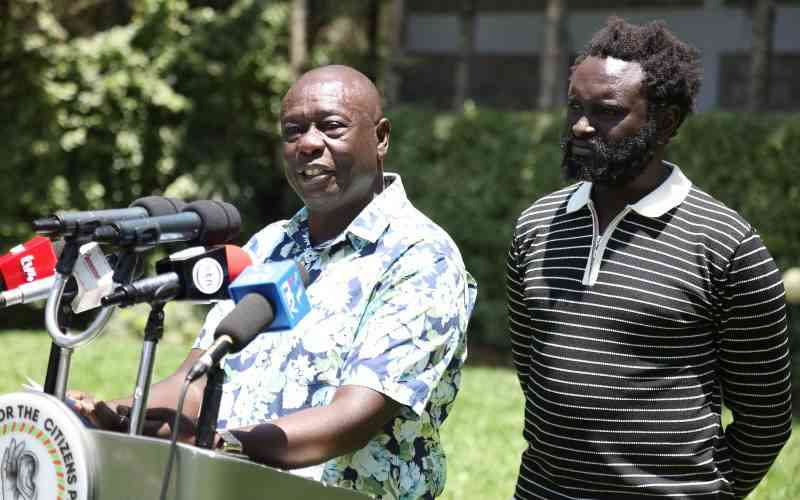
Democracy for the Citizens Party leader Rigathi Gachagua and Nyandarua Senator John Methu
With a disputed election technology tender now before a procurement review board, the real question is whether alarm without evidence moves the country forward
By Hadassah Karangu
As Kenya inches closer to the 2027 General Election, the political conversation is becoming increasingly dominated by one familiar question: will the election be free and fair?
Democracy for the Citizens Party leader Rigathi Gachagua Wednesday placed that question at the centre of national debate, accusing the government and the Independent Electoral and Boundaries Commission of laying the groundwork to manipulate the polls.
Gachagua alleged that the IEBC’s ongoing tender for an Integrated Elections Management System — referenced as IEBC/OIT/01/2026-2027 and advertised on 11 August — is merely a formality intended to give the appearance of a competitive procurement process, with the outcome already predetermined in favour of South Korean firm Miru Systems Company Limited.
He also alleged that IEBC Chairperson Erastus Edung Ethekon, Interior Principal Secretary Raymond Omollo and Immigration Principal Secretary Belio Kipsang had held meetings with Miru Systems representatives linked to the integration of the company’s technology with Kenya’s voter registration database. The former Deputy President did not provide documentary evidence to support the allegations.
Gachagua further claimed that the IEBC’s procurement manager had been removed and replaced with an individual he described as a “puppet”, and that the proposed system could be used to manipulate the voter register and suppress voters in regions perceived as hostile to President William Ruto’s administration.
The IEBC has not been silent. The commission dismissed the claims that tender specifications were designed to favour Miru Systems, describing the allegations as speculative and arguing that no specific requirement had been identified that would give Miru Systems an unfair advantage over other bidders. “The tender is strict. It’s either you are compliant or not. For the bidder to succeed, it should be 100 per cent compliant,” the commission said.
The procurement is, however, on hold. A request for review was filed at the Public Procurement Administrative Review Board by Galadirel Investment Limited, which raised concerns over the tender specifications, the undisclosed contract value and requirements it argued could favour foreign suppliers. Separately, the IEBC admitted to a 20 per cent error in the tender documents, though it maintained the procurement process remained above board.
These are serious allegations. But they remain allegations.
That distinction matters in a country where election-related claims can quickly become political ammunition. Gachagua has not publicly produced evidence that Ruto has an organised plan to rig the 2027 election. Nor should Kenyans treat the IEBC tender as proof of such a plan simply because a political leader has raised questions about it.
At the same time, Kenyans should not be told to dismiss legitimate questions about the electoral system. If there are concerns about how election technology is procured, who writes the technical specifications, how voter data is protected and whether the process is genuinely competitive, those questions deserve clear answers. The IEBC should be able to explain itself. The government should be able to explain itself.
And Gachagua, if he possesses evidence of an organised plan to manipulate the election, should place that evidence before the appropriate institutions — and before the Kenyan public.
That is what accountability looks like.
But there is another question that deserves equal attention: are Kenyans becoming tired of political warnings that offer little beyond the next election?
For millions of ordinary citizens, 2027 matters — but life is happening now. Young people are searching for work. Parents are struggling with the cost of raising families. Small businesses are fighting to survive. Graduates are entering an increasingly competitive job market. Farmers are worrying about markets and production costs.
These Kenyans may reasonably ask: what are politicians doing about these problems today?
A warning about election rigging cannot create a job. A political rally cannot lower the price of food. And repeatedly naming President Ruto cannot, by itself, offer an alternative government.
This is where Gachagua’s political strategy faces its biggest test. His attacks on the Ruto administration may strengthen his position among voters already dissatisfied with the government. His warnings about electoral integrity may also resonate with Kenyans who remain deeply suspicious of political institutions.
But political relevance is not the same thing as public trust.
If Gachagua wants Kenyans to see him as a credible alternative in 2027, he will eventually have to offer more than accusations against his former boss. He will have to tell Kenyans what he would do differently. What is his economic plan? How would he create employment for young people? How would his administration tackle corruption? What would he do about the cost of living? How would he improve healthcare and education? What would his government do for farmers, small businesses and ordinary workers?
And most importantly: what kind of Kenya does he want to build?
These questions matter because elections should not simply be referendums on personalities. Kenya deserves a contest in which competing leaders present competing visions. Ruto should defend his record and explain why Kenyans should give him a second term. Gachagua and other opposition leaders should explain why they deserve the opportunity to govern. And voters should be given enough information to judge both sides fairly.
The danger is that 2027 could once again become a contest of fear, accusation and political alliance — with policy taking a back seat. That would be a disservice to the country.
There is nothing wrong with warning Kenyans about threats to democracy. In fact, vigilance is necessary. Elections must be protected, electoral institutions must remain independent and technology used in elections must be transparent and secure.
But there is a difference between raising legitimate concerns and repeatedly alarming the public without providing a clear path forward.
Gachagua therefore has an opportunity. If he believes the electoral system is being compromised, he should push for concrete reforms. If he believes the IEBC procurement process is flawed, he should submit evidence and demand an independent investigation. If he believes election technology could be manipulated, he should propose safeguards that would make such manipulation difficult — regardless of who is in power.
That would turn political criticism into political action.
The same standard applies to the government. The Ruto administration should not dismiss Gachagua’s allegations as opposition noise. It should welcome scrutiny and demonstrate that the electoral process is above political interference. A government confident about the integrity of its electoral plans should have nothing to fear from transparency.
Kenya has been here before. Election seasons bring dramatic claims, political suspicions and promises to protect the vote. But voters are becoming more politically aware, and many are likely to demand something more substantial in 2027.
They want to know not only who will win — but what the winner will do for them.
Perhaps that is the conversation Kenyan politics needs now. Not simply “Will Ruto rig the election?” Not simply “Can Gachagua defeat Ruto?” But rather: what is the plan for Kenya?
Because Kenyans cannot build their future on accusations alone. They need action. They need accountability. They need credible institutions. They need leaders who can move beyond campaign rhetoric and present practical solutions.
And when 2027 finally arrives, they deserve an election in which their votes are protected and their choices respected.
Until then, politicians should remember that Kenyans are listening — but they are also watching. And they will judge leaders not by how loudly they speak about 2027, but by what they are prepared to do for Kenya today.
Similar Posts by The Mt Kenya Times:
- Mt Kenya Times ePAPER October 17-18, 2026
- Ruto bets billions on Kerio Valley — with one eye on 2027
- Ruto’s health ministry kills Murang’a’s digital hospitals
- Kenya bets on Mount Kenya to drive a billion-shilling tourism revival
- Do you have a wealth vision? Or are you just working until you die?
About the Author