Ruto in Lusaka: ‘Political competition may divide choices — it must never divide our destiny’
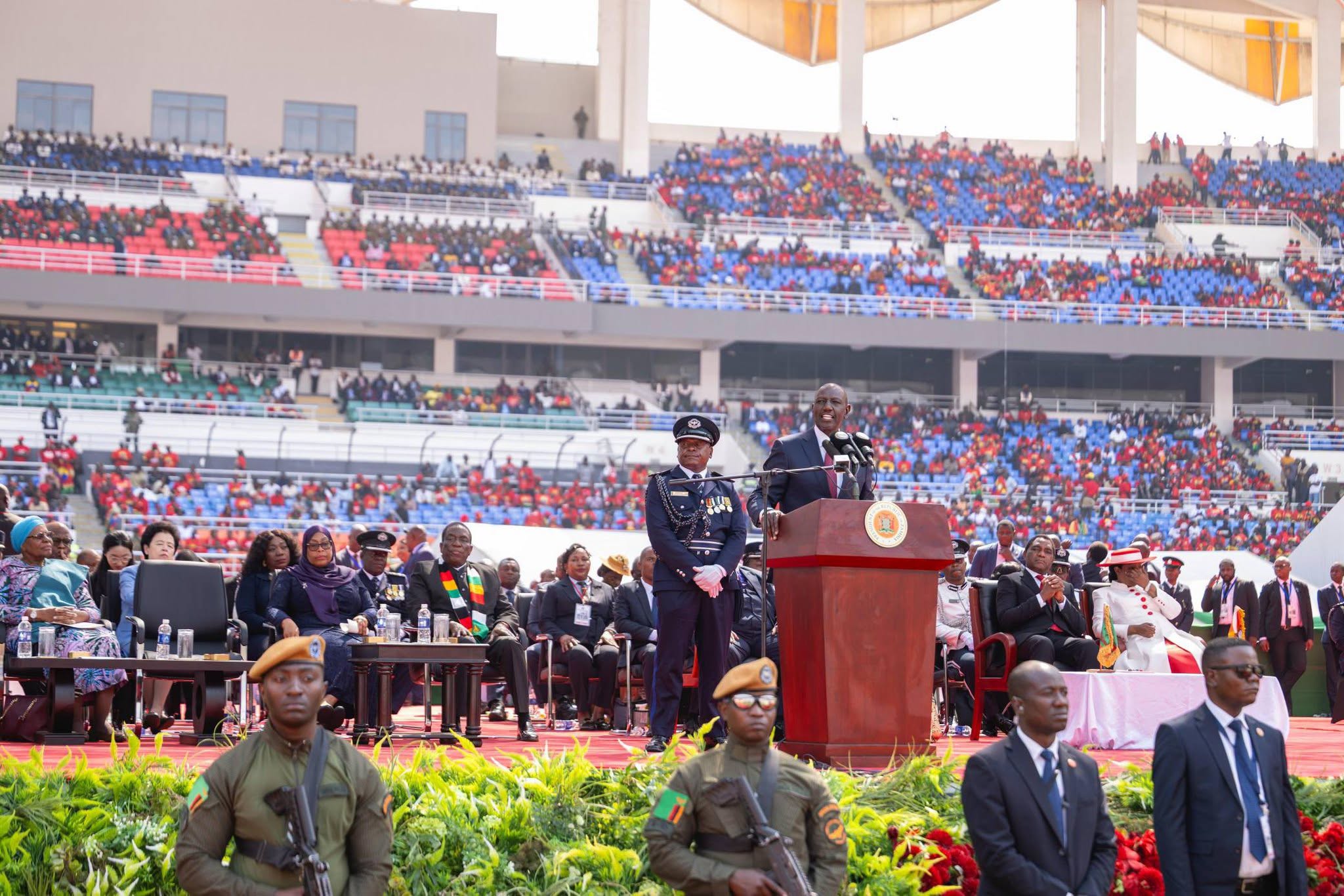
President William Ruto speaking at the National Heroes Stadium, Zambia
Speaking at a disputed election’s inauguration, Kenya’s president delivered a message about democratic responsibility that resonated far beyond Zambia — and pointed unmistakably at home.
By David Kimani
President William Ruto yesterday invoked Kenya’s 2027 general election on an international stage, using the inauguration of Zambian President Hakainde Hichilema in Lusaka to call on African leaders to ensure that political competition never becomes a source of national rupture — a message that carried as much weight in Nairobi as it did in Lusaka.
Speaking at the National Heroes Stadium before a gathering of regional heads of state, Ruto was deliberate in positioning Kenya not as a model but as a fellow traveller on democracy’s uncertain road. “Kenya too will hold a general election next year,” he said. “We therefore speak not as spectators, and certainly not as lecturers, but as fellow Africans travelling the same democratic path.”
The setting lent the remarks a charged quality that Ruto’s carefully calibrated language sought to navigate. Hichilema’s second-term inauguration followed a deeply contested August 13 election in which the incumbent secured approximately 60 per cent of the vote against opposition candidate Brian Mundubile’s 38 per cent, according to official results. Mundubile rejected the outcome and was unable to mount a legal challenge after Zambia’s seven-day presidential petition window closed without a petition being received by the judiciary. He was subsequently arrested alongside his running mate, Makebi Zulu, and charged with treason — a development that drew immediate and sharp international attention to the political environment surrounding the ceremony Ruto was attending.
Election observers had already raised concerns about aspects of the tallying process, including weak verification between digital entries and paper records and delays at certain tallying centres. Hichilema, in his inauguration address, called for political disagreements to be handled peacefully and pledged that his government would engage with opposition ideas where they had merit.
Ruto did not reference the disputed election, Mundubile’s arrest or the observer concerns directly. His remarks operated at a higher level of abstraction — but the context ensured that every word was heard through the lens of what had just unfolded in Zambia. When a Kenyan president speaks of preserving national unity through elections while standing at an inauguration shadowed by a jailed opposition leader and international scrutiny of the vote count, the subtext is unavoidable.
His substantive argument was clear and, in isolation, unimpeachable. Democracy on the African continent must deliver more than the ritual of elections, he argued. It must produce political stability, economic opportunity and the institutional credibility that attracts investment and enables long-term planning. “Africa cannot industrialise if every election becomes a moment of national uncertainty,” Ruto said. “Businesses cannot plan in environments where political uncertainty persists. Investors require trusted institutions and the rule of law.”
The economic framing was characteristic of Ruto’s international posture — an attempt to connect democratic governance to the development agenda that African leaders invoke at virtually every multilateral gathering. The argument has genuine merit. The correlation between political instability and economic stagnation is well established across the continent’s recent history. Elections that produce disputed outcomes, violent contestation or institutional delegitimisation consistently set back the very development goals that governments campaign on.
But the speech also carried an unmistakable domestic dimension. With Kenya’s own election cycle accelerating sharply — opposition coalitions forming, grassroots mobilisation intensifying, political alliances shifting and the Independent Electoral and Boundaries Commission facing serious scrutiny over its procurement decisions — Ruto’s words in Lusaka were as much a message to Kenya’s political class as they were a contribution to any pan-African democratic discourse.
“We must compete vigorously without becoming enemies. We must disagree without destroying anything. And we must seek victory without excluding,” he said. The elegance of the formulation could not entirely obscure the irony that it was delivered by a president whose own political period has been marked by sharp polarisation, the dramatic impeachment of his deputy, allegations of state intimidation of journalists and a deepening confrontation with a growing opposition coalition that has explicitly framed its mission as his removal from power.
Former Deputy President Rigathi Gachagua, whose impeachment in October 2024 restructured Kenya’s political landscape, now leads the Democracy for Citizens Party and sits at the table of the United Alternative Government — the opposition coalition that has signed a unity pact and is actively positioning Wiper leader Kalonzo Musyoka as its likely presidential candidate. The political terrain Ruto will contest in 2027 is more contested, more fragmented and more ideologically charged than the one he navigated in 2022.
The Zambian experience, read carefully, offers cautionary material for all sides of Kenya’s political divide. Hichilema’s first term was marked by arrests of opposition figures and press freedom concerns — episodes that his government justified and his critics condemned. Yet he won re-election with a substantial majority, suggesting that a population facing genuine economic challenges will often prioritise delivery over political pluralism, at least in the short term. Whether Kenya’s electorate will apply the same calculus to Ruto in 2027 depends enormously on whether the economic conditions that have defined his first term — high cost of living, youth unemployment, controversial taxation and fiscal pressure — improve meaningfully before polling day.
The leaders sharing the Lusaka stage with Ruto yesterday — Presidents Netumbo Nandi-Ndaitwah of Namibia, Duma Boko of Botswana, Emmerson Mnangagwa of Zimbabwe and Samia Suluhu Hassan of Tanzania — each carry their own democratic records, ranging from genuinely competitive multiparty systems to heavily managed political environments. That Ruto chose to deliver a democratic unity message in this company, at this particular inauguration, will be noted by observers across the region.
“Political competition may divide choices,” he said. “It must never divide our destiny.”
It was a line worth remembering. Kenya will find out in August 2027 whether its own political class — the president included — was prepared to live by it.
Similar Posts by The Mt Kenya Times:
- Mt Kenya Times ePAPER October 17-18, 2026
- Ruto bets billions on Kerio Valley — with one eye on 2027
- Ruto’s health ministry kills Murang’a’s digital hospitals
- Kenya bets on Mount Kenya to drive a billion-shilling tourism revival
- Do you have a wealth vision? Or are you just working until you die?
About the Author