When campus freedom becomes a trap: Are students choosing to miss classes?
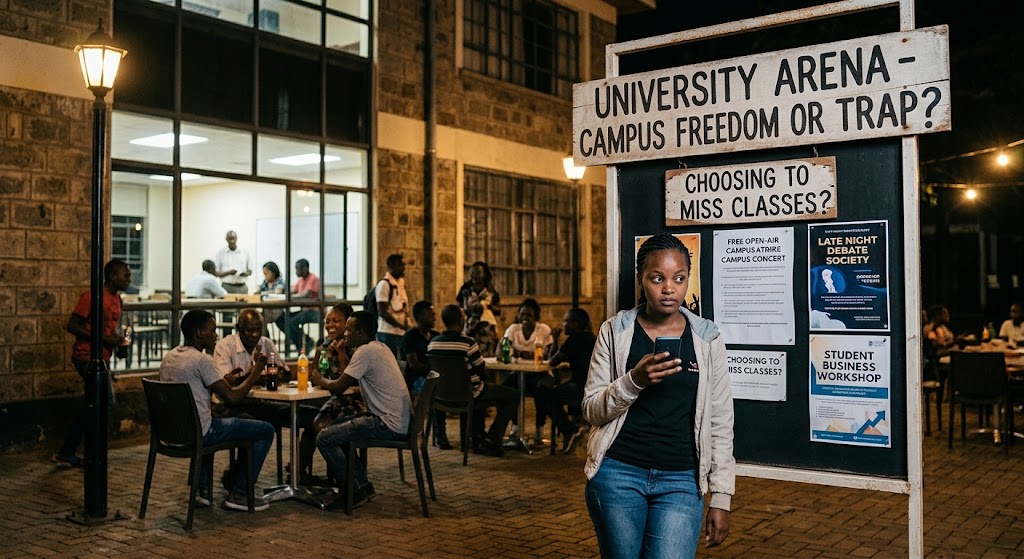
When campus freedom becomes a trap: Are students choosing to miss classes?
University life hands students freedoms secondary school never did — but not everyone is ready for what that freedom costs
By Hadassah Karangu
Walking into university for the first time can feel like stepping into a completely different world. There are no teachers constantly checking whether you are in class, no parent asking why you missed a lesson and, in many cases, no one following up when you decide to stay in your hostel instead of attending a lecture.
For many students, this is precisely what makes campus life exciting. It is a place where young adults are expected to make their own decisions. Attendance is rarely enforced the way it was in secondary school, and students suddenly have considerable control over how they spend their time.
But that freedom comes with a question many students eventually have to confront: what happens when freedom is handed to someone who has not yet learned how to manage it?
University is not a place where attendance is compelled. A lecturer may announce that a class begins at eight in the morning, but ultimately the student decides whether to get up, dress, walk to the lecture hall and sit through it — or stay in bed. That decision can seem harmless when made once. A student may genuinely be tired, unwell, emotionally drained or simply in need of rest. The problem begins when an occasional choice becomes a routine.
“I will attend the next class” can quietly become “I will catch up later.” And later can become next week. By the time a student realises what has happened, several lectures have passed and their grasp of the course has slipped considerably.
What campus freedom often exposes is the gap between being free and being responsible. Freedom gives students choices, but it does not remove the consequences of those choices. A student can choose not to attend a lecture — but the lecturer will still teach the content, the examination will still arrive and the assignment will still demand understanding. Eventually, the student may have to answer for material they were never present to learn.
This is where personal responsibility becomes the real subject of university education.
Some students miss classes because they genuinely struggle with motivation. There are mornings when getting out of bed feels like a battle. After a long day of lectures, assignments and personal pressures, another class can feel like too much. For others, though, the issue is not exhaustion but preference. They simply do not feel like going. The hostel is more comfortable, the phone more entertaining, a film easier than a two-hour lecture and social media far more instantly rewarding than a classroom that demands concentration.
Then there is the influence of friends — perhaps the most quietly powerful force in student life.
University students rarely make decisions in complete isolation. If a group of close friends regularly decides to skip a lecture, it becomes much easier for an individual to follow. One person may genuinely want to attend, but when a friend says “let us just stay here today,” the decision suddenly feels simpler to make. The opposite, however, is equally true. When students surround themselves with friends who take their education seriously, attending class becomes the norm. Studying together becomes normal. Preparing early for examinations becomes normal.
Friendship does not automatically damage academic performance. What matters is the culture created within the friendship group. The danger arises when students begin confusing social belonging with simply following the crowd — skipping class not because they personally wanted to, but because they did not want to be the only one walking to the lecture hall. At that point, a question worth sitting with is this: who is actually making the decision — the student or the group?
Campus freedom also triggers a significant psychological shift. Students are no longer children under constant supervision, yet many are still learning how to manage adulthood. Nobody forces a university student to study for three hours. Nobody confiscates their phone or demands they attend every lecture. Nobody reminds them each evening that examinations are approaching. The responsibility that previously rested with institutions and families now rests with the individual.
That transition can be difficult. Students who were accustomed to external structure can find that when the supervision disappears, their routines disappear with it.
This does not make university freedom harmful in itself. Freedom can actually be one of the most valuable aspects of university life — it teaches independence, decision-making and accountability. The problem arises when freedom is misread as the absence of consequences. Being free to make a decision is not the same as being free from the outcome of that decision.
There is also a broader question worth directing at universities and lecturers. If students consistently avoid certain classes, the answer is not always found by looking only at students. Are the lessons engaging? Are lecturers creating an environment where students feel encouraged to participate? Are timetables reasonable? Are students overwhelmed by workload? Are there genuine academic or personal difficulties affecting attendance? These questions do not excuse students from responsibility. They simply acknowledge that academic behaviour is shaped by more than one factor.
There is a meaningful difference between a student who occasionally misses class because of a genuine personal difficulty and one who repeatedly chooses entertainment over education. There is also a difference between a student struggling with a demanding course and one who has simply decided that showing up is unnecessary. The response to those situations cannot be identical, and the solution cannot simply be blanket punishment for anyone who misses a lecture.
What students ultimately need to develop is something no timetable can impose: self-discipline.
University ends. There will be no lecturer reminding graduates to report for work, no attendance register following them into their careers. Employers are unlikely to accept “I was not in the mood” as a reason for failing to meet responsibilities. Campus can therefore be seen for what it is — a training ground for a much larger life.
The small decisions students make today can become habits tomorrow. Choosing to attend class when friends are staying behind teaches independence. Studying when nobody is compelling you to teaches discipline. Walking away from distractions teaches self-control. And taking responsibility when a poor decision is made teaches maturity.
Perhaps the real question is not whether students should be given freedom. It is whether they understand what freedom demands of them.
Freedom without responsibility can easily become self-sabotage. Freedom combined with discipline, however, can become one of the finest opportunities university has to offer. A student does not have to attend every class because someone is standing at the door counting heads. They should, in time, develop the maturity to understand why they are there in the first place.
After all, university is not only about passing examinations. It is about learning to make decisions when nobody is watching.
And sometimes, the most important lecture is the one a student chooses to attend even when no one is making them.
Similar Posts by The Mt Kenya Times:
- Mt Kenya Times ePAPER September 18, 2026
- Kenya’s High Court orders IEBC to open voter register and election servers to parties and observers
- Global Concern: Solid Waste and E-Waste Management
- Kenya to establish 10 bamboo nurseries as Meru expo puts sector in national spotlight
- Understanding why most people write poetry after heartbreak
About the Author