Ruto and Uhuru: Why is Kenya still trapped in yesterday’s political battles?
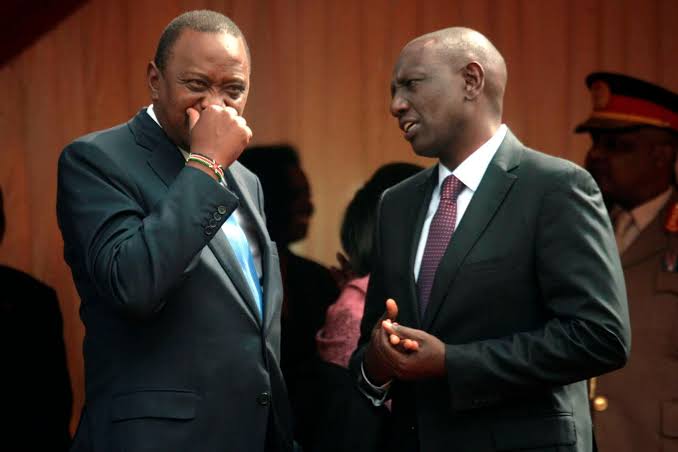
President William Ruto and his predecessor, Uhuru Kenyatta
As the Ruto-Uhuru feud flares again, Kenyans are entitled to ask whether their leaders are focused on the future or imprisoned by the past
By Collins Kibet
Kenya’s political conversation has once again been pulled back into the turbulent relationship between President William Ruto and his predecessor, Uhuru Kenyatta. Yesterday, Ruto renewed his criticism of the retired president, accusing him of actively working to undermine his administration and questioning his continued involvement in the country’s political affairs.
The renewed exchange raises a question that goes well beyond the two men at the centre of it: why does Kenya’s political debate keep revolving around yesterday’s battles when the country faces pressing present-day challenges?
Ruto is the sitting president. He carries the responsibility of accounting for his administration’s record and responding to the real concerns of ordinary Kenyans. Kenyatta, having left office in 2022, remains an influential figure — but his current role and the extent of that influence have become subjects of increasingly heated political debate. A Democracy for the Citizens Party official, Peter Mbae, argued yesterday that Kenyatta should not be cast as Ruto’s political opponent, a framing that itself reflects how contested these boundaries have become.
Ruto has framed his criticism around what he describes as deliberate efforts to destabilise his government. Meanwhile, opposition-linked figures and Kenyatta’s allies operate in a political environment where the contest for influence ahead of the 2027 General Election is already intensifying. The argument over who bears responsibility for Kenya’s political direction is sharpening — and it is doing so well before the formal campaign period has begun.
This matters because political narratives have consequences. When the dominant conversation in a country centres on the personal grievances between two powerful men, it crowds out the debates that ordinary citizens most need their leaders to be having. The cost of unga. The state of public hospitals. Youth unemployment. The credibility of county governments. The reliability of the Kenya Revenue Authority’s tax burden on small businesses. These are the conversations Kenyans at the grassroots level are having every day — and they deserve to hear their leaders having them too.
The more important concern for Kenyans, therefore, is whether this confrontation is generating solutions or simply consuming political oxygen. The country continues to face serious questions about the economy, employment, the cost of living, the delivery of public services and the credibility of institutions meant to serve ordinary people. These challenges require sustained, policy-grounded public debate — not an endless recycling of personal grievances dressed up as national politics.
Kenyatta’s continued political relevance, however, cannot simply be wished away. Former presidents retain influence through experience, networks and longstanding relationships within political structures. That is the nature of high office — it does not end cleanly on the day a successor is sworn in. Kenyatta built political relationships over a decade at the centre of Kenyan power. Those relationships do not dissolve simply because he no longer occupies State House.
A recent High Court ruling has sharpened attention on his position within Jubilee, upholding the statutory restriction that prevents retired presidents from holding formal party office beyond six months after leaving State House, while affirming their right to remain party members and participate in political activity. The ruling does not silence Kenyatta — but it does clarify the legal boundaries within which his political role must now be exercised. Whether those boundaries are respected in practice, or creatively worked around, will itself become a political story in the months ahead.
Kenya is therefore entering another sensitive period in which the influence of former leaders, the record of the current administration and the choices of voters will increasingly intersect. The Ruto-Kenyatta confrontation may ultimately matter less as a personal dispute and more as a visible symptom of the wider struggle for political positioning ahead of 2027. Both men understand this. So do their respective political networks. The public exchanges are rarely simply about what is being said — they are about signalling strength, testing loyalties and shaping the narrative that will define the next electoral cycle.
For Ruto, the central challenge is keeping the national conversation anchored to his administration’s record, plans and policies — ground on which a sitting president should feel most comfortable standing. An incumbent who is perpetually drawn into confrontations with a predecessor risks appearing reactive rather than in command. Leadership, at its most effective, sets the agenda rather than responding to one set by others. Every week spent relitigating the Ruto-Kenyatta relationship is a week not spent making the affirmative case for why the current administration deserves a second term.
For Kenyatta and other opposition-aligned figures, the challenge is equally clear. Political relevance in a democracy must ultimately rest on something more substantial than opposition to a sitting government. Kenyans are entitled to know what an alternative political formation would do differently — concretely, measurably and honestly. The country has heard enough about what past governments failed to deliver. What voters increasingly want to hear is a credible account of what the next chapter could look like, and who is genuinely capable of delivering it.
There is also a generational dimension to this conversation that deserves attention. Kenya has a large and growing population of young people who were children or teenagers during the Kibaki era, came of age politically during the Kenyatta years and are now navigating early adulthood under Ruto. For many of them, the Ruto-Kenyatta relationship is not a story of betrayal or broken brotherhood — it is simply background noise from an older generation of politicians whose rivalries feel distant from their daily realities. Young Kenyans want a political conversation about their futures, not a replay of their parents’ political disappointments.
This is not a small consideration. The youth vote will be decisive in 2027. Any political formation that speaks convincingly to the aspirations, frustrations and ambitions of young Kenyans will have a significant structural advantage. The danger for all sides is that a political conversation dominated by yesterday’s feuds alienates precisely the voters who will determine tomorrow’s outcome.
Kenya cannot afford to remain permanently imprisoned by rivalries born in previous election cycles. The country’s political class may find old battles familiar and convenient, but ordinary Kenyans have present-day concerns. They want jobs, affordable living costs, accountable leadership, reliable public services and a political system that actually addresses their problems rather than endlessly performing its own internal dramas.
The question, therefore, is not simply whether Ruto and Kenyatta will continue their confrontation. The more important question is whether Kenya’s leaders — on all sides — can find the discipline and the vision to move the national conversation from personalities and grievances toward the issues that will genuinely shape the country’s future.
The 2027 election will come. Voters will choose. And when they do, they will be looking for leaders who demonstrated, well before polling day, that they understood what the country actually needed — and were serious about delivering it.
Similar Posts by The Mt Kenya Times:
- Mt Kenya Times ePAPER September 18, 2026
- Kenya’s High Court orders IEBC to open voter register and election servers to parties and observers
- Global Concern: Solid Waste and E-Waste Management
- Kenya to establish 10 bamboo nurseries as Meru expo puts sector in national spotlight
- Understanding why most people write poetry after heartbreak
About the Author