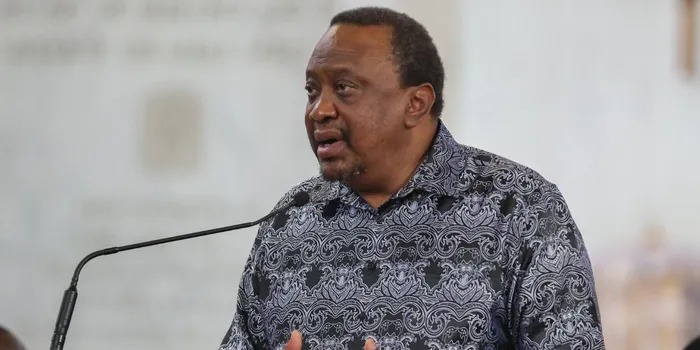
Former President Uhuru Kenyatta
When a former president turns a slur into a slogan, the man who coined it has already lost the argument.
By David Kimani
Former President Uhuru Kenyatta publicly embraced the “sponyo” — sponsor — nickname that President William Ruto has spent weeks wielding against him, signing off a funeral address in Murang’a on Friday with the line, “That is all from the sponsor… we will meet again and continue being together,” drawing loud laughter and producing one of the most widely shared political clips of the year.
The moment was brief, deliberate and deceptively light-hearted. But in the compressed, highly symbolic language of Kenyan politics in the year before a general election, it carried the weight of a full press statement. Kenyatta had said nothing about policy, nothing about 2027, nothing that could be clipped out of context and turned against him by a hostile headline. He had said everything that needed saying simply by repeating the word his successor had chosen as an insult and making it sound like a title of honour.
Kenyatta had initially considered speaking off the cuff before deciding to deliver a prepared condolence message, explaining his caution: “Usually, me, I speak off-cuff, but these days life is becoming quite dangerous for me.” That line, delivered with the timing of a man who has been in rooms where language shifts power, told its own story. Kenyatta is not hiding. He is choosing his battles — and Friday’s was a small one won cheaply, in front of mourners, before the cameras Ruto has ensured are always trained on him.
To understand what the moment means, it is necessary to understand what preceded it. Ruto spent five days in Nyanza — historically the country’s most reliable opposition territory — traversing Siaya, Kisumu, Homa Bay and Migori, launching markets, unveiling projects worth billions of shillings, and sharing platforms with ODM leaders. The tour was framed publicly as a development mission. Politically, it was something else: a sustained, escalating attempt to define Kenyatta as the hidden hand behind every challenge to his administration before voters have the chance to form their own conclusions.
Ruto made the remarks on Thursday as he concluded his four-day tour of Nyanza, marking the third straight day in which he directly criticised Kenyatta. His language was blunt. “The one who hired them failed with Universal Health Coverage, meaning he is angry because now Universal Health Coverage is ongoing. The one who hired them is angry because housing, which he failed at, today housing is ongoing in our nation of Kenya,” he said. The accusation has become so routine that political analysts have stopped treating it as news and started treating it as a campaign strategy — one that says as much about the accuser as it does about the accused.
When Ruto was challenged in a newspaper interview to substantiate his repeated assertions that Kenyatta was sponsoring the opposition, Nairobi Senator Edwin Sifuna said the president admitted his only source was media reports. That admission, buried beneath the noise of rally rhetoric, is politically significant. It means the sponsor narrative is not intelligence. It is optics. And Kenyatta’s decision on Friday to inhabit that optic rather than fight it represents a calculated response: if you cannot disprove a label, wear it.
The political backdrop to all of this is a 2027 race that is taking shape earlier, and in more complicated ways, than most expected. Kenyatta’s Jubilee Party has endorsed former Interior Cabinet Secretary Fred Matiang’i as its presidential flagbearer. The Kenyatta family’s backing of Matiang’i was seen as potentially complicating the race for former Deputy President Rigathi Gachagua and Wiper leader Kalonzo Musyoka, who had both been angling for Uhuru’s support. Meanwhile, the Linda Mwananchi movement, led by Sifuna and drawing its energy from grassroots disaffection with the Kenya Kwanza administration, has emerged as the most kinetic force in the opposition. Vihiga Senator Godfrey Osotsi said the movement had settled on Sifuna as its preferred presidential candidate, adding that he would formally declare his bid at an upcoming event.
Gachagua has meanwhile declared his readiness to serve as Sifuna’s running mate, saying he has “no problem” in such an arrangement, describing the proposed alliance as one designed to “send Ruto home early.” For a political class in which egos typically precede strategy, the willingness of a former deputy president to accept a number-two slot under a first-term senator represents a remarkable measure of how seriously the opposition takes the task of unseating a sitting president.
Jubilee Deputy Party Leader Matiang’i offered his own commentary on the political temperature, saying: “When you see leaders, including national leaders, hurl insults, lie, saying things that don’t make sense, that is a story also about how they grew up.” It was a pointed remark — and one that reflected the broader opposition posture: let Ruto throw the punches, absorb them with dignity and let the electorate score the round.
That posture is precisely what Kenyatta demonstrated on Friday. A man who governed Kenya for a decade and could, if he chose, respond to every allegation through any platform available to him, chose instead to sign off a funeral speech with a wink. The message was not “I deny this.” The message was “I am unbothered.” In political communication, unbothered is often more powerful than indignant.
What does all of this mean for Ruto? A sitting president who enters the final year before an election already fighting on multiple fronts — against a former ally, a former deputy president, a street-level opposition movement, and the accumulated frustrations of a population that took to the streets in June 2024 — is a president whose re-election cannot be assumed. Ruto defended his government’s record in areas including education, affordable housing, healthcare and infrastructure, contrasting it with his assessment of the Jubilee administration’s record. The defence was necessary. The fact that it was necessary, this far from polling day, is itself an indicator.
The “sponyo” episode will be studied by political strategists on both sides long after the laughter at the Murang’a funeral has faded. For Kenyatta, it marks a shift from defensive to playful — the posture of a man who has stopped worrying about the attack and started thinking about the endgame. For Ruto, it is a reminder that the labels a politician attaches to his opponents have a habit of boomeranging. The sponsor has accepted the title. The question that follows — sponsor of what, and to what end — is now entirely Ruto’s problem to answer.
For voters, the exchange is a reminder that the 2027 contest is already being shaped through language and alliances rather than manifestos. The “sponyo” label, once a jab, is now part of the former president’s own public vocabulary. Kenya’s next election is eleven months away. The opening act has begun.
Similar Posts by The Mt Kenya Times:
- Mt Kenya Times ePAPER September 19-20, 2026
- Kenya joins US and UK to put citizens on the terrorism frontline
- Kenya’s parliament races to tame the AI frontier
- Kalonzo calls Ruto to order over Uhuru attacks
- Gachagua takes his 2027 campaign to America
About the Author