For a generation navigating anxiety, identity and the pressure to perform, an ancient adornment has become something far more personal than fashion
By Purity Wambui
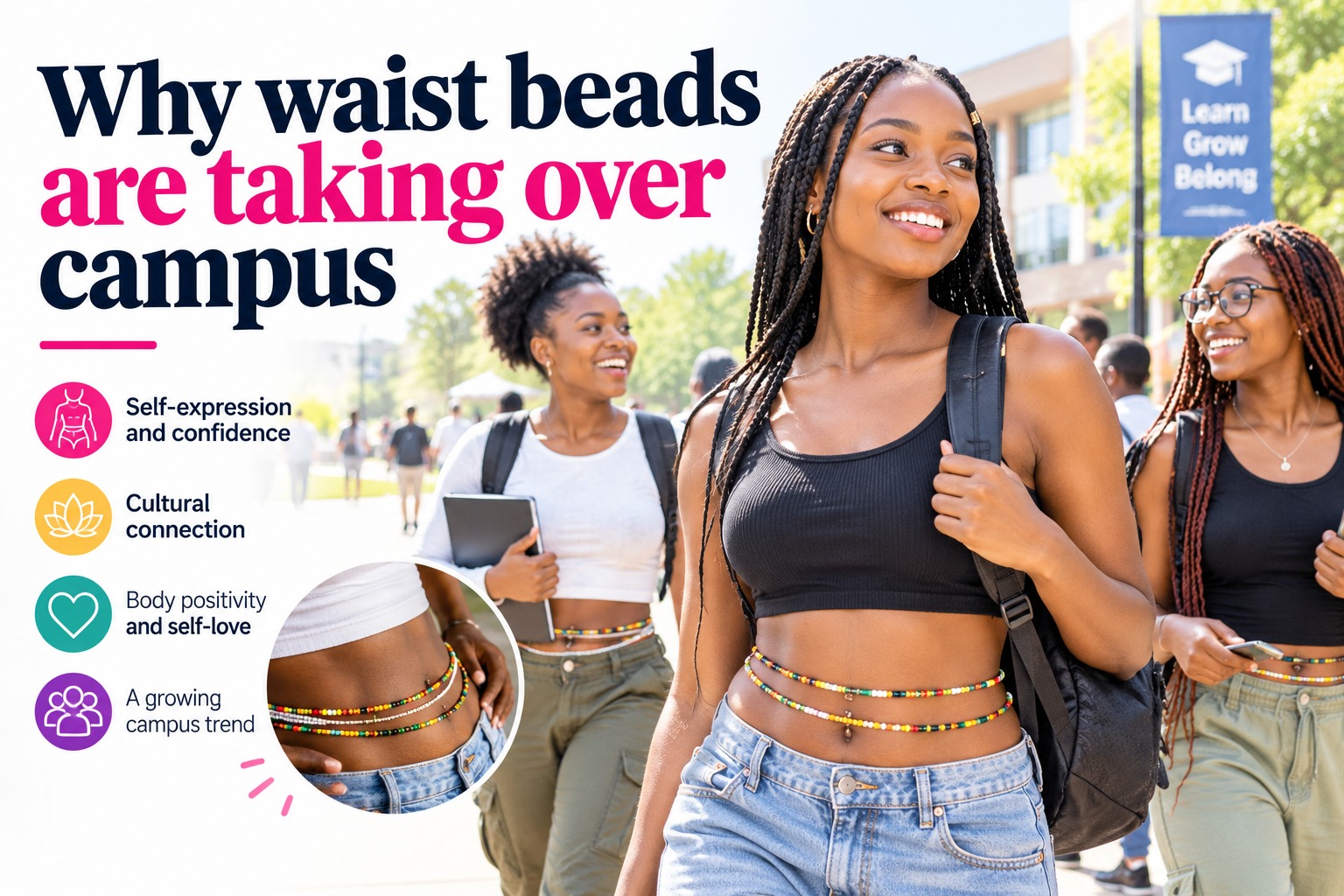
Walk through any university corridor and you might not see them at first — that is precisely the point. You catch a flash of gold or blue when a crop top rides up. You hear a faint, delicate sound on the staircase. You notice a girl in the washroom adjusting her skirt, and there they are, sitting perfectly on her waist as though they have always belonged there.
Waist beads are everywhere on campus right now, and the reasons go considerably deeper than aesthetics.
They were here long before Instagram made them a trend. In Ghana they are called jigida. Along the Swahili Coast, mshipi. Among the Kikuyu, Maasai and Kamba, women wore them for centuries — not as decoration for anyone else’s benefit, but as markers of womanhood, fertility, growth and self-knowledge. Faith, a student from Mombasa, recalls what her grandmother told her: “She wore them to know when she was getting full. Not for a man. For herself. When the beads start feeling tight, you know you need to check your eating.”
Colonialism and missionary Christianity reframed all of that as pagan and immoral. Mothers hid their beads and told their daughters to forget them. An entire generation grew up believing their own cultural inheritance was something to be ashamed of. What is happening on campuses today is, in part, a quiet act of reclamation — young women reaching back for what was discarded and deciding it still belongs to them.
The personal stories behind the beads are striking in their honesty. Achieng, a third-year student, got her first set after a painful breakup in second year. “I was so insecure. I had lost so much weight. I didn’t want beads for anyone to see — I wanted something that only I would know was there. When I wear them, I remember I have a waist, I have hips. I am still a woman even when someone leaves.” That kind of quiet, private affirmation is something earrings and Instagram-ready nails cannot provide. Waist beads are felt before they are seen. In a campus culture where almost everything is performed for an audience, that privacy is genuinely rare.
Stacy, who sells strands in Ndagani for KSh150 each, says the vast majority of her customers are second- and third-year students. They come with friends, she says, and they are very specific about what they want: small, gold, a charm or two. Many tell her they do not want their boyfriends to notice. They want to feel.
There is also something quietly radical about how the beads interact with body image. Campus culture has been reliably unkind to young women’s relationship with their own bodies — flat-tummy teas, three-day gym challenges, the reflex of sucking in when passing a group of boys. Waist beads do the opposite. They do not conceal the stomach. They decorate it. Joan, who once avoided looking at her stretch marks, now oils her stomach so her beads catch the light more. “Instead of hiding my tummy,” she says, “I oil it so the beads shine more.” The beads, which do not stretch when the body does, have also replaced the weighing scale for many women — a gentler, non-judgmental way to track changes without the violence of a number flashing up to define the day.
For plus-size students, the significance runs deeper still. For years, campus beauty culture drew a narrow template around small waists and flat stomachs. Waist beads expand that template simply by existing on every body that chooses to wear them.
The intimacy dimension exists too, and there is no reason to pretend otherwise. Many women buy beads before weekends with their partners. But the more telling detail is what Brenda said with a laugh: “I wear them even when I am not in a relationship. If I only wore them for intimacy, they would be in my drawer collecting dust.” Some strands carry charms for protection, womb healing or positive energy. Whether or not one believes in that, the point stands: these women have assigned the beads a meaning that has nothing to do with male approval.
Their popularity also comes down to practical realities. At KSh150 to KSh300 a strand, they are accessible to students who cannot afford a tattoo or piercing. They are painless and removable. And they fit neatly into the broader cultural moment — the rise of the African aesthetic, the soft girl era, the growing exhaustion with imported beauty standards that were never designed to look like us.
There is one more thing. Campus is an anxious place. The questions are relentless: Will I graduate? Will I find work? Is this relationship going anywhere? Therapy is expensive and overbooked. Small, grounding rituals fill the gap. Tying beads in the morning, choosing a colour, oiling them — two minutes that say: I am still here, in my body, and that matters.
Sarah put it simply. “I noticed I started walking differently. Not sexier — just more aware. I felt my hips when I walked up the hill to class. I felt present.”
That, more than anything, is why waist beads are taking over campus. Not because of a trend. Not because of men. But because somewhere between the assignments and the anxiety and the constant performance of being young and surviving, a small string of beads sitting quietly on the waist says something no algorithm can say: you are still in there, and you are worth adorning.
If you hear that soft sound near the library, now you know what it is.
It is not just beads. It is someone remembering herself.
Similar Posts by The Mt Kenya Times:
- Nyoro suspended over pipeline IPO claims
- Kirigiti gets its first primary school as construction begins
- National Assembly approves Fatuma Ali for parliamentary commission
- The five types of teachers found in WhatsApp professional groups
- Ebola comes to Kenya: Preparedness faces its first test
About the Author