BY Oduor Rosequillet Nabwire
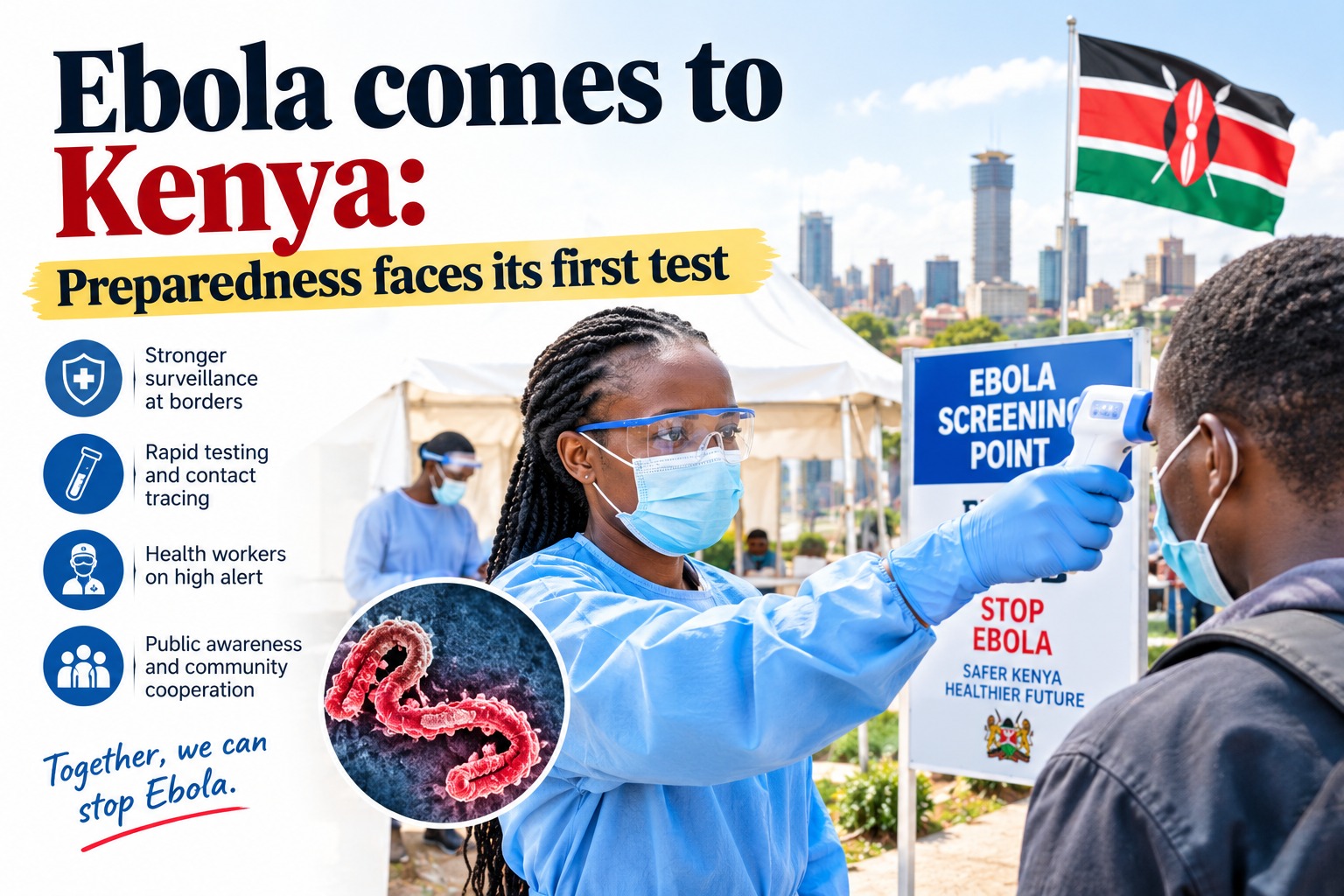
For months, Kenya had prepared for a disease it hoped would remain beyond its borders. Then, on October 3, Kenya recorded its first imported case.
A Kenyan citizen who had lived in the DRC for seven years travelled by road from the DRC to Kampala before boarding a flight to Nairobi. He arrived at Jomo Kenyatta International Airport, underwent routine screening by Port Health and immigration officials, and was taken directly to Nairobi Hospital by a relative and a friend.
He had been ill for about a month and had sought treatment at several hospitals in the DRC.
At Nairobi Hospital, his travel history and symptoms raised suspicion of viral haemorrhagic fever. He was isolated in a separate room in the Accident and Emergency department before being transferred to the East Wing Isolation Facility. Tests returned positive for Bundibugyo virus at both the National Virology Reference Laboratory and a Kenya Medical Research Institute laboratory.
Despite receiving supportive treatment, he died on the night of October 5.
The patient was buried on October 6 under safe and dignified burial protocols. But his arrival left Kenya facing a question that went beyond one patient: How did he travel across borders and pass through airport screening before being identified?
For Nairobi resident Kenneth Omondi, the case exposes the challenge of detecting infected travellers who may not show obvious symptoms at the point of entry.
“We’re constantly assured that airport screening is rock-solid, but how does someone just walk right through?” he asks.
Health Director General Dr Patrick Amoth said the patient’s symptoms may have been less apparent when he arrived. Medication he had taken could have reduced some symptoms, including fever, making the infection harder to detect during routine screening.
His death shifted the focus from diagnosis to containment: identifying everyone who may have been exposed.
Health Cabinet Secretary Aden Duale said authorities had initially identified 28 contacts, including family members and healthcare workers. They were also seeking 23 passengers and four crew members who had been on the same flight.
By October 7, the number of contacts had risen to 57, with 10 people in quarantine. Duale said the contacts would be monitored for 21 days.
Professor Omu Anzala, a virologist and member of the National Task Force for Ebola, said the growing number of contacts showed why rapid action was essential.
“Quarantine and contact tracing are the entire essence of controlling an outbreak. This is where our emphasis should be,” he said.
At Nairobi Hospital, where the patient was treated, Chief Executive Officer Dr Felix Osano said infection prevention and control measures were in place throughout his care.
Osano said the hospital remained fully operational, with the isolation facility physically separated from the main hospital. The case also raises a broader concern: whether healthcare workers are adequately protected when a suspected high-risk infection enters a hospital before its nature is known.
The Kenya Medical Practitioners, Pharmacists and Dentists Union has called for medical monitoring, psychological support and follow up for healthcare workers who may have come into contact with the patient, as well as adequate specialised personal protective equipment, infection prevention measures and trained personnel capable of handling suspected Ebola cases safely.
“Our healthcare workers must not be the weakest link in our response. They must be our first line of protection,” KMPDU Secretary General Dr Davji Atellah said.
Kenya had been strengthening its preparedness as Ebola outbreaks in the DRC and Uganda heightened the risk of cross border transmission.
The progress was reflected in Kenya’s WHO preparedness score, which rose from 66 per cent in May to 82 per cent in July, following gains in surveillance, isolation and treatment capacity and the strengthening of response teams.
By June 3, more than 71,000 travellers had been screened at 26 official points of entry, while 22 Ebola alerts had been investigated and all tested negative. Laboratories had been prepared, isolation facilities assessed and rapid response teams placed on standby.
Health Cabinet Secretary Aden Duale said 4,971 healthcare providers at national and county levels had been trained in Ebola prevention and case management. The country had established 15 isolation and treatment units, with the number expected to rise to 22, while 23 specialised isolation and treatment facilities had been identified across 29 counties.
Four major isolation centres are at Kenyatta National Hospital, National Police Hospital, Moi Teaching and Referral Hospital and Garissa County Referral Hospital, with a combined capacity of 137 beds for suspected and confirmed Ebola cases.
International partners have also supported Kenya’s preparedness, including the United States Government, World Health Organization, World Bank, Africa Centres for Disease Control and Prevention and the Intergovernmental Authority on Development. The United States provided US$14.52 million for Ebola preparedness, allocated to surveillance and response, clinical preparedness, emergency operations, supply chains and logistics.
The gains point to stronger capacity, but the real challenge is whether those systems can work beyond national plans and designated facilities.
This is particularly important at the Busia border, where more than 3,000 people cross each day. Joseph Oprong, Busia County Director of Health and Public Sanitation, said preparations at Alupe included assessing isolation and quarantine facilities.
“We have already trained our health officers, and the assessment of our isolation center at Alupe is ongoing. We are also assessing quarantine facilities so that any identified case can be managed effectively,” Oprong said.
But the first person to notice a sick traveller may not be a health worker. At the Busia border, traders, truck drivers, youth representatives and other stakeholders have taken part in Ebola exercises designed to help them identify warning signs and know where to report suspected cases.
David Omondi Olong’o, a clearing agent at the Busia One Stop Border Post, said the training filled a practical gap.
“We are in this market every day. If someone is sick, we see it before anybody at the office does. What we needed was to know who to call,” he said.
That community role is crucial because early action enables health authorities to trace contacts and respond quickly.
Vigilance across the country also depends on public cooperation. Kenyans are urged to report suspected Ebola cases or symptoms through the toll-free health line 719 and follow Ministry of Health advisories. Staying alert and seeking medical attention promptly will strengthen early detection and help authorities act before suspected infections become wider threats.
Containment does not end when a patient dies.
In Uasin Gishu County, the Kenya Red Cross Society and county health teams have conducted simulations on the safe and dignified handling of remains from people who may have died from highly infectious diseases.
Oscar Okumu, Kenya Red Cross Society North Rift Region Coordinator, said the exercises allow responders to practise procedures before a real emergency. They covered the handling, packaging and transportation of remains while safeguarding responders and preserving dignity for the deceased and their families.
That preparation is also part of a wider regional effort to prevent an imported case from becoming sustained transmission. For Dr Mohamed Janabi, WHO Regional Director for Africa, the measures already in place give Kenya an advantage.
“Health emergency preparedness gives us a head start,” he said, stressing that rapid and coordinated action can prevent further spread.
Kenya has many of the systems needed to contain an imported case. The real test is whether those systems can respond quickly and effectively when another suspected case appears.
Similar Posts by The Mt Kenya Times:
- National Assembly approves Fatuma Ali for parliamentary commission
- The five types of teachers found in WhatsApp professional groups
- Why waist beads are taking over campus
- Ruto’s Mt Kenya gamble: Can he win it twice?
- Samsung opens 24th experience store and first service centre in Kisii as regional market grows
About the Author