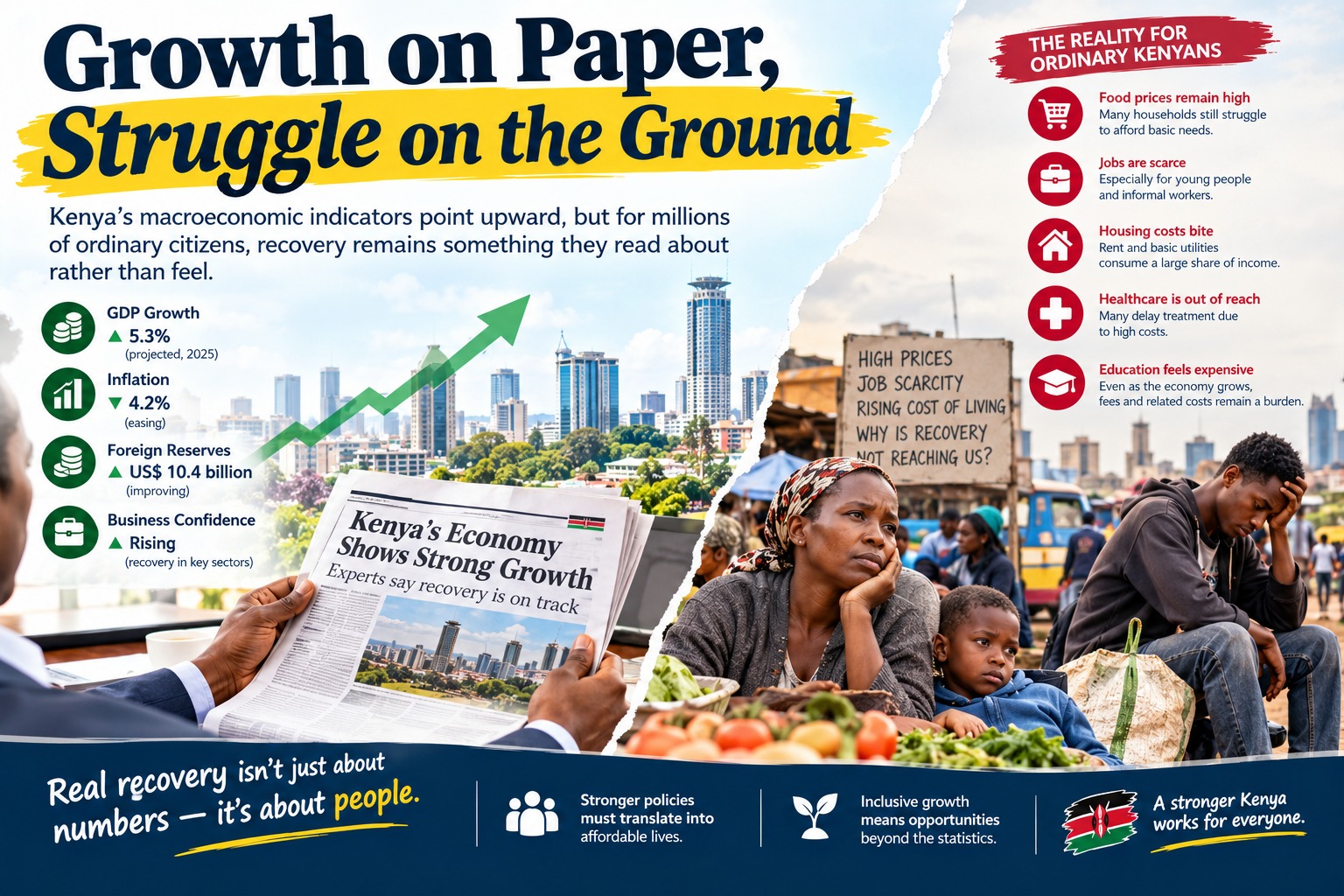
Kenya’s macroeconomic indicators point upward, but for millions of ordinary citizens, recovery remains something they read about rather than feel
By Collins Kibet
Kenya’s economy appears to be moving in the right direction — on paper. Government statistics point to growth, rising investment, and improving macroeconomic indicators. Yet behind those figures sits a markedly different reality: families struggling to afford food, young people searching endlessly for work, small businesses battling shrinking purchasing power, and households cutting back on basic necessities simply to get through the month. The growing distance between economic statistics and lived experience raises a question that policymakers cannot indefinitely avoid: if the economy is growing, why are so many Kenyans still struggling?
Economic growth is conventionally measured through gross domestic product, investment flows, government revenues, exports, and overall production. These indicators matter — they help policymakers understand the direction of travel. But growth alone does not guarantee that ordinary citizens are becoming more financially secure. An economy can expand while wealth remains concentrated in a narrow segment of society. The real test of economic progress should therefore not be how quickly the economy grows, but whether that growth creates decent jobs, strengthens household incomes, reduces the cost of essential goods, and gives ordinary people a credible opportunity to build better lives.
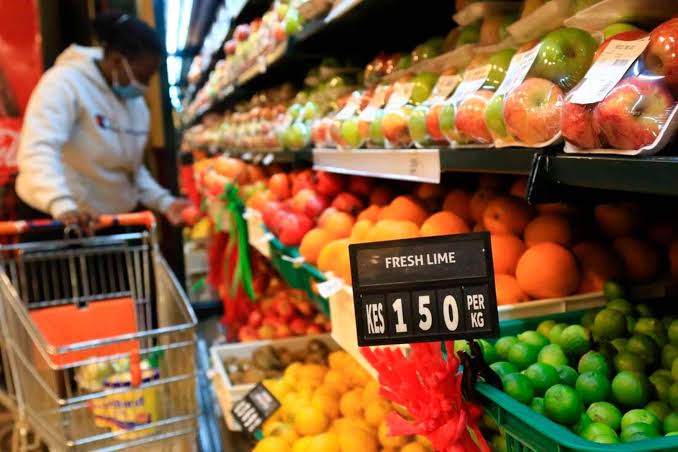
For most Kenyan households, the cost of living remains the most immediate and visible sign of economic pressure. Food, transport, housing, electricity, education, and healthcare consume a significant and growing share of household income. Even when headline inflation appears manageable from a macroeconomic vantage point, individual families experience price increases very differently. A parent whose salary stays flat while food and transport costs rise does not experience stability — they experience a quiet, grinding decline in purchasing power. The consequences are difficult choices made daily: fewer meals, postponed medical treatment, cheaper housing, opportunities withdrawn from children, and money borrowed to cover expenses that wages no longer reach.
The situation is particularly acute for Kenya’s young population. Every year, thousands complete secondary school, college, and university and enter a labour market that cannot absorb them all into stable employment. A university degree, once a dependable pathway to economic security, no longer carries that guarantee. Many graduates spend years in a cycle of applications, interviews, and additional qualifications without finding meaningful work. Others turn to casual labour, informal trading, or online gigs simply to survive. The problem is not a lack of willingness to work. In most cases, it is a structural insufficiency of opportunity relative to the number of people seeking it.
Small and medium-sized enterprises — which form the backbone of Kenya’s everyday economic activity — are equally under pressure. Traders, shopkeepers, transport operators, farmers, and service providers depend heavily on consumers having disposable income. When households are stretched, businesses feel it immediately. Customers buy less, delay purchases, or shift to cheaper alternatives. Simultaneously, entrepreneurs must contend with operating costs, taxation, expensive credit, rent, and competition. A business can remain technically open while its owner earns barely enough to cover expenses and nothing more.
Agriculture presents its own contradiction. Kenya remains deeply dependent on farming for employment, food security, and rural livelihoods, yet farmers continue to face high input costs, unpredictable weather, unreliable markets, and inadequate farm-gate returns. A farmer may produce food that becomes expensive for consumers while receiving a price that barely justifies the effort of growing it. Between farm and table lie multiple layers of transport, storage, processing, and distribution that absorb value without always adding it. Until these structural inefficiencies are addressed, Kenya risks the absurdity of struggling farmers and unaffordable food existing simultaneously.
The government deserves recognition for pursuing infrastructure development, attracting investment, and implementing measures intended to strengthen the economic base. Roads, energy projects, and digital infrastructure create real long-term opportunity. But development must ultimately translate into improved living standards that citizens can actually perceive. Kenyans should be able to draw a clear line between national economic policy and their own daily circumstances. Programmes that produce impressive headline figures while failing to generate jobs, strengthen household incomes, or reduce economic insecurity will eventually face a credibility problem that no amount of statistics can resolve.
 There is also a deeper need to reconsider how Kenya defines and measures economic success. GDP growth matters, but it should not be treated as the sole measure of prosperity. Greater attention is needed to the quality of jobs created, household purchasing power, youth employment rates, access to affordable credit, small business productivity, food security, and the capacity of ordinary families to save rather than merely survive. Growth should be broad-based — felt across sectors and income levels — rather than concentrated in areas that generate impressive aggregates without meaningfully changing most people’s lives.
Kenya also needs to build stronger support for local production. The country imports many goods that could be produced domestically, and exports significant volumes of raw materials that could generate considerably more value if processed locally. Expanding manufacturing, agro-processing, and value addition would create employment while reducing dependence on imported goods and the vulnerability that comes with it. Kenyan entrepreneurs need easier access to affordable financing, a predictable tax environment, and markets where they can compete on fair terms.
Kenya stands at an economic crossroads. One path fixates on impressive growth figures and macroeconomic achievements. The other asks a harder question: what does economic growth actually mean to the ordinary Kenyan? That answer should be taken from the kitchen table, the classroom, the market stall, the farm, and the workplace — not from a spreadsheet. If families cannot comfortably afford basic necessities, if graduates cannot find decent employment, and if small businesses cannot survive, then the country must be honest with itself: growth has not yet reached everyone.
Kenya does not simply need an economy that grows. It needs an economy that works for its people — one where growth translates into jobs, affordable living, productive agriculture, resilient businesses, and genuine opportunity for the young. The challenge for policymakers is not merely to increase the size of the economy, but to ensure that prosperity is shared widely enough to be felt. Until that happens, Kenya’s economic growth will continue to look impressive on paper while millions of its citizens experience a very different reality on the ground.
Similar Posts by The Mt Kenya Times:
- Mt Kenya Times ePAPER October 9, 2026
- Ruto claims farming revolution as election season dawns
- China grants Kenya $2M for drought and Ebola response
- High Court upholds KSh2.5M IEBC fine against Gikaria
- Kenya’s opposition fractures with 11 months to the ballot
About the Author