Kenya’s fuel price crisis: How long can ordinary families survive the rising cost of living?
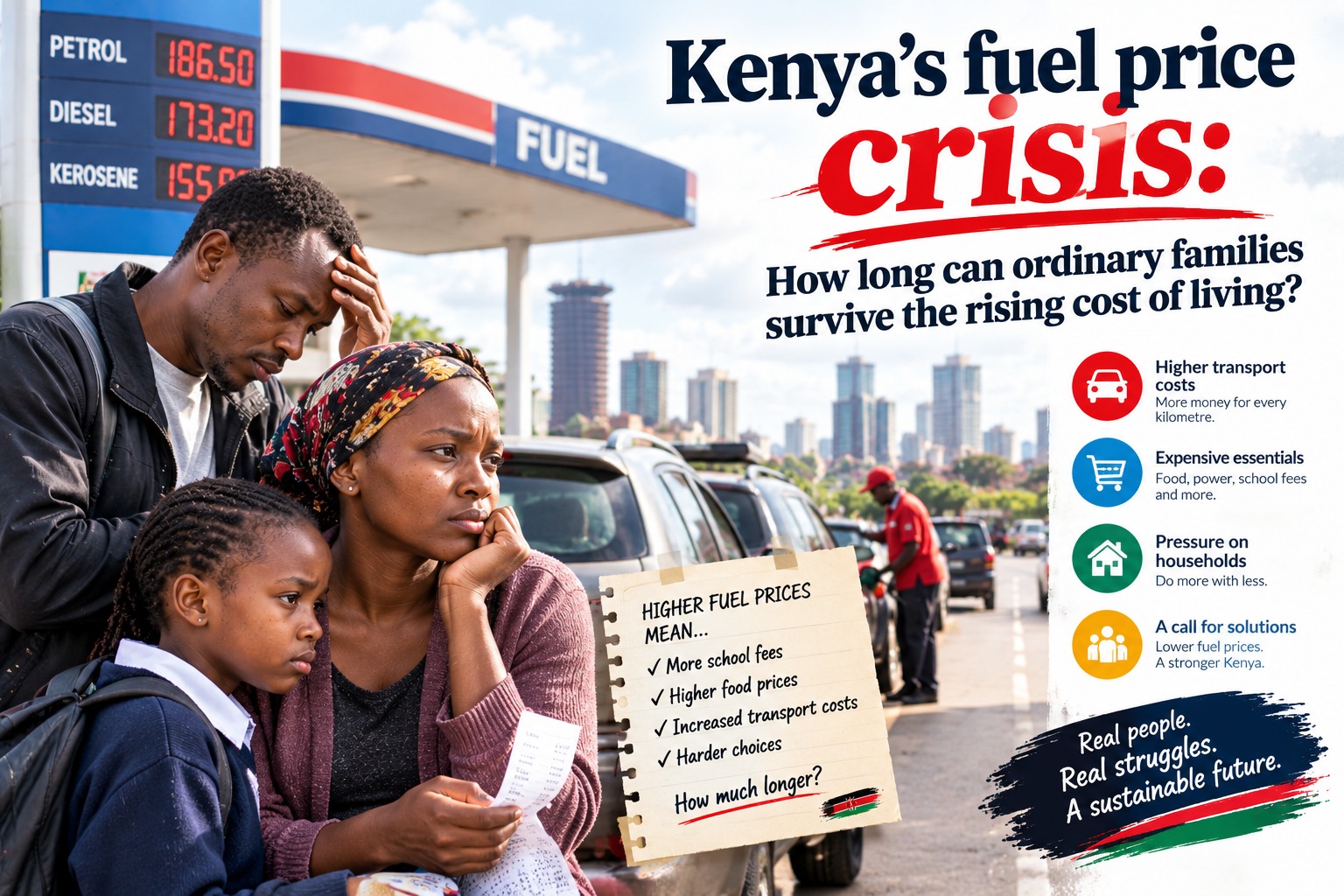
Every time international markets shudder, it is the Kenyan household with the thinnest margins that absorbs the hardest blow
By Collins Kibet
Kenya is confronting another painful economic reality. Effective 15 October 2026, the Energy and Petroleum Regulatory Authority raised the maximum retail prices of petrol, diesel and kerosene for the period ending 14 November. In Nairobi, a litre of super petrol now costs KSh 226.96, diesel KSh 227.76 and kerosene KSh 219.87 — increases of KSh 12.93, KSh 9.90 and KSh 28.49 respectively. These figures arrive at a moment when millions of households are already stretched across food, rent, transport, school fees and electricity bills. They are not abstract statistics on a regulatory schedule. They are another test of how much ordinary Kenyans can absorb before something gives.
The immediate explanation lies partly beyond Kenya’s borders. EPRA attributes the increases to higher import costs, with the landed price of petrol rising 11.81 per cent between August and September 2026, diesel by 11.32 per cent and kerosene by 9.41 per cent. Ongoing conflict in the Middle East has added pressure to international petroleum markets and disrupted supply chains. Because Kenya imports all its refined petroleum requirements, it remains acutely exposed to external price shocks. That context is real and relevant. But acknowledging global pressures cannot be allowed to end the domestic conversation. The more important question is whether Kenya has developed sufficient economic safeguards to prevent international crises from repeatedly becoming household emergencies for families with no financial cushion to speak of.
Fuel is not merely a commodity purchased by motorists. It is a foundational input into almost every productive activity in the economy. When diesel rises, transport operators face higher operating costs, manufacturers pay more to move goods, farmers spend more on machinery and distribution, and traders confront rising expenses throughout their supply chains. Businesses rarely absorb every additional cost indefinitely. Many transfer the burden to consumers through higher prices. A family that owns no vehicle still suffers when the cost of delivering vegetables, maize flour, cooking oil and other necessities increases. The fuel crisis therefore extends far beyond the petrol station, reaching markets, farms, workplaces and kitchen tables across the country.
For low-income families, the consequences are particularly severe. Essential expenditure already consumes most of what they earn. A salaried worker may now spend more on daily transport to the office. A casual labourer could find that higher commuting costs eat directly into money set aside for food. Parents may be forced to cut household purchases, delay medical appointments or reconsider school-related expenses. In rural communities, where transport connects families to markets, hospitals and schools, rising fuel costs make basic services simultaneously more expensive and less accessible. When income stays flat but the cost of survival rises, families are quietly pushed into a lower standard of living without any formal reduction in their wages — and without any formal acknowledgement that this has happened to them.
Kerosene demands particular attention because its increase dwarfs those of petrol and diesel. A jump of KSh 28.49 per litre places immediate pressure on households that depend on it for cooking or lighting — households that typically cannot afford reliable electricity or cleaner cooking alternatives. For these families, this is not a matter of adjusting discretionary spending. It concerns the affordability of daily necessities. A responsible energy policy must recognise that fuel price increases do not land equally. Those with higher incomes may absorb the additional cost with some discomfort. Poorer households often have no alternatives and no savings to buffer them against sudden economic shocks.
The government and energy regulators face a genuinely difficult balancing act. Kenya must maintain reliable fuel supplies, meet legitimate importation costs and give suppliers a workable regulatory framework within which to operate. EPRA’s maximum-price mechanism provides a measure of consumer protection by capping what petrol stations may charge. But price regulation alone cannot eliminate the underlying cost of imported petroleum. What the government must do, and has consistently failed to do with sufficient clarity, is explain in plain terms what relief measures exist, how they are financed and whether they reach the people who need them most. Fiscal support must be transparent, targeted and sustainable — not presented as a structural solution to a problem that keeps returning.
Taxation must remain part of the conversation. The October pricing schedule incorporates an eight per cent value-added tax on petroleum products. Taxation funds public services and infrastructure, and that function matters. But policymakers must continuously assess how the combined burden of taxes, levies and import costs affects households and businesses operating at the margins. Any proposal to reduce fuel taxes must be weighed honestly against its effect on public finances. Any decision to retain them must be accompanied by a credible account of how the revenue serves the public interest. Kenyans deserve a tax framework that raises necessary revenue without systematically undermining employment, enterprise and household welfare at the same time.
More fundamentally, Kenya must stop repeatedly reacting to fuel price increases and begin building genuine long-term energy resilience. Investment in dependable public transport, efficient rail freight, renewable electricity, affordable clean cooking alternatives and energy-efficient industries can progressively reduce dependence on petroleum. Agricultural production and food distribution systems must also become more efficient, so that higher transport costs do not translate mechanically into disproportionate price increases for consumers. These structural changes require sustained planning, credible financing and effective implementation. They cannot reverse the latest increase overnight. But they can substantially reduce the vulnerability of households and businesses to the next international disruption — and the one after that.
The government must also take the cost-of-living conversation seriously as a question of economic opportunity, not merely energy management. Stable fuel prices alone will not resolve Kenya’s underlying difficulties if wages remain inadequate, youth unemployment persists and small businesses cannot access affordable credit. Economic progress should be measured not only through national growth figures or infrastructure announcements, but through the ability of ordinary citizens to afford food, secure housing, educate their children and set something aside for emergencies. A government cannot credibly celebrate economic transformation while a growing number of its people are quietly choosing between one essential need and another.
How long can Kenyan families keep absorbing higher costs without corresponding improvements in income? How many small businesses can sustain operations as transport and distribution expenses climb? How long should citizens wait for an economic environment where diligence carries a reasonable prospect of financial security?
These questions demand more than political assurances. They require practical answers, measurable commitments and accountability that extends beyond press statements. The real test of Kenya’s economic leadership is not whether it can explain why fuel has become expensive. It is whether it can protect its people, build a more resilient economy and ensure that the burden of every international shock does not fall, as it persistently does, on those least equipped to carry it.
Similar Posts by The Mt Kenya Times:
- Oburu marks birthday and brother’s death from Nairobi Hospital bed
- Natembeya and Orengo demand answers over security withdrawal
- Linda Mwananchi Movement: The brand that could reshape Ruto’s path to 2027
- ODM and Linda Mwananchi clash at Raila’s Bondo memorial
- Kenya’s opposition fractures at Raila’s memorial
About the Author