How Kenya’s state-owned giants feast on preferential privilege while competition starves
 The Mt Kenya Times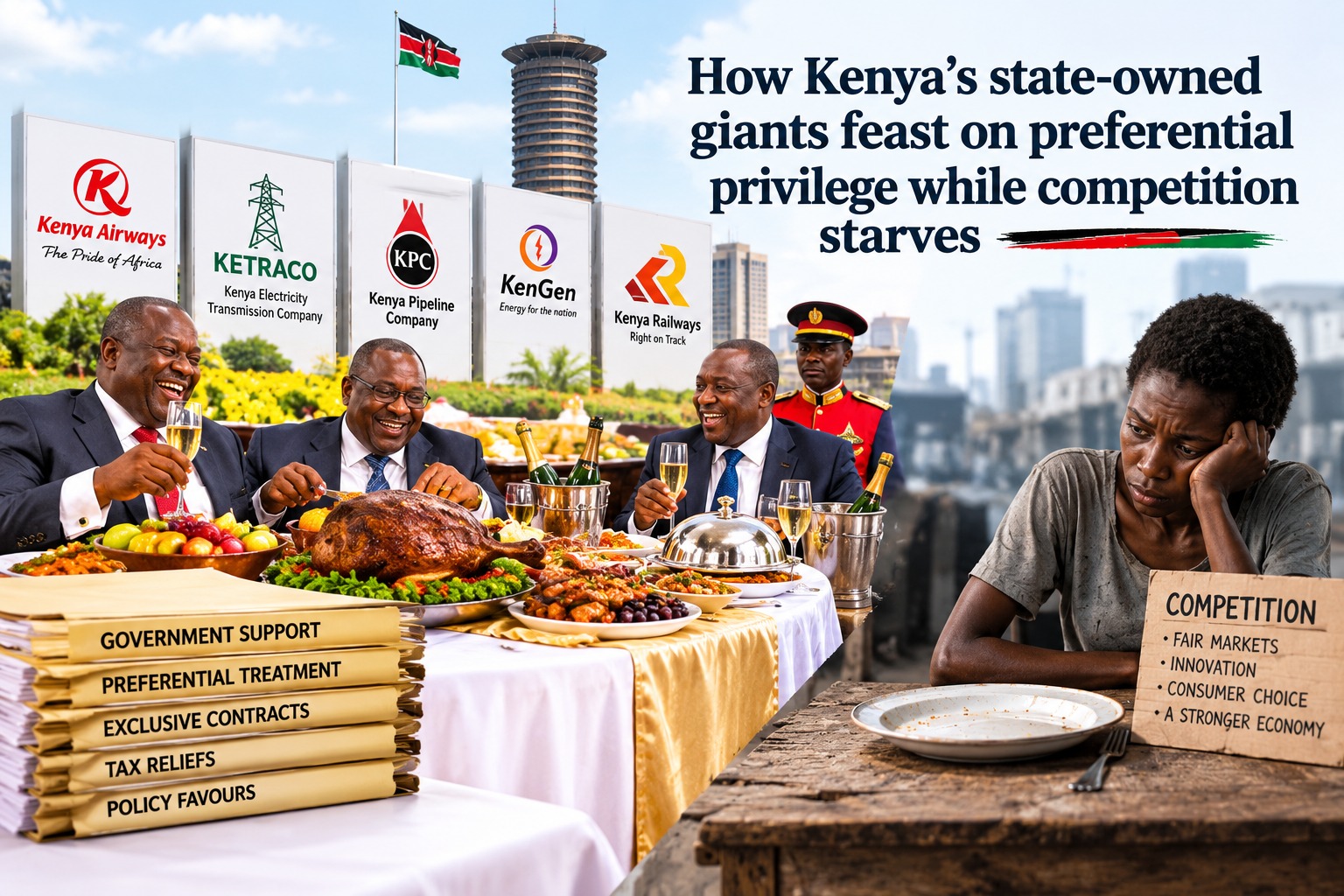
By: Jerameel Kevins Owuor Odhiambo
In the financial year ending June 2024, the Kenyan taxpayer poured the equivalent of six to seven percent of the nation’s entire GDP some 1.199 trillion shillings into underperforming state-owned enterprises. That is not investment. That is transfusion. And the patient remains anaemic. Over two hundred of these entities, one of the largest such portfolios among emerging economies, continue to operate across energy, agriculture, transport and beyond, insulated by debt write-offs, soft financing, procurement preferences and regulatory forbearance that private firms can only dream of. Kenya ranks third-worst globally for market distortions induced by public ownership trailing only Mexico and Türkiye. The average labour productivity of these SOEs sits 72 percent lower than that of comparable firms with minority state stakes. The diagnosis is clinical: preferential treatment has become the disease that masquerades as public purpose.
This is no abstract market failure. It is a living architecture of advantage. Consider the sugar sector, that long-suffering theatre of national aspiration and fiscal haemorrhage. State-owned mills command roughly 15 percent of the market yet remain chronic loss-makers. In 2023 the government wrote off 117 billion shillings in their debts on top of a 62-billion-shilling erasure in 2020. Grants followed: 150 million to Mumias farmers, 166 million non-reimbursable to Muhoroni. Private millers, operating without such oxygen, must compete against entities that can run losses indefinitely, pay suppliers more, and still survive. The result is not merely inefficiency; it is the systematic crowding-out of more productive capital. Doubling SOE market share correlates, across economies, with 5–30 percent less firm entry and 30 percent higher concentration. Kenya’s sugar fields are merely the most visible scar.
History supplies the deeper pathology. Post-independence Kenya inherited and expanded a developmentalist faith in the state as entrepreneur. The 1960s and 1970s saw nationalization and the creation of parastatals as instruments of Africanization and industrialization. Under Moi the portfolio metastasized into patronage networks; under subsequent administrations the rhetoric of reform never quite matched the reality of soft budgets. The State Corporations Act and its successors provided the legal scaffolding, while procurement rules and sectoral regulators quietly tilted the table. What began as nation-building calcified into a protected caste of commercial entities that answer neither to the discipline of the market nor, fully, to the scrutiny of the citizen. The irony is bitter: the same republic that celebrates private enterprise in its Vision documents simultaneously subsidises its most inefficient competitors with public blood.
The distortions cascade. In energy, Kenya Power and KenGen benefit from policy protections that blunt genuine competitive pressure, contributing to elevated electricity costs that tax every factory and household. In aviation, Kenya Airways has become the archetypal serial recipient of rescue: the latest cabinet approval of roughly 45 billion shillings in new shareholder financing, layered atop the conversion of 122 billion in existing government loans, is merely the newest chapter in a decade-long saga of taxpayer underwriting. Commercial SOEs as a group recorded aggregate net losses even as private firms in the same spaces fight for survival without such cushions. The private competitor is forced to price for profit while the state entity prices for political convenience. Suppliers may temporarily rejoice at higher offers; customers may briefly enjoy lower tariffs; the long-term cost is a thinner private sector, fewer jobs of quality, and a fiscal hole that future generations must fill.
Private law is not powerless, yet it has been largely sidelined. Competition law applies, in principle, to state-owned entities. The Competition Authority of Kenya possesses the statutory tools to investigate abuse of dominance, restrictive practices and the competitive effects of state support. In practice, enforcement against the state’s own commercial arms remains tentative. Preferential treatment whether through below-market financing, debt forgiveness, or regulatory exemptions rarely faces rigorous private challenge. Contractors and competitors who suffer exclusion or margin squeeze confront the practical asymmetry of litigating against an opponent that can draw on the consolidated fund. The result is a chilling of private initiative: why invest in efficient capacity when the state can always outbid you with other people’s money?
The intellectual failure is as grave as the fiscal one. Competitive neutrality is not an ideological luxury; it is the precondition for productivity growth. When SOEs can survive without matching private efficiency, the entire economy’s resource allocation is warped. Capital that could fund new factories, logistics networks or digital services is instead recycled into the soft-budget continuum of the parastatal. The correlation is not mysterious: jurisdictions that impose hard budget constraints and genuine competitive neutrality on their state entities tend to record higher private investment rates and faster formal-sector job creation. Kenya’s continued tolerance of the opposite pattern is a choice, not a fate.
The remedy requires categorical action from multiple actors. Parliament must legislate a hard competitive neutrality principle into the heart of the SOE framework requiring transparent costing of public service obligations, full commercial pricing of residual activities, and the phase-out of soft financing. The National Treasury must cease the annual transfusion and publish, in real time, the full fiscal cost of every bailout, write-off and guarantee. The Competition Authority must treat state preferential treatment as a core enforcement priority, opening market studies into sugar, energy and transport with the same vigour applied to private cartels, and recommending structural remedies where necessary. Sector regulators must dismantle the residual protections that allow SOEs to act as both player and referee. The judiciary, when private litigants finally bring challenges under competition or administrative law, must refuse to grant the state commercial arm any presumptive deference. Private associations and chambers of commerce must abandon polite lobbying and litigate strategically, documenting the concrete harm of distorted competition. Citizens must demand that every shilling diverted to keep inefficient giants afloat be weighed against classrooms not built, roads not maintained, and hospitals under-equipped.
There is no romanticism in this diagnosis. State ownership can serve legitimate public purposes where genuine market failures exist. But the current portfolio is not a carefully calibrated instrument of public good; it is a sprawling empire of privilege that distorts prices, crowds out private capital, and transfers risk from poorly governed entities onto the shoulders of ordinary Kenyans. The preferential treatment is not neutral policy. It is a quiet transfer of wealth from the productive and the patient to the protected and the persistent. Until the iron curtain of privilege is lifted, Kenya’s markets will remain half-free, its private sector half-starved, and its developmental ambitions half-realised. The data are no longer ambiguous. The history is no longer obscure. The only remaining question is whether those charged with stewardship will continue to feed the sacred inefficiencies or finally starve them of the preferential oxygen that keeps them breathing at the expense of the republic.
The writer is a social commentator
Similar Posts by The Mt Kenya Times:
- Faith on campus: Why students drift, and what keeps them rooted
- We lowered the flag, but never cut the chain
- Kenya’s fuel crisis: Ordinary citizens bear the cost
- Martínez apologises after United boardroom row
- Women farmers at risk of being left behind as global food crisis deepens, report warns
About the Author