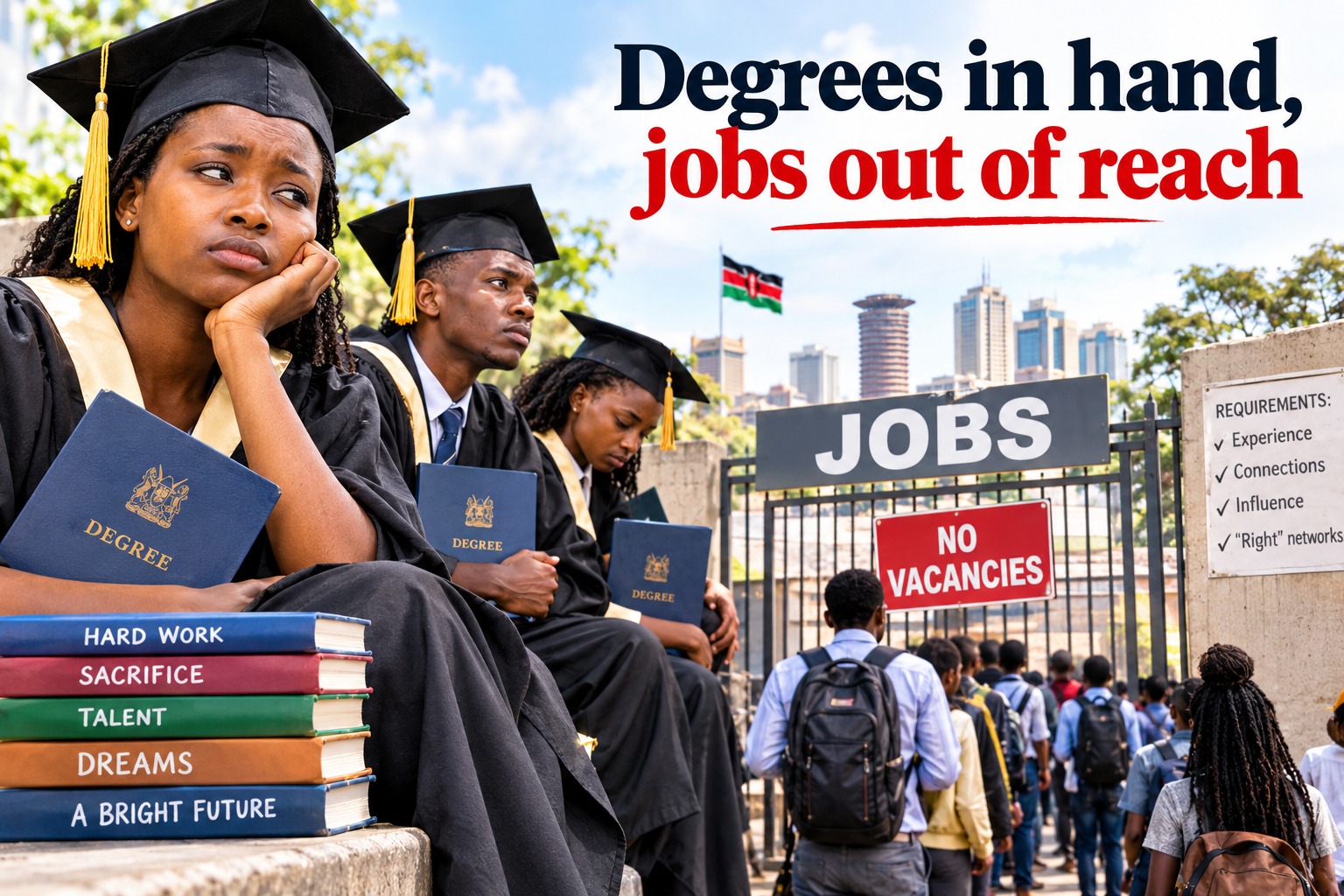
For many Kenyan graduates, years of study and family sacrifice culminate in a degree, but securing employment remains a challenge.
By Oduor Rosequillet Nabwire
A degree is supposed to open doors, yet for Brian Omondi, years after graduating, the career he hoped to build remains out of reach.
At 6:30 a.m. in Roysambu, Nairobi, he prepares for his first job interview in seven months. His laptop is ready, and his internet connection is stable.
“You prepare like your entire life depends on those 20 minutes on Zoom,” he says. “Because in many ways, it does.”
Brian graduated in November 2023 with a Bachelor of Commerce in Finance, attaining Second Class Honours, Upper Division. Nearly three years later, he is still searching for his first formal job. He estimates that he has submitted more than 400 applications through recruitment platforms, corporate email and in person at workplaces across Nairobi’s Industrial Area.
“Out of hundreds of applications, I have received only four automated rejection letters,” he says. “The rest just disappeared into dead silence.”
For Wanjiku ‘Shiku’ Njuguna, a 24-year-old graduate with a Bachelor of Arts in Communication, the struggle has taken a different form. Although she has found work, her job as a temporary supermarket cashier in Westlands is unrelated to her communications background. She also takes on unpaid digital management assignments to maintain her portfolio.
“I spend my days scanning groceries and my nights writing social media strategies for small startups for free,” she says. “The search costs you everything: cybercafé prints, bus fare for interviews that lead nowhere, internet bundles, and your peace of mind.”
Behind graduates like Brian and Shiku are families whose sacrifices were driven by the hope that a university education would lead to employment and, eventually, the ability to support the household. When those expectations go unmet, the strain extends beyond the graduate to the parents who invested in their future.
Grace Wanjiku, also known as Mama Kevin, is a 52-year-old small-scale farmer from Nakuru who sold part of her family’s land to help pay for her son’s university education.
“When a child goes to university, the whole village expects them to uplift the family,” Grace says. “When they return home without a job after graduation, people start whispering. As a parent, you feel heartbroken because you took out SACCO loans, and now you see your educated child struggling emotionally.”
For Brian, the emotional toll of unemployment has gradually changed his relationship with his parents.
“In the beginning, my parents called every week asking if I’d heard back from companies,” he says. “Now, the calls are quiet. They ask if I’ve eaten, not where I am working. You feel like a financial burden after they sacrificed so much. Your self-esteem erodes, and life feels paused while everyone around you moves on.”
Those family expectations are colliding with a labour market where most new jobs are created outside the modern sector.
The Kenya National Bureau of Statistics’ Economic Survey 2025 reported that Kenya created 782,300 jobs in 2024, of which 703,700 were in the informal sector and 78,600 in the modern sector. While these figures cover job creation across the economy rather than graduate employment specifically, they provide context for the challenges facing graduates seeking formal employment that draws on their training.
Dr Jacob Omolo, a senior lecturer in applied economics at Kenyatta University whose research focuses on labour and employment dynamics, attributes the challenge to a mismatch between graduates’ skills and the jobs the economy creates.
“We are facing a fundamental economic mismatch,” says Dr Omolo. “The issue is not that our youth are lazy; it is an economy growing without creating sufficient wage-earning roles with high absorptive capacity. As a result, degree holders are pushed into casual labor or micro enterprises completely outside their areas of training.”
Even when vacancies arise, recruitment requirements can create another hurdle. Some positions advertised as entry level require prior work experience, potentially disadvantaging graduates who have had few opportunities to acquire it.
Perminus Wainaina, chief executive officer and lead human resources consultant at Corporate Staffing Services in Nairobi, says employers assess how well candidates can translate academic knowledge into practical performance.
“When we evaluate entry-level applicants, we often see strong theoretical knowledge but a gap in practical execution, such as proficiency in industry tools, data software, or professional soft skills,” Wainaina explains. “Employers demand some years of experience even for junior roles because tight budgets prevent them from spending six months training a fresh graduate from scratch. They want plug-and-play staff.”
Internships can help graduates develop practical skills, but gaining experience does not necessarily secure a permanent job.
Peter Nchogu, a communication and public relations graduate in Cohort 8 of the Public Service Internship Programme (PSIP), is approaching the end of his placement with that uncertainty in mind. Posted to a government ministry in Nairobi, he has gained experience in stakeholder management, institutional file tracking and daily media monitoring.
“I learned real stakeholder handling, institutional file tracking, and daily media monitoring. You quickly realize that in government communication, accuracy, speed, and discretion matter just as much as creativity,” Peter says.
With three months remaining before his placement ends, he is already considering what comes next.
“The biggest challenge is the lack of a clear absorption path. Once your 12 months end, you exit to make room for the next cohort, regardless of how dedicated you were. You leave with strong skills and networks, but you step right back into a hyper-competitive job market as soon as the stipend stops,” he says.
Peter’s experience points to the value of stronger university partnerships with employers and structured, paid internships that give graduates practical experience and a clearer route into the workforce.
For Brian, the wait continues beyond the interview room. His latest interview ends after 25 minutes. The panel thanks him and promises to communicate within two weeks.
He closes his laptop and returns to the notebook where he records his applications and interview outcomes.
“You cannot afford to give up,” Brian says. “My degree isn’t just a paper; it represents four years of hard work and my family’s sacrifices. I am qualified, I am capable, and I am ready. I just need one door to open.”
Similar Posts by The Mt Kenya Times:
- Ruto’s health ministry kills Murang’a’s digital hospitals
- Kenya bets on Mount Kenya to drive a billion-shilling tourism revival
- Do you have a wealth vision? Or are you just working until you die?
- PS Isaboke lauds digital literacy programme in Kisii as 332 schools benefit
- “‘रूह से रू-ब-रू’”: The World of Emotions in Bharti Raina’s Poems and Ghazals
About the Author