From a single link to the entire chain: The working principle and secret of a mechanical device
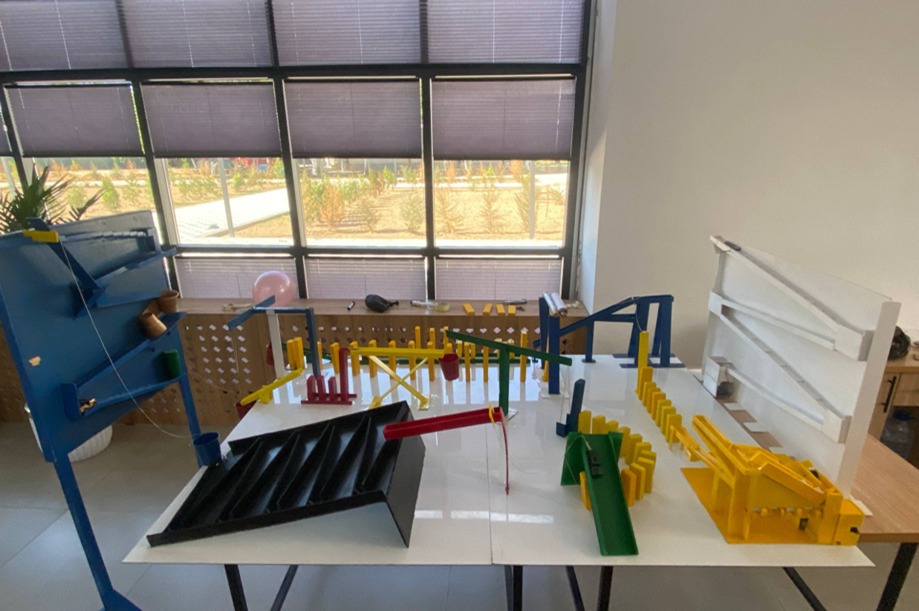
Operating principle of a mechanical chain device

By: Erkinov Jaloliddin
It is a device that demonstrates complex mechanical processes through a harmony of simple movements, where sometimes a single movement alone initiates the entire process. A single small ball in motion can trigger other mechanisms, topple a series of stacked columns, and set off the next action through strings and inclined planes. This requires an understanding of mechanical principles, the harmonious coordination of parts, and the creation of a solid structure, and through this sequence of processes, a principle with a complete scheme is created.
The mechanical chain device we created works on this very principle, meaning that a process initiated by the first movement continues through various mechanical transmissions, balls, columns, inclined planes, and control elements, ultimately is completed by the lighting of a special lamp. The sequence of movements to the final stage is continuous and uninterrupted.
Below, we will examine the sequence and descriptions of the mechanical relay’s operating principle:
How does the motion begin?
The device’s initial operation begins with the electric motor. The resulting mechanical motion is transmitted through a belt drive and a crankshaft mechanism. As a result, the ball is set in motion and guided along the inclined chute.
When the ball reaches the control column, it activates a special mechanism and the gate opens. The ball moves along a curved trajectory and returns to the starting point. This process allows the next ball to pass through the control section.
In this way, the device’s initial mechanical stage is completed. Here, the transmission of motion, the change of direction, and the coordinated operation of the mechanisms are of great importance.
One ball — many movements
One of the most interesting stages of the setup is when the ball hits the columns arranged in a row. The toppling of the first column affects the next one, creating a chain reaction. This process reminds many people of the game of dominoes.
As the dominoes fall in succession, a string attached to the last one is pulled, setting off mechanisms in another row. In the next stage, a special P-shaped column is activated, causing the waiting ball to drop into a container at the end of the chute.
The process then repeats: the ball rolling down the inclined ramp falls into a container, transmitting the motion to another column via a string. This column, in turn, pushes the next ball, sending it down another inclined ramp. The ball then strikes another set of columns, triggering the next stage of the mechanical chain.
Thus, each element in the device serves as part of the overall system. The movement of one mechanism acts as the initial impulse for the second.
Physics Laws in Action
The significance of this device is not only in the sequence of its actions, but also in the fact that several important laws of physics can be observed in action during its operation.
In particular, the electric motor converts electrical energy into mechanical energy. The kinetic energy of the moving balls is transferred to other objects during collisions. The toppling of the pillars, in turn, is related to the application of force, momentum, torque, and the state of equilibrium of the objects.
Chutes determine the direction of the balls’ motion, while ropes serve to transmit force and motion between mechanisms. Some of the energy is lost due to friction, sound, and other factors. Thus, the device also demonstrates the transmission and conversion of energy in mechanical systems in a visual way.
These aspects are particularly important in studying physics, as seeing theoretical knowledge in the context of a practical mechanism helps in better understanding complex concepts.
The final stage is the result indicator light.
In the last stage of the mechanical chain, the final ball activates a special mechanism, reaching the “Completion Post.” The ball’s impact closes an electrical contact, and as a result, the “Completion Light” turns on.
The lighting of the lamp indicates that the entire process has been completed in the prescribed sequence. This solution demonstrates the ability to convert mechanical motion into an electrical signal, while also allowing the entire process from start to finish to be monitored and the outcome confirmed by a clear indicator.
Research, Engineering, and a Creative Approach
This device we created is based on the idea of uniting mechanical elements into a single system, coordinating their movement, and concluding the process with a specific outcome. In its creation, the function of each component, its direction of movement, and its interaction with other parts are crucial.
Such devices can be a useful tool for understanding the principles of mechanics and automation, developing design skills, and connecting theoretical knowledge with practical application. Most importantly, the device is not limited to movement alone: it integrates numerous interconnected mechanical processes into a single chain. The result is that a seemingly simple combination of a ball, a column, a string, and inclined planes becomes a practical expression of the laws of physics.
This experiment demonstrates that one of the key achievements of engineering is to properly combine various elements and use their capabilities to create a unified system.
Conclusion: This device is a complex chain system that demonstrates the laws of kinematics and dynamics in practice, where the conversion of energy from one form to another and Nyuton’s laws are clearly manifested.
Erkinov Jaloliddin
Karshi state technical university of 3rd year student
Similar Posts by The Mt Kenya Times:
- Kenya’s opposition fractures at Raila’s memorial
- Kenyan lecturer wins 15-day Asian trip after topping Old Mutual wellbeing challenge
- Kenya’s fuel price crisis: How long can ordinary families survive the rising cost of living?
- Beyond university degrees: Why Kenyan youth must embrace practical skills
- The power of speaking out in mental health
About the Author