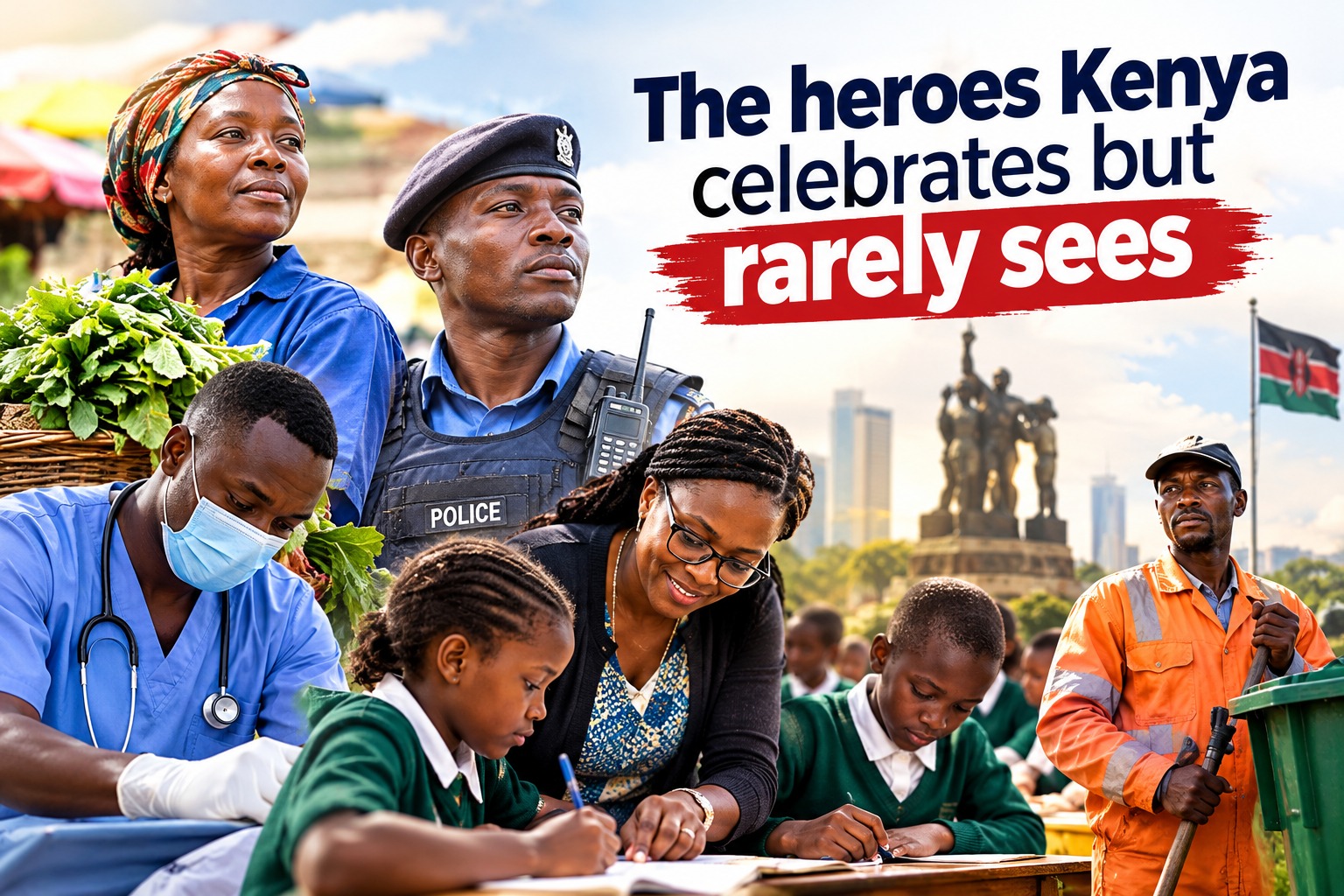
As Kenya celebrates Mashujaa Day, true recognition of heroism goes beyond national honours to include the dignity, protection and support afforded to those whose everyday sacrifices keep the country running.
By Oduor Rosequillet Nabwire
At 4:30 a.m., while Eldoret is still quiet, Emmanuel Kipchirchir is already sweeping its streets. Armed with a broom and a shovel, the 29-year-old sanitation worker clears rubbish and unblocks drains clogged with waste.
For five years, Kipchirchir has worked in Eldoret’s central business district. When dignitaries visit, sanitation workers put in extra hours to tidy the streets, yet their efforts often go unnoticed.
“We work through freezing nights so the streets are clean, yet we remain invisible and unrecognised for the essential service we give Kenya,” he says.
The work exposes Kipchirchir to physical danger. As he handles waste and clears drains, he encounters broken glass and discarded needles that can cause serious injuries.
“Unblocking storm drains with my bare hands means risking serious injury just to keep the town from flooding before the rain starts,” he says.
Despite these risks, Kipchirchir earns KSh450 a day. As a single father of three who also supports his elderly mother in Turbo, he struggles to provide for his family, particularly when his wages are delayed for weeks.
In Nairobi’s Muthurwa Market, Wanjiku Muthoni, 48, carries a different responsibility. For 14 years, she has sold vegetables and dry cereals from a wooden crate to support her four children and two orphaned nieces.
Her day begins at 3:30 a.m. in Pipeline, Embakasi. By 4:15 a.m., she is travelling to Wakulima Market, popularly known as Marikiti, to buy produce before carrying it across the railway tracks to Muthurwa. She aims to open her stall by 6 a.m.
Her daily sales range from KSh2,500 to KSh4,000, but after paying for stock, transport and other expenses, she often retains less than KSh800.
“People see me selling KSh20 kale at dusk, but they don’t see the mud in Marikiti or the heavy sacks I carry. This single crate pays school fees and feeds two households,” she says.
Wanjiku’s stall also serves as an informal safety net for struggling mothers.
“A mother with nothing to feed her children doesn’t go to a bank; she comes to my stall because in this neighbourhood, we look out for one another,” she says.
When customers cannot afford food, she sometimes allows them to take vegetables on credit, recording their debts in a small book. If they remain unpaid at the end of the month, she tears out the page and absorbs the loss.
The unpaid debts have strained her finances.
“Unpaid debts left me with so little cash flow that I defaulted on my chama savings for four months,” she says.
Missing the contributions cost her access to a business expansion loan, delaying her plans to grow the enterprise. The financial pressures affecting her customers have also held back her own progress.
“We don’t ask for national medals or speeches on television,” she says. “We just want street lights that work, security at night, and lower market tariffs so that our sweat actually counts for something at the end of the day.”
For Wanjiku, the difference between recognition and meaningful support is found in the conditions under which she earns a living. In public hospitals, similar pressures confront workers whose responsibilities can mean the difference between life and death.
In Nyando, Kisumu County, Oyoo, a pseudonym used to protect the source’s identity, works as a community health worker in the emergency unit at Ahero Sub-County Hospital. With nine years of healthcare experience, Oyoo balances 12-hour shifts with raising two children.
During a severe cholera spike in 2025, Oyoo recalls staying at the facility for 32 hours because of staff shortages and helping establish hydration lines for more than 40 paediatric patients.
“When a child comes in dehydrated from cholera and you don’t have enough IV fluids in the ward, you don’t sleep that night. You improvise, you stay hours past your shift, and you pray. That is not extraordinary to us. That is just Tuesday,” Oyoo says.
Shortages of protective equipment and rehydration supplies, coupled with generator failures, further complicate emergency care.
“Patients sometimes think we don’t care because the queues are long or the medicine runs out. They don’t see that we are fighting the same broken system they are. We don’t need praise; we need working equipment and enough hands on deck,” Oyoo says.
Oyoo’s account highlights the strain on healthcare workers who must respond to emergencies with limited resources. Personal commitment cannot substitute for adequate staffing, essential supplies and reliable equipment.
For border officer Mwai, whose name is also a pseudonym, the cost of service is often measured in time spent away from family. His work in border control and immigration has meant missing birthdays, school sports days and anniversaries while stationed hundreds of kilometres from his wife and children.
“When you look at a traveller holding their child’s hand while passing through your counter, you swallow a lump in your throat because you haven’t held your own kids in months. That silent homesickness is a uniform many officers wear every single day,” he says.
His duties include verifying travel documents and monitoring cross-border movement, responsibilities that often go unnoticed when operations proceed smoothly.
“A border officer is the country’s first filter and its quietest shield. If we do our job right, nothing happens, and that’s the point,” he says.
Mwai says reliable digital verification systems, adequate housing at remote stations, fair risk allowances and mental health support would improve officers’ working conditions.
Heroism is not confined to the workplace. It can also be expressed by citizens who risk their safety to demand accountability and insist that their rights be respected.
During the 2024 Finance Bill protests, young Kenyans took to the streets to oppose tax proposals they considered burdensome and call for greater government accountability. For some, the demonstrations were an expression of economic frustration; for others, they became an experience marked by violence, injury and loss.
Frank Okoth, who was shot six times during the protests, described what had brought him to the streets in an interview with Citizen TV on July 1, 2024.
“Before maandamano I had gone to look for work but was unsuccessful, so I went for the protests,” he said.
His account illustrates the economic frustrations that shaped some young people’s participation in the demonstrations. Yet the consequences extended far beyond the demands voiced in the streets.
On June 25, 2024, 25-year-old Erickson Kyalo Mutisya was shot dead near Parliament. His death left his mother, Caroline Mutisya, grieving and seeking justice. Speaking at a commemoration two years later, she said, “I have come here today to remember my son, who was killed just 50 metres from Parliament, and to demand justice for his death.”
Her words bring the cost of the protests into sharp focus. Behind the public debate over taxation and accountability are families left to mourn loved ones and survivors still seeking answers.
The Kenya National Commission on Human Rights documented 60 deaths and 601 injuries linked to the demonstrations between June 18 and July 15, 2024. These figures represent lives lost, people injured and families whose futures were changed by the violence.
Recognising those who died means remembering them as individuals, supporting the families they left behind and pursuing accountability for violations. It also means protecting the constitutional right to peaceful assembly under Article 37 of Kenya’s Constitution. The courage to demand change should never mean that citizens must pay for exercising their rights with their lives.
After Mashujaa Day, Kipchirchir will return to sweeping Eldoret’s streets, Wanjiku will rise before dawn to buy stock, Oyoo will return to caring for patients, and Mwai will continue serving far from family. For the young Kenyans who took to the streets demanding accountability, the pursuit of justice continues.
Together, their experiences show that heroism extends beyond the names on national honours lists. It lives in the workers who keep towns clean, the traders who sustain families, the healthcare workers who care for the sick, the officers who serve away from home and the citizens who stand up to demand accountability.
The true measure of Mashujaa Day is not simply whom the nation honours, but what it does for those whose sacrifices sustain it. Recognition must translate into dignified working conditions, fair livelihoods, protection of constitutional rights and justice for those whose rights have been violated. A country that honours its heroes must also stand by them.
Similar Posts by The Mt Kenya Times:
- Reading culture: Towards an enlightened generation
- How society treats people according to status a review of a Tale of Two Cities by Charles Dickens
- Mashujaa Day 2026: Eldoret’s moment of national pride, the test of inclusion and the promises Kenya must now fulfil
- Beyond mobile phones: The new frontiers of KCSE examination malpractice
- Grief, golf and growing up: The Shujaa tournament that turned loss into legacy
About the Author