Beyond the job ticket: Rethinking education’s true purpose in an era of uncertainty
 The Mt Kenya Times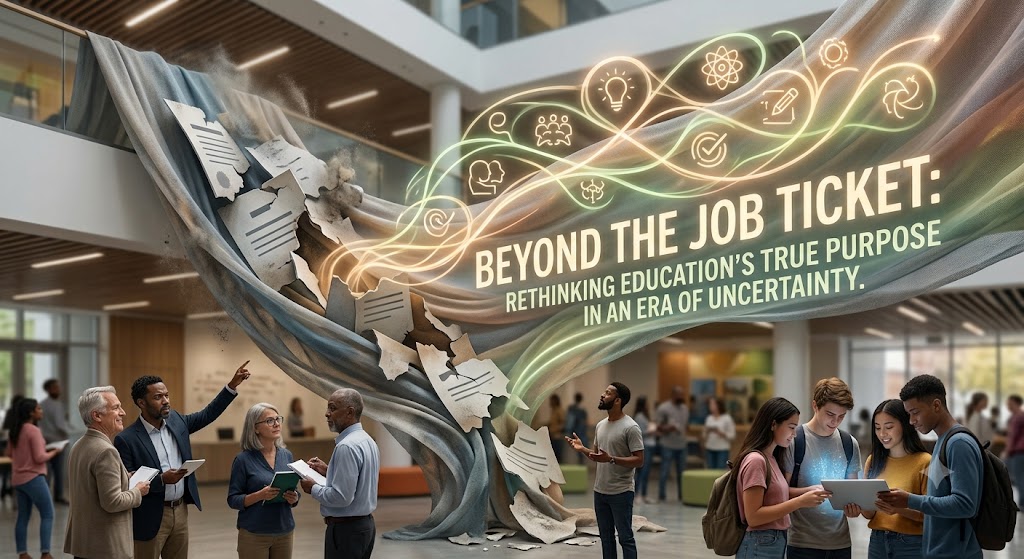
By Jerameel Kevins Owuor Odhiambo
Education systems worldwide, particularly in postcolonial nations like Kenya, face a profound tension. Each year, Kenya’s over 60 public and private universities graduate more than 60,000 students, yet youth unemployment hovers around 35-40% in recent estimates, with many graduates underemployed or in jobs unrelated to their degrees. The economy grapples with contractionary pressures, public debt burdens, and rapid technological shifts including artificial intelligence (AI) automation that accelerates downsizing and redundancy across sectors. In this context, the dominant narrative frames education primarily as a pathway to employment and career success. Prospective students are routinely advised or seduced into choosing “marketable” courses in engineering, medicine, business, information technology, or data science, while fields in the social sciences and humanities, such as anthropology, political science, sociology, psychology, history, and literature, are often dismissed as impractical dead-ends that “lead nowhere.” This raises fundamental questions: Is the main end result of education merely securing jobs and financial stability? Or does this narrow focus undermine education’s deeper potential for human flourishing?
The prevailing job-centric view of education has deep roots. In Kenya and many developing economies, it stems from colonial legacies that positioned schooling as a tool for producing compliant administrators and skilled labor for extractive economies. Post-independence, this evolved under neoliberal influences emphasizing human capital for market productivity. Parents, policymakers, and institutions reinforce this by tying educational value to return on investment measurable in salaries, job placement rates, and GDP contributions. Choosing a course becomes a calculated bet on employability: STEM fields promise higher starting salaries and alignment with global labor demands, while humanities and social sciences are seen as luxuries for the privileged or idealistic. This perception persists despite evidence that many “marketable” graduates still struggle in saturated markets, while skills like critical analysis, communication, and cultural insight honed in social sciences underpin adaptable careers in journalism, public policy, education, NGOs, diplomacy, and even entrepreneurship.
Professor Wandia Njoya, a prominent Kenyan academic and public intellectual, offers a compelling counter-critique. She argues that the primary purpose of education is not job training but human flourishing, liberation, critical consciousness, creativity, and the acquisition of broad knowledge. Reducing education to a “pathway for employment, certificates, and economic productivity,” she contends, treats individuals as instruments for profit rather than full human beings. This ideology, rooted in colonial and neoliberal frameworks, prioritizes rote learning, exam cramming, and credentialism over genuine intellectual growth. Njoya advocates for education that raises consciousness, fosters mastery of skills for understanding self, society, history, and the world, and equips citizens to innovate, collaborate, and live with dignity. Degrees, in her vision, should signify academic qualification for those passionate about knowledge or research, while employers bear responsibility for job-specific training. Public university education ought to be free and universal as a public good, diminishing cheating, credential-based discrimination, and undue pressure on students and lecturers.
This perspective resonates with classical and progressive educational philosophies. Thinkers from Aristotle to John Dewey emphasized education as character formation, wisdom cultivation, and preparation for democratic citizenship. It develops critical thinking, creativity, curiosity, problem-solving, and self-awareness qualities that enable meaningful lives beyond paychecks. Broad education builds resilience against technological disruption; narrow vocational training risks producing specialists obsolete when AI automates routine tasks. In an age where companies prioritize robotics and efficiency for profit margins, graduates who “donate their thinking to AI” may lack the imaginative edge to create new opportunities or challenge systemic issues.
Even so an objective analysis must acknowledge practical realities that complicate Njoya’s ideal. For most individuals, especially in resource-constrained settings, education must translate into economic independence. One cannot fully flourish without the ability to sustain basic needs like food, shelter, water, healthcare, and social amenities. In Kenya, where graduate unemployment exacerbates poverty, inequality, and even social instability, dismissing job outcomes as secondary feels disconnected. Families invest heavily in education expecting tangible returns; students endure grueling competition not merely for intellectual joy but survival. Linking education solely to employment fuels anti-intellectualism and devalues humanities, as Njoya notes, but ignoring economic pressures risks romanticizing poverty. Data from labor market reports consistently show that while humanities graduates may initially earn less, they often excel in versatile roles requiring adaptability, ethical reasoning, and interpersonal skills precisely the attributes AI struggles to replicate fully. Moreover, societies benefit immensely from educated citizens in non-market spheres: informed voters, cultural producers, ethical leaders, and social innovators who address inequality, governance failures, and cultural erosion.
The tension is evident in Kenya’s context. With a burgeoning youth population and an economy vulnerable to global shocks, exporting skilled professionals (e.g., doctors and engineers) while domestic critical thinking remains underdeveloped perpetuates dependency. AI and automation amplify this: projections suggest significant job displacement in administrative, manufacturing, and even creative sectors, favoring those with hybrid competencies technical skills plus humanistic insight. Purely job-focused education may produce short-term employability but long-term fragility, as seen in graduates chasing diminishing formal opportunities or gig economies that offer little security. Conversely, purely liberation-oriented education without pathways to sustenance could widen gaps, leaving graduates conscious yet economically marginalized.
A balanced approach recognizes that education serves multiple, complementary ends. Job preparation is a valid and important outcome, providing the material foundation for autonomy and dignity. However, subordinating all else to market demands shortchanges individuals and society. True education integrates both: it equips people with practical skills while nurturing broader capacities for creativity, ethical reflection, and adaptability. Reforms could include strengthening foundational humanities and social sciences alongside vocational elements interdisciplinary programs that blend sociology with data analytics, or philosophy with entrepreneurship. Employers shifting from credential obsession to skills-based hiring would alleviate pressure. Expanding public investment in libraries, arts, civic education, and lifelong learning treats education as a societal good rather than individual commodity. In the AI era, curricula must emphasize uniquely human traits: moral imagination, complex problem-framing, and collaborative innovation.
Ultimately, education’s value transcends immediate employability. It should enable better lives materially secure nevertheless intellectually rich, personally fulfilling, and socially contributory. The confusion many feel stems from a false binary: money versus meaning. A flourishing life integrates both. Graduates need tools to navigate uncertainty perhaps creating jobs through innovation rather than merely seeking them. Policymakers, educators, and students must resist reductive narratives. By reclaiming education as liberation and consciousness-raising, while pragmatically addressing economic imperatives, societies can cultivate versatile humans resilient to technological and economic flux. In Kenya and beyond, the future of education lies not in choosing between jobs and enlightenment, but in forging systems where one reinforces the other. Only then can graduates thrive, not merely survive, in an unpredictable world.
The writer is a social commentator
Similar Posts by The Mt Kenya Times:
- Mt Kenya Times ePAPER October 12, 2026
- Gachagua’s party storms Kikuyu from afar as 2027 countdown begins
- Counties caught: The KSh100B payroll scandal Kenya can no longer hide
- CS Ogamba: tree planting could generate carbon credit millions to fund education
- Farouk Kibet calls for unity and development as leaders rally behind Ruto’s 2027 re-election bid
About the Author