Counting votes, counting costs: The arithmetic shaping Kenya’s 2027 election
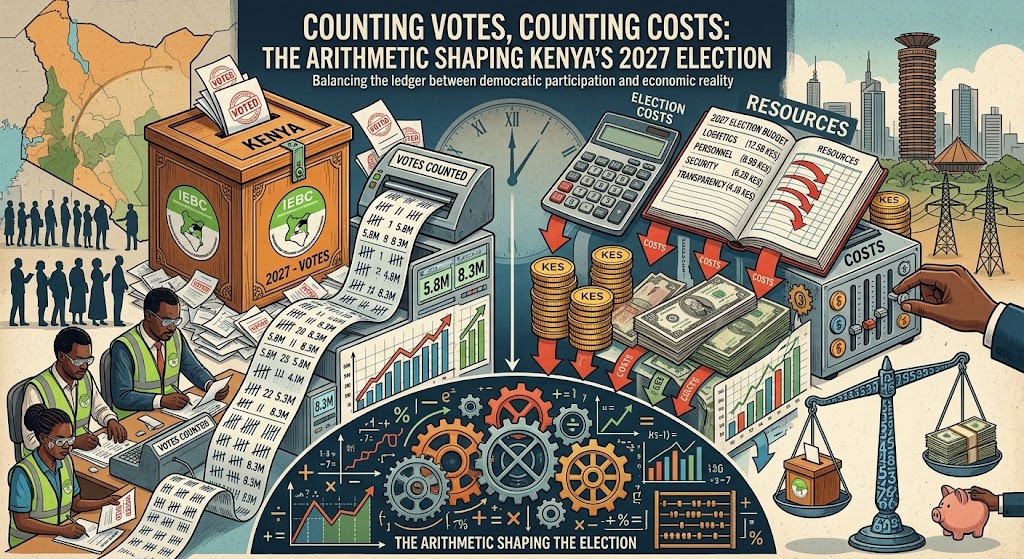
While politicians tally constituencies and calculate coalitions, ordinary Kenyans are doing a very different kind of mathematics — and both sets of numbers will meet at the ballot box.
By Levis Wangamati
Kenya has already begun counting. Politicians are tallying constituencies, weighing alliances, debating running mates and mapping regional voting blocs. Parties are measuring their reach, leaders are testing their popularity, and political formations are quietly calculating the mathematics required to win in August 2027.
Away from the strategy rooms and rally podiums, however, ordinary Kenyans are engaged in a vastly different kind of arithmetic. They are calculating what remains after paying rent, buying food, covering transport, settling school fees and clearing electricity bills. For them, the numbers are not about electoral margins. They are about whether an income can survive the demands of another month.
This contrast forms the uncomfortable core of Kenya’s emerging political landscape. The political class is consumed by the arithmetic of winning; millions of citizens are consumed by the arithmetic of survival. For politicians, the imperative is assembling votes. For families, it is stretching a paycheck to the next payday.
That divergence matters more than political commentators typically acknowledge. Elections are not spreadsheet exercises — they are fundamentally about people. Yet as the 2027 political calendar accelerates, citizens risk being reduced to data points in calculations detached from their daily realities. A constituency becomes a target. A region becomes a bloc. A community becomes an electoral asset. A rally crowd becomes evidence of popularity.
Behind every percentage point, however, sits a household. Behind every vote is a person navigating economic pressure, frustration and expectation.
For most Kenyans, governance is not experienced through parliamentary debates or political declarations. It is felt at the supermarket, the petrol station, the matatu stage, the hospital and the school fees office. It is experienced when salaries disappear faster each month and when a basic basket of goods becomes an agonising financial calculation. Can young graduates transition from education to meaningful work? Can households afford basic food without accumulating debt? Can small businesses survive rising costs and taxation? Can healthcare and education deliver value without placing an unbearable burden on families?
These questions rarely dominate political speeches because they do not fit neatly into the mechanics of coalition building. They are less dramatic than announcing a new political alliance and less thrilling than presidential speculation. Yet they determine whether campaign promises mean anything once the dust settles.
What makes this moment particularly significant is that Kenya has entered campaign mode unusually early. Long before political parties formally unveil their manifestos, the country is already immersed in speculation about coalitions, succession plans, regional kingpins and electoral calculations. The danger is not simply that politicians begin campaigning prematurely. The danger is that public attention becomes consumed by the next election before the challenges of the present have been adequately confronted.
For ordinary citizens, life does not pause for political strategy. Bills arrive regardless of political seasons. School fees must be paid whether alliances hold or collapse. Businesses must navigate difficult economic conditions regardless of which leaders dominate the headlines. The concerns occupying households are immediate and practical; the concerns dominating political discourse are increasingly long-term and electoral.
This creates a growing disconnect between the language of politics and the language of everyday life. Politicians speak of numbers in terms of votes, percentages and constituencies. Citizens speak of numbers in terms of prices, salaries, debts and household budgets. Both conversations involve arithmetic, but they are calculations with very different consequences.
There is a real hazard in allowing public life to become permanently electoral. When leaders spend years campaigning, governing risks becoming secondary. Policies are framed around political advantage, regions are treated as strategic calculations and public appearances become exercises in power consolidation. Meanwhile, the citizen remains on hold, waiting for better roads, reliable healthcare, accessible employment and an economy where honest work offers a decent chance at a decent life.
The consequences of this disconnect are not merely political. There is a psychological cost to living under persistent economic uncertainty. Many Kenyans find themselves planning less for the future and focusing more on getting through the present. When economic pressure becomes constant, households adjust their expectations downward. Ambitions are postponed, spending is reduced and long-term plans are replaced by short-term survival strategies.
These experiences rarely appear in political speeches or government statistics. Yet they shape profoundly how people understand leadership. A young graduate who spends years searching for employment does not experience the economy as a percentage in a quarterly report. A small trader struggling to keep a business open does not experience taxation as a policy debate. A parent struggling to meet school expenses experiences it as a personal calculation with immediate and painful consequences.
Kenyans are not indifferent to politics. They understand that political power controls public resources, legislation and national priorities. But there is a widening gap between being politically engaged and being politically satisfied. A voter can follow every shifting coalition and still wonder what any of it changes at home.
The political class should be careful not to mistake crowd size or campaign enthusiasm for genuine endorsement. Citizens may attend rallies, cheer leaders and debate alliances while carrying deep economic frustrations that no amount of political theatre has resolved. Political excitement and economic satisfaction are entirely different metrics — and conflating them is a mistake Kenya’s leaders have made before.
The 2027 election presents a clear challenge: convince voters that politics can meaningfully improve their lives rather than simply determine who occupies office. The most compelling argument in 2027 may not belong to the largest coalition. It may belong to whoever can persuade a discerning and increasingly impatient electorate that government can deliver tangible, measurable results.
That will require more than slogans. It will require explaining not only what a government intends to build, but how those plans will translate into jobs, affordable services, productive businesses and greater economic security. Voters are growing more interested in the distance between a promise and its measurable outcome — and they are growing less forgiving when that distance proves to be vast.
Citizens keep ledgers of their own. They remember unfulfilled promises, rising taxes, climbing living costs, scarce employment, struggling businesses and relentless bills. They remember what was pledged before the vote and what followed after. By the time 2027 arrives, voters may be carrying a more detailed record of their experiences than politicians expect.
While politicians calculate the votes required to secure power, ordinary Kenyans calculate whether their incomes can carry them through another week. While parties count constituencies, families count expenses. While leaders calculate alliances, citizens calculate sacrifices.
Those two calculations will eventually meet at the ballot box.
And when they do, politicians may discover that voters are not simply choosing between parties or personalities. They are passing judgment on their own lived experience.
Politicians may be counting votes for 2027. The people are counting the cost of surviving until then. And when the ballots are finally cast, the most important arithmetic may not be found in coalition agreements or electoral spreadsheets.
It may be found in the accumulated answer to one simple question: did our lives get better?
Similar Posts by The Mt Kenya Times:
- Mt Kenya Times ePAPER October 17-18, 2026
- Ruto bets billions on Kerio Valley — with one eye on 2027
- Ruto’s health ministry kills Murang’a’s digital hospitals
- Kenya bets on Mount Kenya to drive a billion-shilling tourism revival
- Do you have a wealth vision? Or are you just working until you die?
About the Author