Court seals national tallying of presidential votes as 2027 election battle lines form
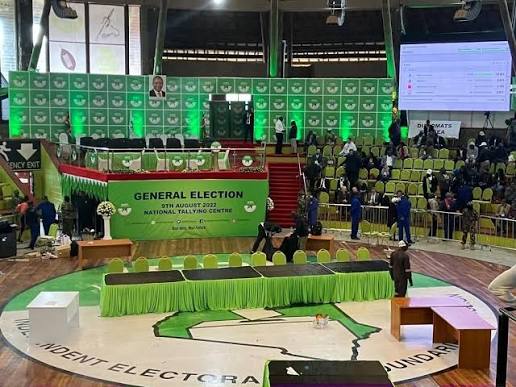
National tallying of presidential votes
The ruling closes one legal front in Kenya’s electoral wars — but Parliament must now act before the next contest reopens them
By James Mwangi
The High Court yesterday upheld the national aggregation and verification of presidential election results, dismissing a petition by Busia Senator Okiya Omtatah that had challenged the legal basis of Kenya’s national tallying centre and its role in determining the presidential winner.
The court upheld Section 39(1C) of the Elections Act and Regulation 83(2) of the Elections (General) Regulations, finding that national aggregation is not an arbitrary addition to the electoral process but a constitutional requirement. Under Article 138(4) of the Constitution, a presidential candidate must secure more than half of all votes cast nationally and at least 25 per cent of votes in more than half of Kenya’s 47 counties — a two-tier threshold that, the court found, can only be established by aggregating results at the national level.
“A national aggregation and confirmation exercise is accordingly not an arbitrary extra burden imposed on presidential candidates or voters,” the court held, describing the process as a “necessary and rational corollary” of the Constitution’s unique presidential threshold.
Omtatah had argued that the Constitution assigns constituency returning officers the primary and final responsibility for tallying, verifying and declaring presidential results, making national re-tallying unconstitutional. The court rejected that framing, drawing a clear distinction between declaring results at polling station level and determining whether the constitutional threshold for a presidential win has been met across the country.
The ruling, however, was not a blanket endorsement of the Independent Electoral and Boundaries Commission’s powers. The court was explicit that national aggregation does not give the IEBC authority to alter results declared at polling stations. Where a discrepancy exists between electronically transmitted results and physical results declared at a polling station, the polling station result prevails. That clarification carries particular weight in a country where disputes over electronic transmission have defined post-election litigation since 2017.
The court also declined to strike down related provisions of the Elections Act in their entirety, finding that several of Omtatah’s claims — including those relating to ballot reconciliation, government timelines and aspects of an equality challenge under Article 27 — were insufficiently supported by evidence. “These claims proceed largely by way of general assertion and invocation of constitutional provisions without the requisite nexus to a demonstrated or imminent violation,” the judges said.
Perhaps the ruling’s most consequential passage, however, was directed not at the parties before the court but at Parliament. The judges called on lawmakers to review Kenya’s electoral laws ahead of the 2027 General Election, invoking the political philosophy concept of the “veil of ignorance” — associated with philosopher John Rawls — to argue that electoral laws should be developed without regard to which political actors or interests would benefit from them. Laws shaped by current political convenience, the court warned, serve only the “narrow, temporal and variable goals” of those in power at the time of drafting.
With Kenya fourteen months from its next general election, that recommendation lands at a critical moment. Questions surrounding tallying, verification and result transmission have featured in every presidential dispute since the advent of multiparty democracy. Yesterday’s ruling settles the legality of national aggregation. It does not settle the deeper question of whether Kenya’s electoral architecture commands sufficient public trust to deliver a result that all sides will accept.
That work belongs to Parliament. The court has pointed the way. Whether lawmakers follow it — and how quickly — will shape not just the 2027 contest, but the credibility of whatever result it produces.
Similar Posts by The Mt Kenya Times:
- Mt Kenya Times ePAPER September 23, 2026
- Kagwe vows to fight punitive taxes choking Kenya’s flower farmers
- Jubilee’s new dawn: Matiang’i takes the helm
- Kenyatta passes the torch: Jubilee’s Matiang’i gambit and the battle for Kenya’s political soul
- Uhuru’s 2022 election claim: What really happened?
About the Author