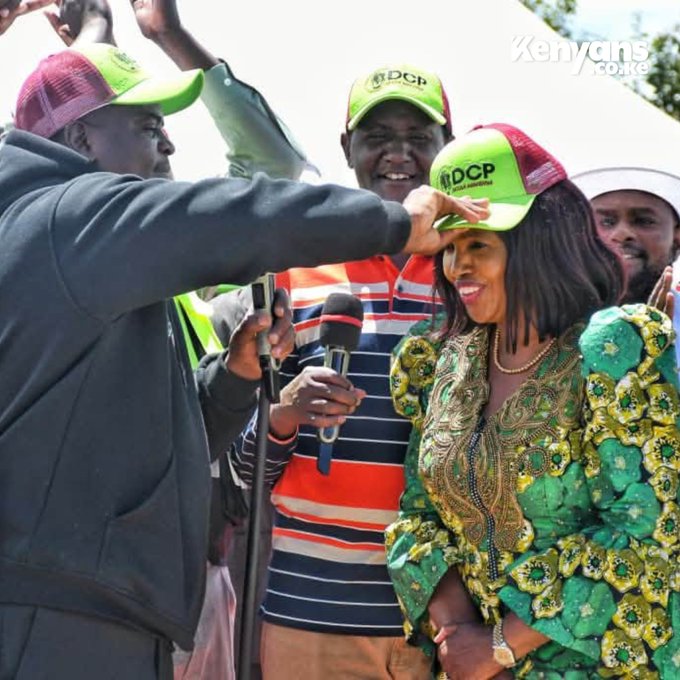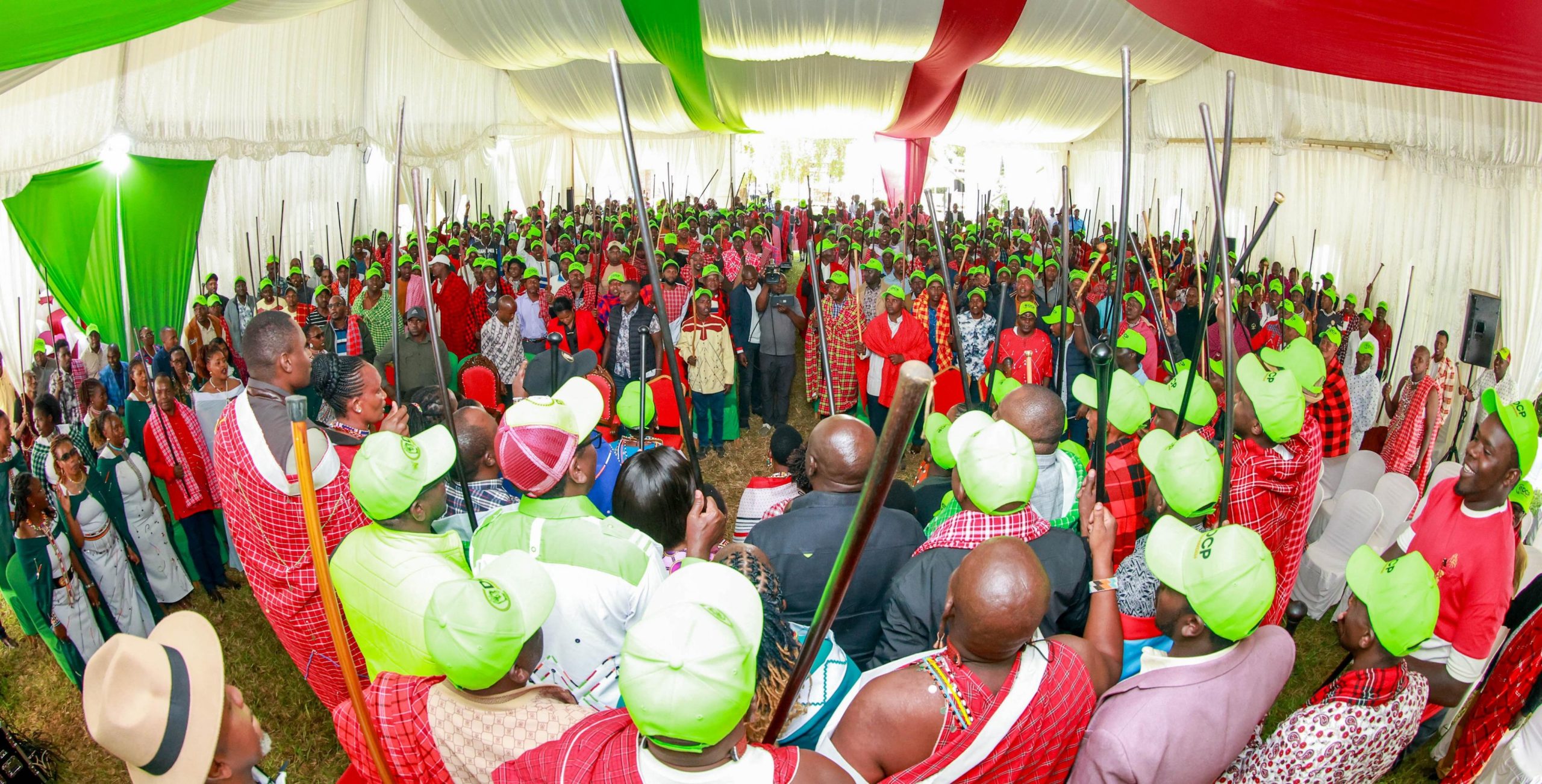
Democracy for the Citizens Party leader Rigathi Gachagua with delegation from Narok and Kajiado counties.
DCP leader accuses president of blocking a lasting solution to the Narok and Kajiado land conflicts he pledged to resolve in 2022
By MKT Reporter
Democracy for the Citizens Party leader Rigathi Gachagua accused President William Ruto on Friday of failing to resolve long-standing land disputes over the Kedong and Kibiko ranches in Narok and Kajiado counties, despite promising to do so during the 2022 election campaign.
Gachagua made the remarks while receiving a delegation of opinion shapers and grassroots leaders from Narok County at his Wamunyoro residence, a courtesy call that gave the former deputy president a fresh platform to revisit one of the most contentious land questions in the Maa region.

He alleged that Ruto has vested interests that have obstructed a genuine settlement of the dispute, arguing that land earmarked for the Maasai community was instead being pushed toward development that serves other interests. “The place where the Maasai live is the very place they now want to turn into an industrial park. They have moved the Maasai out and want to resettle them on the hillside, on land they call 6,000 acres. But that ground is full of rocks and deep gullies where water cuts through — you cannot farm it. Not a single Maasai should be sent to that hillside acreage,” Gachagua said.
His remarks referenced a long-disputed 6,000-acre parcel of Kedong Ranch, which President Ruto allocated to the Maasai community during a tour of Narok in May 2025, bringing the total land handed to the community to 10,000 acres alongside an existing 4,000 acres. The Kedong Ranch dispute, which involves land hosting the Naivasha Inland Dry Port, has for years drawn accusations that politically connected figures from past administrations sought to appropriate it. The neighbouring Kibiko dispute in Kajiado has similarly featured in Gachagua’s past accusations of irregular land allocations to individuals close to the government, a claim he has raised at previous rallies in the region.
Positioning himself as untainted by the unresolved conflicts, Gachagua presented himself as the leader capable of delivering a lasting resolution, accusing Ruto of using the land question as a political bargaining chip rather than pursuing genuine reform. “Even a year of hunger can be ended with a single plate of food. Is waiting until December really such a long time? Haven’t you already waited all these years? Aren’t we removing Kasongo so that we can take over government ourselves? So do not move. Stay exactly where you are. Let no one remove the Maasai from that land — stay there and do not leave,” he told the gathering, using a nickname opposition leaders have adopted for the president.

Gachagua’s remarks came amid intensifying activity at his Wamunyoro home, which has increasingly become a hub for delegations from beyond his traditional Mt Kenya base, including from Kajiado, Narok, Samburu and Western Kenya, as he builds toward a 2027 challenge to Ruto.
Turning to the immediate contest ahead, Gachagua expressed confidence that his party would win the Ol Kalou parliamentary by-election scheduled for July 16, dismissing what he characterised as a last-minute government push to influence voters through a surge of development announcements in the constituency. He argued that residents would not be persuaded by initiatives introduced only in the run-up to the vote. “The message there is simple — we elected this Ruto in 2022 and he gave us nothing. Now that an opportunity has come up, he wants us to hand it back to him. The money Ruto is spending there now is really a debt owed since 2022. But they are saying the vote on the 16th will go their way? Not a chance. And let me tell the Kikuyu community — do not underestimate what is happening here. Ruto will be shocked when the results are announced,” Gachagua said.
The Ol Kalou by-election has emerged as an early test of political sentiment in Nyandarua County, a region considered part of Gachagua’s Mt Kenya stronghold, and its outcome is likely to be read nationally as a signal of the DCP leader’s standing ahead of the 2027 general election. Gachagua’s camp has framed the contest as a referendum on the president’s standing in a region that backed the Kenya Kwanza ticket in 2022 but has since grown more openly critical of the administration.
The land question in Narok and Kajiado, meanwhile, remains one of the more emotionally resonant issues in Maa politics, touching on decades-old grievances over ownership, resettlement and access to fertile ground. Successive administrations have promised resolution without delivering one that satisfies affected communities, and Gachagua’s intervention adds another layer to a dispute that has already drawn presidential attention. Whether his renewed criticism translates into political traction in the Maa region — a constituency he has been actively courting in recent months — will likely become clearer as the 2027 electoral map takes shape.
For now, Gachagua’s message to his Narok visitors was unambiguous: stay on the land, resist any relocation, and wait for a change in government he insists will deliver the resolution the community has been promised for years.
Similar Posts by The Mt Kenya Times:
- Mt Kenya Times ePAPER October 10-11, 2026
- Cabinet clears path for pending bills payout in relief for Kenya’s struggling suppliers
- Karanja quits UDA and targets Nakuru governorship on Gachagua’s DCP ticket
- Gachagua’s team plants DCP flag in Kiambu as 2027 battle lines harden
- A moment of recognition for service in energy
About the Author