Governments Of Japan, Kenya Launch New Centre For Malaria Elimination At MKU
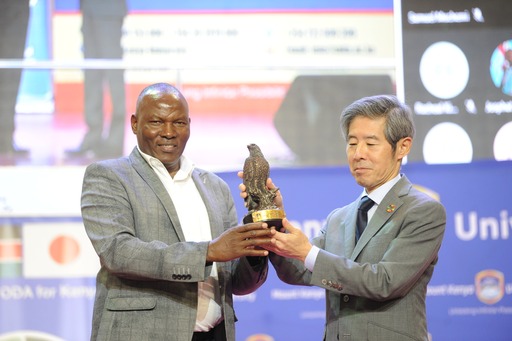
Japan’s ambassador to Kenya Okaniwa Ken receiving a gift from MKU Vincent Gaitho

By James Wakahiu
Worth Noting:
- Launching the facility at MKU’s main campus in Thika town, the envoy said he had visited the project site in Homa Bay County and regretted the fact that malaria has been so devastating a disease in Africa. “I have been briefed about the challenges facing the people of that region from the malaria disease,” he said.
- Added Mr Okinawa; “It is disheartening to know that there continues to be so many people suffering from malaria. It is a complete waste of human resources and human lives”.
The government of Japan, in collaboration with Kenya’s ministries of education and health, have inaugurated a state-of-art malaria research laboratory at Mount Kenya University (MKU)’s main campus in Thika town.
The Centre for Malaria Elimination at MKU is part of the Project for Interdisciplinary Research for Integrated Community-Directed Strategy for Sustainable Freedom from Malaria being implemented at MKU in collaboration with Osaka City University and other universities of Japan, the Homa Bay County government, the Kenya national government’s ministries of health and education as well as the Japan International Cooperation Agency (JICA).
Partners in the project say it aims to evaluate an integrated community-directed strategy for malaria elimination in western Kenya and has achieved significant milestones in the fight against the disease. The new lab at MKU is being funded by the government of Japan, Japan’s ambassador to Kenya said in Thika on Friday.
The overall project has made substantial investments in the fight against malaria. The total project cost is approximately Sh450 million, with Sh300 million allocated for activities in Kenya and Sh150 million for activities in Japan.
Already, a cutting-edge molecular and immunology laboratory has been established at MKU’s Thika campus. The state-of-the-art facility enables advanced research and diagnostics for malaria. Researchers and students from MKU and collaborating Japanese universities, such as Osaka City University, have also benefited from exchange training programmes, enhancing their skills and knowledge in malaria research.
Launching the facility at MKU’s main campus in Thika town, the envoy said he had visited the project site in Homa Bay County and regretted the fact that malaria has been so devastating a disease in Africa. “I have been briefed about the challenges facing the people of that region from the malaria disease,” he said.
Added Mr Okinawa; “It is disheartening to know that there continues to be so many people suffering from malaria. It is a complete waste of human resources and human lives”.
The ambassador said malaria has been a persistent threat to residents of Nyanza region and many regions of Kenya. “It involves the spread of mosquitoes and the status of housing in these regions and we must know how to tackle the menace,” he said.
MKU vice-chancellor Prof Deogratius Jaganyi said the inauguration of the Centre was a testimony of the university’s unwavering commitment to combating one of the worlds most persistent and devastating tropical diseases. He noted that Malaria remains a formidable global health challenge, disproportionately affecting the most vulnerable members of the society, particularly children and pregnant women.
“It ravages communities, undermines economic development and perpetuates a cycle of poverty that we must break. The burden of this disease is not only a health concern but also a social injustice that demands our joint attention and action for eradication,” he said
The VC said MKU has always been at the forefront of addressing societal needs and uplifting communities. “Today, we reaffirm our commitment to advancing scientific knowledge, fostering innovation and working hand in hand with local communities and global partners to achieve a malaria-free future,” he added.
MKU has postdoctoral candidates and graduate students dedicated to unraveling the complexities of malaria immunity in children and pregnant women. “Their work will not only deepen our understanding of the immune response to malaria but also pave way for targeted interventions that can protect the most vulnerable populations,” he said.
The researchers are also investigating on antimalarial drug resistance, a growing concern in the global fight against malaria. “We strive to develop new strategies and therapies that can overcome this challenge and ensure the efficacy of available treatments. Furthermore, we have dedicated teams working on the development and evaluation of malaria diagnostic kits. The production of these innovation-driven diagnostic tools, will provide accurate and rapid diagnosis, enabling timely treatment and preventing the spread of the disease.
The VC called upon Kenyans and donors of good will to support the center for sustainability, whether through advocacy, volunteering, or philanthropic contributions so that one day, nobody will ever suffer from malaria, as it will be a thing of the past. “Through this Centre, we shall witness more partnerships with county and national governments; with governments of different countries in Africa and beyond, more collaborations with non-governmental organizations, academic institutions and industry leaders,” he said.
MKU Pro-Chancellor, Dr Vincent Gaitho said health is a panacea for development and growth since an unhealthy person cannot perform effectively. He said the laboratory represents a significant milestone in MKU’s relentless pursuit of excellence, innovation and societal impact. “We have come together as a community, driven by a shared purpose—to alleviate the burden of disease, eradicate malaria and revolutionize healthcare in our region. Thus, hats-off to the winning team of researchers that brought forth this victory to MKU and Kenya and the region,” he said.
Thanking partners, sponsors and supporters of the project, Dr Gaitho said; “Your investment in the future of healthcare will yield immeasurable dividends, not only in terms of scientific advancement but also in the lives we touch and the communities we uplift today and in the future. A university that does not connect with the community remains ivory tower disconnected from its own vision and mission”.
The Pro-Chancellor said the laboratory will be a springboard to innovations and patents. “We are laying down the foundation for a future where preventable diseases will be targeted and where access to quality healthcare shall be guaranteed, and where scientific breakthroughs shall shape the destiny of our society. It will be an incubation for innovative Centre for cutting-edge research while also being a catalyst for collaboration, patents, interdisciplinary learning, and commercialization of human health-related services and products,” he said
“This Centre shall always serve as MKU’s lasting commitment to academic excellence, groundbreaking research, and profound societal change for the greater common good,” said Dr Gaitho.
In addition to laboratory development, the project has allocated resources for capacity building and training initiatives. Exchange programs for researchers and students between MKU and collaborating Japanese universities, including Osaka City University, have been financially supported. These programmes aim to enhance the skills and knowledge of individuals involved in malaria research and foster international collaborations.
To strengthen field research capacity, the project has procured field vehicles and mobile research equipment, which has facilitated data collection and surveillance activities in malaria-endemic areas. It also generating intellectual outputs, including publications and innovations. These contributions have elevated MKU’s profile as a Science and Technology university and have enhanced its webometrics and research rankings.
Similar Posts by The Mt Kenya Times:
- The hidden pressure of being a university student
- Youth surge in Kenya’s 2027 elections: From protest to power
- Kenya’s educated jobless: A generation waiting for a chance
- Eldoret must deliver more than a ceremony
- The long road back: How to conquer PTSD
About the Author