Governors step in where the state refused: Samburu families receive 435 cows
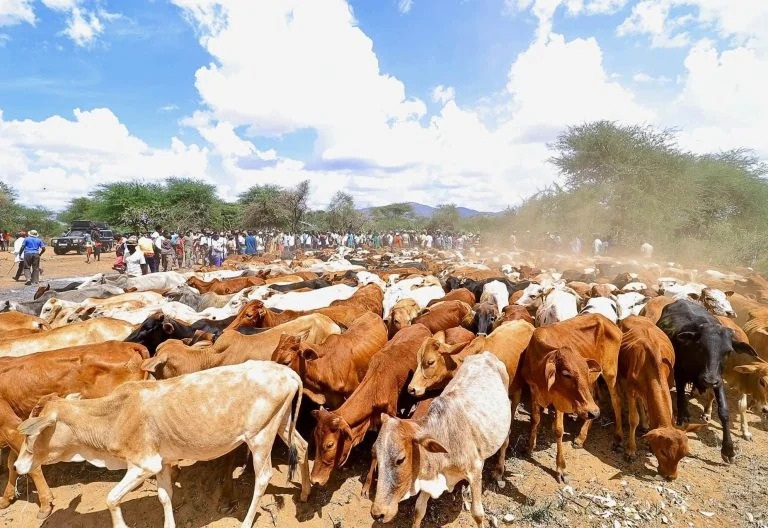
Hundreds of cows assembled for distribution to families whose livestock were killed during a police security operation in Samburu East on Sunday, November 8. PHOTO |Facebook - Stephen Letoo
Narok Governor Patrick Ole Ntutu and his Samburu counterpart Jonathan Lati Lelelit have distributed 435 replacement cattle to families who lost livestock during a multi-agency security operation in Samburu East in September — a gesture that underscores the national government’s refusal to pay compensation and raises unresolved questions about accountability.
By David Kimani
Narok Governor Patrick Ole Ntutu and Samburu Governor Jonathan Lati Lelelit yesterday distributed 435 cattle to pastoralist families whose livestock were killed during a security operation in Samburu East, filling a gap left by the national government’s explicit refusal to compensate the affected households.
The distribution took place at Naishamunye Grounds in an emotionally charged ceremony attended by Samburu elders and representatives of the 43 families who lost animals during the operation. The cattle were received with the customary gravity that livestock commands in pastoralist communities — animals that represent not merely property but the financial security, social standing and future of entire households. For families who had spent weeks navigating parliamentary petitions and ministerial stonewalling, the arrival of replacement cattle offered some measure of relief, even as the broader questions of accountability and justice remain unanswered.
The backdrop to the distribution is a story that generated significant national controversy. Between September 19 and 21, 2026, security forces turned their guns on pastoralists’ livestock in Waso Ward, Samburu East, during a multi-agency operation launched to address banditry and recover livestock stolen from neighbouring Isiolo County. Governor Lelelit said his administration had supported the security operation, whose stated objectives included recovering stolen livestock and removing illegal firearms, but criticised the manner in which the operation was conducted, saying livestock belonging to residents had been killed. The governor’s own tally of losses was detailed and location-specific. In Komgala, 102 cows were reported killed, while Nengardedi recorded 243 cows, 116 goats and 29 donkeys. Another 287 cows and 54 donkeys were reported killed at Lake Lash, while 132 cows died in Kapuru — amounting to 764 cows, 116 goats and 83 donkeys in total.
Led by Lelelit, affected residents presented a petition to the National Assembly’s Security Committee on October 2, demanding KSh70M in compensation for losses they described as atrocities committed during the operation. “We have talked to the victims,” Lelelit told legislators. “They are innocent, and even the Cabinet Secretary for Interior admitted there were transgressions in the operation. We are not asking for too much, but compensation for their mistakes.”
The national government’s response was blunt. Interior Cabinet Secretary Kipchumba Murkomen, appearing before the National Assembly’s Departmental Committee on Administration and Internal Security on October 7, ruled out any payment from the state. “If I were to say we are compensating people, I would be opening a Pandora’s box,” Murkomen said. “I cannot be that reckless as a minister. We don’t have that budgetary line in the ministry, and legally speaking, we cannot compensate.” The CS also disputed the losses, saying police records indicated 237 livestock had been killed — a figure sharply lower than the 700-plus documented by the county government and formally reported to Archers’ Post Police Station.
That dispute over numbers matters. Samburu County Women Representative Pauline Lenguri sought answers from the Ministry of Interior on the indiscriminate shooting of residents and livestock on September 19 and 21, citing 15 goats, two cows, 400 goats and 100 calves killed in one incident, with a further 198 cattle and 14 donkeys killed at Lekilash on September 23. The gap between the government’s figure and the county’s count — a difference of some 500 animals — has not been resolved, and no independent audit of the losses has been publicly announced. Former Interior Cabinet Secretary Fred Matiang’i, now an opposition figure, urged the Maa community to pursue compensation through the courts, arguing the government’s refusal to pay left legal action as the only remaining avenue.
The 435 cows distributed yesterday, while a meaningful act of solidarity between two pastoral communities and their governors, do not close the account. The figure falls short of the cattle losses alone as recorded by the county government, and covers none of the goats or donkeys reported killed. It also does not address the constitutional question that Governor Lelelit himself framed in the aftermath of the operation: when does a legitimate security intervention become collective punishment of the innocent? That question — and the government’s silence on accountability for individual officers involved in the operation — hangs over the ceremony at Naishamunye Grounds.
For the pastoralist families of Samburu East, livestock is not a commodity. It is the savings account, the dowry, the inheritance and the safety net — all in one breathing animal. The loss of hundreds of cattle in a single operation represents a generational wound that 435 replacement cows begin, but do not complete, healing. When governors must reach into their own networks to repair what a government operation destroyed, the state has not simply failed to compensate — it has failed to account for itself.
Similar Posts by The Mt Kenya Times:
- Gachagua and Kalonzo vow to end Ruto’s presidency in 2027
- Ruto takes his development case to Gusii, dismisses fractured opposition
- Absa exits Kenya’s insurance market as Mudavadi-linked investors take full control
- Ruto maps the road west: Rironi highway to extend to Kisii and Malaba
- Kenya at a turning point: Kitengela unites the opposition
About the Author