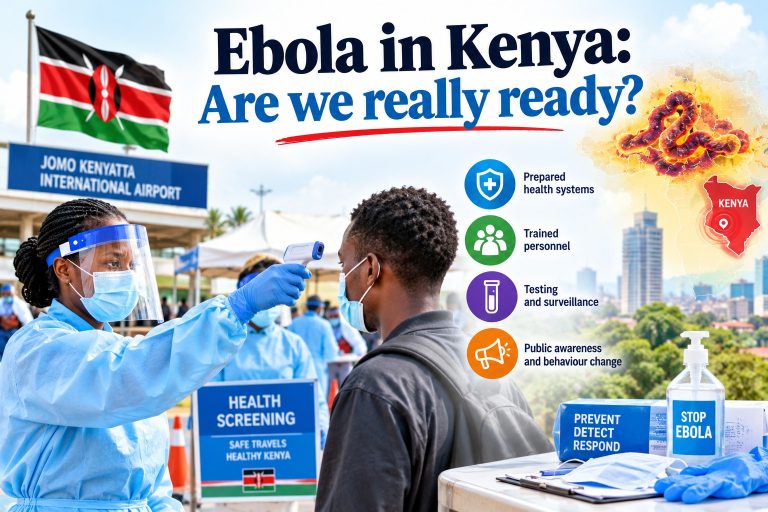
Kenya designates JKIA Gate 16 for Ebola high-risk arrivals in sweeping border health overhaul

Public Health PS Mary Muthoni/SCREENGRAB
With more than 634,000 travellers already screened, genomic testing deployed on aircraft wastewater, and isolation units positioned across East Africa’s busiest airport, Kenya is mounting its most sophisticated border health response in years.
By John Kimani
Kenya has converted Gate 16 at Jomo Kenyatta International Airport into a dedicated arrival point for passengers from Ebola high-risk countries, Public Health Principal Secretary Mary Muthoni announced on Friday following a hands-on inspection of the country’s frontline disease surveillance infrastructure at the nation’s busiest port of entry.
The designation of Gate 16 is the most visible element of a sweeping border health overhaul that Kenya has quietly assembled over the past several weeks as the Ebola outbreak in the Democratic Republic of Congo — involving the Bundibugyo strain, for which no licensed vaccine or approved targeted treatment currently exists — intensified and crossed into neighbouring Uganda. The World Health Organization declared the outbreak a Public Health Emergency of International Concern on 16 May 2026, while the Africa Centres for Disease Control and Prevention classified it as a continental public health emergency — designations that elevated the urgency of Kenya’s response from precautionary to operational.
“The border management team domiciled at the airport has increased surveillance at the six international arrivals gates, with Gate 16 now designated for passengers coming from high-risk countries,” Ms Muthoni said following her inspection. The statement was precise and deliberate — the language of a government that has moved from policy discussion to physical implementation. Gate 16 is not simply a labelled corridor. It is a health checkpoint staffed by port health officials, equipped with an isolation centre capable of rapid assessment and management of any traveller displaying symptoms consistent with Ebola virus disease, and positioned as the first line of a response chain that runs from the airport tarmac to Kenyatta National Hospital.
Additional isolation points have been established at multiple locations across the airport to ensure that no symptomatic traveller reaches the general public before being assessed. Kenya’s Ministry of Health has stated that more than 634,500 travellers — including international passengers, truck drivers, and transport conveyances — had undergone screening by 18 May 2026, a figure that reflects the scale of the operation Kenya has mounted in a remarkably short period. The screening infrastructure covers not only JKIA but extends across air, sea, and land borders, with Ms Muthoni confirming that the government has expanded mandatory health screening to cover arrivals from ten neighbouring countries.
The technological sophistication of Kenya’s surveillance response goes well beyond temperature checks and symptom questionnaires, though both remain in place. Port health authorities are now collecting and testing wastewater samples from all aircraft arriving at JKIA — both domestic and international — through national laboratories, deploying genomic sequencing as a tool to detect disease patterns and identify potential threats including Ebola before they can establish a foothold within the country. The approach borrows directly from techniques refined during the Covid-19 pandemic, when wastewater surveillance became a globally recognised early-warning mechanism. Applied to aircraft arriving from affected regions, it provides a layer of population-level intelligence that individual passenger screening cannot deliver alone. Samples are stored under controlled conditions at the port health clinic before analysis, and laboratory officials say results can be returned within six to eight hours.
All travellers arriving in Kenya are now required to complete online self-reporting forms detailing their travel history and current health status before landing. The digital data feeds into a broader passenger risk profiling system that allows health officials to identify and prioritise high-risk individuals for enhanced screening at arrival. The integration of digital data collection with physical screening represents a meaningful upgrade on the paper-based systems that characterised Kenya’s border health management in previous outbreak responses.
Ms Muthoni’s inspection covered the full scope of the airport’s preparedness architecture — passenger screening procedures, thermal scanning systems, laboratory readiness, aircraft and wastewater surveillance programmes, and emergency response coordination mechanisms. She commended frontline health workers and port health officers for their vigilance, while calling for a strengthened whole-of-government approach. “Effective disease surveillance requires collaboration among all agencies operating at points of entry,” she said, directing her message not only at health officials but at immigration, customs, aviation security, and airline operations staff who occupy the same physical space and whose cooperation determines how quickly a suspected case can be isolated and managed.
Kenya’s position in this outbreak demands more than routine vigilance. As East Africa’s primary aviation hub, JKIA handles more international traffic than any other airport in the region. That connectivity is a source of enormous economic and diplomatic strength. In a public health emergency, it is also a vulnerability. Passengers transiting through Nairobi to destinations across the continent and beyond represent a potential transmission pathway that Kenya is, in practical terms, managing on behalf of the entire region. The country’s response is therefore not merely a domestic health measure — it is a regional public health service of considerable consequence.
The government has been equally clear-eyed about what it does not yet know. Kenya remains free of confirmed Ebola cases, but officials have explicitly declined to offer reassurances about how long that status will hold as the outbreak in DRC and Uganda continues to evolve. Instead, the message from the Ministry of Health has been consistent and calibrated: the risk is real, the surveillance is functioning, and the public has a role to play.
Ms Muthoni urged Kenyans to practise proper hand hygiene, seek medical attention promptly when unwell, and follow Ministry of Health channels exclusively for accurate information rather than social media rumour. “Please, I want to plead with members of the public to only pay attention to the information coming from the Ministry of Health. Let us stop unverified information,” she said. She also cautioned against non-essential travel to countries experiencing active Ebola transmission. “Avoid unnecessary travel to those countries that have reported cases. If possible, wait until the situation stabilises before making the trip,” she advised.
Airport personnel and border officials across all points of entry have been briefed on Ebola symptoms, transmission routes, and response procedures. The government is working directly with airlines and affected countries to obtain passenger health information and exit screening reports, closing a coordination gap that has historically weakened border health responses in previous outbreaks across the region.
The gate has been designated. The laboratories are ready. The surveillance is running. Whether it will be enough depends, as it always does in public health, on how the virus behaves next — and how quickly Kenya moves when it does.
Similar Posts by The Mt Kenya Times:
- Mt Kenya Times ePAPER October 16, 2026
- Oburu marks birthday and brother’s death from Nairobi Hospital bed
- Natembeya and Orengo demand answers over security withdrawal
- Linda Mwananchi Movement: The brand that could reshape Ruto’s path to 2027
- ODM and Linda Mwananchi clash at Raila’s Bondo memorial
About the Author