Kenya’s hidden talent: The grassroots sports crisis we keep ignoring
In villages across the country, world-class talent is going to waste — and the system knows it.

By Simon Juma
When outsiders hear the word Kenya, they picture wildlife, world-beating distance runners and a peaceful nation on the African map. It is a flattering image, and not entirely wrong. But ask a Kenyan, and the pride comes wrapped in frustration — because they know what this country could be if it actually invested in the talent it produces so naturally and so abundantly.
Kenya is a nation of dreamers. In villages from Trans-Nzoia to the coast, children grow up convinced that their name will one day mean something. For many families, that belief is not merely ambition — it is strategy. Talent, if it can be harnessed, is a pathway out of poverty, a way to put food on the table and change the story of an entire household.
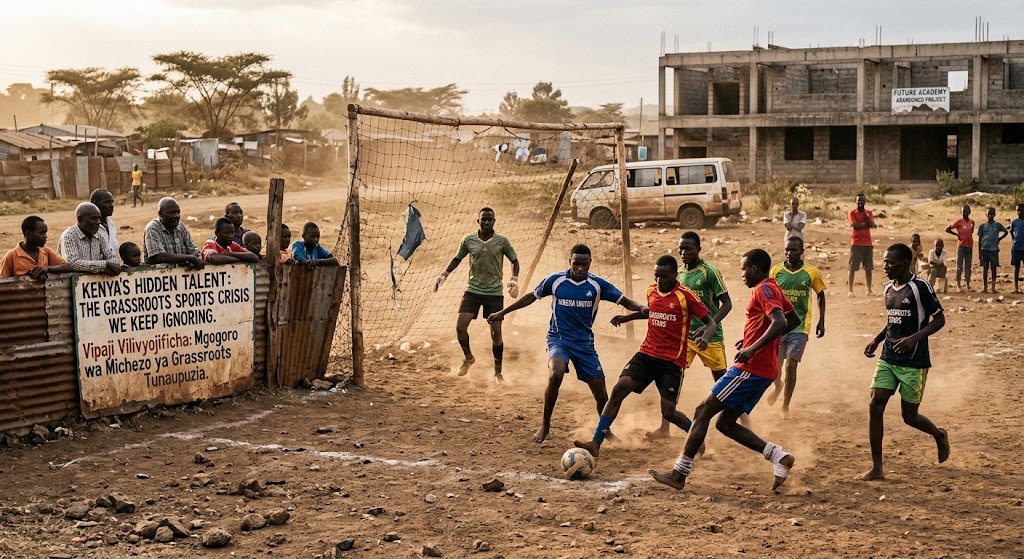
Walk through any rural community on a weekend and you will find football teams playing on open grounds with improvised goalposts, young men and women who pooled small contributions to buy a ball and a set of jerseys. In Trans-Nzoia County, clubs such as Siata FC and Coast FC may never appear on national television, but within their communities they command the kind of loyalty that fills terraces and silences crowds. Whole villages turn out to watch, cheering as though the final of a major tournament were being played on that dusty patch of ground.
The quality, by many accounts, is remarkable. Yet it goes unseen. There are no proper pitches, no training equipment, no academies, no scouts and no coaches operating at ward level. If grassroots football in Kenya were broadcast nationally, many supporters who follow the English Premier League would be startled by what exists on their doorstep. The talent is real. The infrastructure to support it is not.
The human cost of this neglect is written on the faces of those who have lived it longest. In Siata village, there are men who have played football for more than two decades and have nothing material to show for it — no income, no property, no professional recognition. Their passion endures but their bodies are ageing and their windows of opportunity have closed. Their stories are not exceptional. They are the norm for thousands of Kenyan athletes across football, athletics, volleyball and rugby who gave their youth to sport and received nothing back because the system was never designed to support them.
This is a failure of policy and political will, not of talent. Corruption and the misappropriation of public funds have redirected money that should have built sports academies into private accounts and lavish expenditure that serves no one but those in office. Had even a fraction of those resources been invested in grassroots sport, Kenya would today have a pipeline of professional athletes generating income, inspiring communities and representing the country on the global stage.
The remedy is not complicated, even if it requires genuine commitment. The government must establish sports centres in every county, deploy qualified coaches at ward level and create a tournament structure that begins in the village and scales to the national level. Talent identification cannot remain a Nairobi exercise. It must reach every corner of the country, because the next generation of world-class Kenyan athletes is almost certainly not training at a well-funded urban academy. They are playing barefoot on a school field somewhere, waiting for someone to notice.
A well-supported athlete does more than compete. A player earning a professional wage builds a house for his parents, educates younger siblings and becomes a living example of what is possible for other children in his community. Sport, when properly resourced, does not merely entertain — it generates employment, reduces crime and anchors young people in purpose and discipline.
In Europe, a talented child from a modest background can become a millionaire because the system identifies, develops and rewards ability from an early age. Kenya produces the raw material at least as generously. What it has consistently failed to produce is the system.
The question Kenya must answer honestly is not whether the talent exists. It plainly does. The question is whether those in positions of authority are finally prepared to stop wasting it.
Similar Posts by The Mt Kenya Times:
- Kenya’s Ebola cases climb to eight as outbreak spreads beyond health workers
- Kenya braces for heavy rains as El Niño and Indian Ocean Dipole combine
- Kenya’s opposition gamble: One ticket or another defeat
- Bridging languages in tourism: A French-Uzbek perspective
- Amsons Group acquires Oryx Energies Tanzania business in a historic energy transaction
About the Author



 Shamlal Puri