Kenya’s political compass in dilemma: Why the country must recalculate its route before it is too late
 The Mt Kenya Times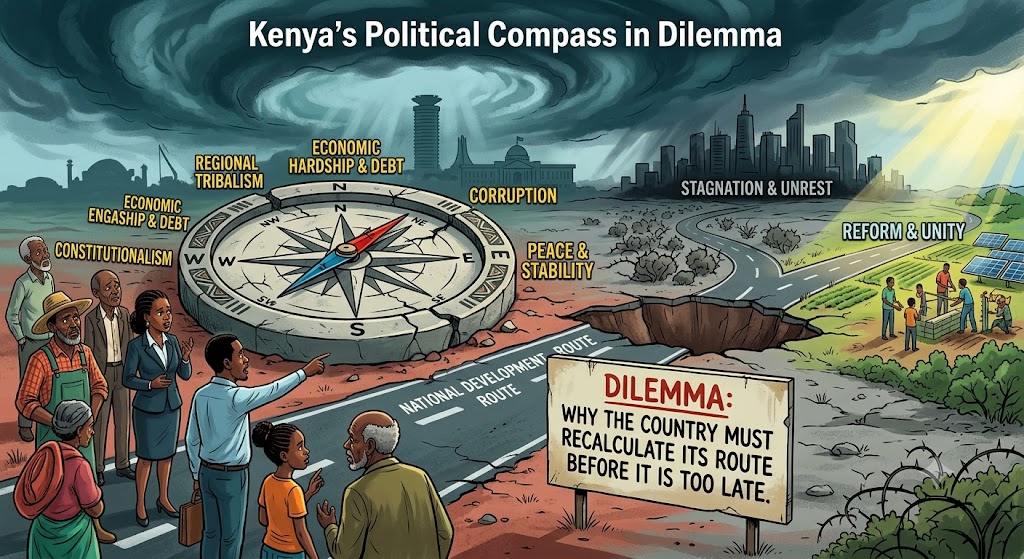
By Mr. Fredrick Kipchumba Chelimo PWD
Email: fkipchelimo@yahoo.com
Every journey begins with a simple question: Where are we, where are we going, and how do we get there? For centuries, humanity struggled to answer these questions. Early traveler’s followed familiar landmarks, watched the movement of the sun and stars, studied the winds and waves, and stayed close to the safety of the shore. When they ventured into unknown waters, they relied on courage, memory and instinct. Over time, the compass gave them direction, the astrolabe and sextant helped them establish their position, the marine chronometer enabled them to determine longitude, and maps transformed their understanding of the world. Today, satellites and GPS can pinpoint a person’s location within seconds. Yet even the most sophisticated navigation systems can be jammed, spoofed or misdirected. The lesson is profound: navigation is never simply about having a tool; it is about knowing where you are, trusting the information you receive and having the wisdom to correct your course when you are wrong.
Kenya’s political journey is no different. The country has travelled from traditional systems of community leadership through colonial rule, independence, one-party dominance, multiparty democracy and constitutional devolution. Each era introduced new political instruments intended to help the nation find its direction. Yet, more than six decades after independence, Kenya appears to be facing an unsettling question: Are we actually moving towards the destination we have repeatedly promised ourselves, or have we become experts at navigating in circles?
Politics, in its most noble sense, is society’s navigation system. It exists to organize collective life, resolve competing interests, distribute scarce resources and establish the rules by which people live together. Aristotle understood politics as inseparable from the pursuit of the common good. In Kenya, however, politics has too often become less about the destination and more about controlling the steering wheel. Elections are treated as the ultimate measure of political success, while the deeper questions of national progress, social justice, economic opportunity and institutional integrity are frequently pushed aside.
Our political journey began with inherited maps. At independence, Kenya inherited a highly centralised state whose structures had largely been designed for colonial administration rather than inclusive national development. The early years of independence strengthened central authority, creating political stability but also concentrating power and resources at the centre. Over time, the consequences became evident: regional inequalities deepened, political competition became intertwined with ethnicity and access to state resources, and communities increasingly viewed national politics through the lens of who was winning and who was losing.
The return to multiparty democracy in the 1990s was supposed to provide a new compass. It opened political space and restored competition. But while Kenya acquired more political parties, it did not necessarily acquire more political ideas. Parties frequently became temporary vehicles for personalities, alliances and electoral calculations rather than enduring institutions with coherent philosophies and long-term national programmes. The faces changed, coalitions shifted and political friendships were repeatedly rewritten, but the fundamental architecture of power remained remarkably resilient.
The Constitution of 2010 attempted to redraw the national map. Devolution was designed to bring government closer to the people, distribute resources more equitably and give communities greater control over their development priorities. It was one of the boldest attempts to correct the historical imbalance created by excessive centralisation. Yet devolution has also demonstrated a hard truth: a better map does not automatically produce a better journey. Where institutions are weak, corruption is tolerated and political interests override public priorities, power can simply be decentralised without governance being transformed.
Today, Kenya possesses more data, policies, strategies, development plans and performance frameworks than perhaps at any other time in its history. We have sophisticated statistics and elaborate monitoring systems. We can count kilometres of roads built, projects launched, beneficiaries registered, funds allocated and meetings held. But increasingly, citizens are asking a more uncomfortable question: What has all this activity actually changed?
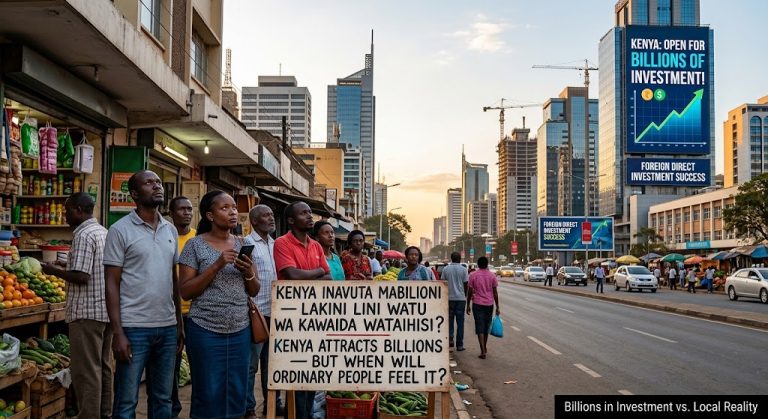
The farmer wants a reliable market, not another workshop. The young person wants a job, not another promise. The parent wants a functioning school and affordable healthcare, not another policy document. The person with a disability wants genuine inclusion, not a paragraph in a government report. The small business owner wants an economy in which effort is rewarded rather than suffocated by bureaucracy, corruption and unpredictable taxation. The ordinary citizen wants to know why, despite decades of development programmes and billions of shillings spent, the quality of everyday life remains so difficult.
This is where Kenya’s political GPS appears to be failing.
A GPS can confidently direct a driver to the wrong destination if the information guiding it is inaccurate. Politics can do the same. False narratives, political propaganda, ethnic mobilisation and misinformation can create an alternative reality in which failure is presented as success and responsibility is endlessly shifted to someone else. A government may announce progress while citizens experience hardship. Leaders may celebrate statistics while families struggle with the rising cost of living. Political actors may spend enormous energy explaining why the past was responsible for the present, while offering little credible evidence that the future will be different.
Kenya is also experiencing a form of political jamming. Good policies often exist, but their signals are obstructed by corruption, patronage, bureaucratic inertia, weak accountability and political interference. A well-designed agricultural programme can fail because farmers cannot access markets. A development fund can exist without producing sustainable livelihoods. A county can receive resources yet fail to deliver quality services. The problem is not always that Kenya lacks ideas. Too often, it lacks the political discipline and institutional integrity to execute them.
The greatest danger, however, is short-termism. A nation cannot navigate by looking only at the next wave. Yet Kenyan politics is frequently trapped in the rhythm of electoral cycles. Leaders favour projects that generate immediate political visibility over reforms whose benefits may take years to emerge. National priorities are repeatedly reshaped by succession politics, coalition bargaining and the pursuit of electoral advantage. The country moves from election to election, while structural problems remain stubbornly in place.
Kenya therefore needs more than new political leaders. It needs a new political navigation system.
The politics of the future must be measured by results rather than rhetoric, competence rather than charisma, institutions rather than personalities, citizenship rather than ethnicity, and long-term national interest rather than short-term electoral gain. The central political questions must change. Instead of asking who belongs to which community, we should ask who can deliver. Instead of asking who has captured power, we should ask what power has delivered. Instead of celebrating how much money has been allocated, we should demand to know what has been achieved.
Kenya must learn to navigate by four simple principles: distance, duration, direction and destination. How far are we from the promises of the Constitution? How long will genuine transformation take? Which direction will produce sustainable prosperity? And what will ordinary citizens actually experience when we finally arrive?
The answer will require a new political culture—one willing to confront uncomfortable truths, acknowledge failure, reward competence and hold power accountable. Kenya must stop confusing movement with progress and activity with impact. It must stop mistaking political noise for national direction.
The history of navigation teaches us that every system eventually reaches its limits. The compass replaced guesswork; the sextant improved precision; GPS transformed global movement; and now quantum navigation is being explored because even GPS has vulnerabilities. Politics must evolve in the same way.
Kenya cannot navigate the complexities of the twenty-first century with political instruments designed for another era. The country must recalculate its route before the distance between political promises and citizens’ lived realities becomes impossible to bridge.
The real question before Kenya is therefore not simply who will win the next election. It is far more consequential: Are we finally prepared to choose a destination worthy of the nation we want to become—and to build the political system capable of taking us there?
Kenya is not short of navigators. What it desperately needs is a direction.
Similar Posts by The Mt Kenya Times:
- Mt Kenya Times ePAPER September 15, 2026
- Court ruling clips Kenyatta’s wings at the worst possible moment
- Ruto takes the sponsor war to Nyanza — and finds a warmer welcome than his opponents expected
- Kisumu water project lays foundation for dignified urban growth
- The months ahead offer Kenya a golden opportunity to grow tourism
About the Author