Kenya’s public finance crisis: Taxpayers are paying more, but who is accounting for the money?
 The Mt Kenya Times
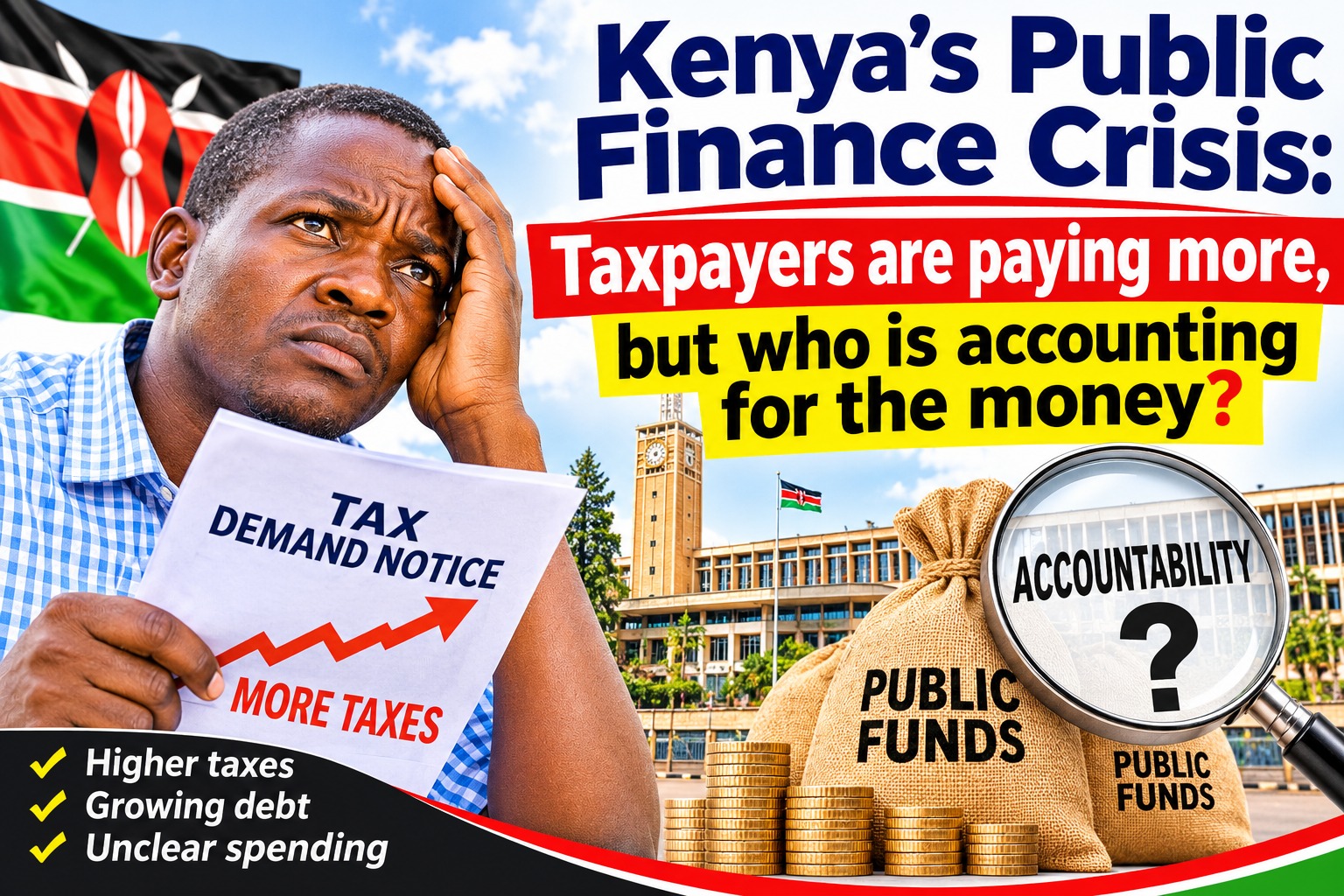
By Fredrick Kipchumba Chelimo – PWD
Email; fkipchelimo@yahoo.com
“Taxation is a constitutional obligation imposed on citizens in trust that the resources collected will finance public services, advance national development and improve the quality of life. When the Government demands more from its citizens but cannot satisfactorily explain what happens to the money collected, the problem ceases to be merely financial; it becomes a crisis of public trust, institutional responsibility and constitutional accountability.”
There is a growing contradiction in Kenya’s public finance management that deserves serious national reflection. Citizens are confronted with taxation, statutory deductions, service charges, borrowing costs and rising living expenses, yet the institutions entrusted with collecting, appropriating and spending public resources repeatedly appear unable to establish precisely where substantial amounts of money have gone. More disturbing is the spectacle of senior government officials and parliamentary committees expressing surprise when audit findings expose unexplained balances, irregular transfers, unsupported expenditure and financial discrepancies. The question is no longer whether Kenya has sufficient resources to finance its development ambitions, but whether those resources are being managed with the discipline, transparency and responsibility demanded by the Constitution.
The e-Citizen revelations provide a particularly instructive illustration. The National Treasury’s FY2023/2024 consolidated financial statements reported approximately KSh100.84 billion in platform receipts. However, subsequent audit examinations identified weaknesses in reconciliation, transaction reporting, government access to records and the movement of collections. The Auditor-General’s report for FY2024/2025 subsequently questioned the reliability of approximately KSh206.13 billion in reported transfers to government entities, identifying discrepancies that required explanation and reconciliation. These figures cover different reporting periods and must not be added together or automatically characterised as losses. Nevertheless, they demonstrate the scale of the financial control problem.
The concern is that citizens make payments believing they are dealing directly with the Government of Kenya, yet the Government itself has experienced difficulties independently establishing the complete movement of those payments. The reported KSh6.3 billion associated with a private Pesaflow account, the unresolved questions surrounding settlement arrangements and the dependence on private technical service providers raise fundamental questions about the custody and administration of public revenue. Digitalisation was intended to eliminate financial opacity, not introduce another layer of institutional uncertainty.
However, e-Citizen is only one manifestation of a much wider public finance challenge. The Office of the Controller of Budget, in its FY2024/2025 National Government Budget Implementation Review, highlighted revenue shortfalls, pending bills, expenditure pressures, delayed releases and the misuse of Article 223 to finance foreseeable expenditure. The Controller also warned that accumulated pending bills could become increasingly difficult to manage as Government transitions towards accrual accounting. These are not merely accounting inconveniences. They reflect weaknesses in planning, commitment control, procurement and expenditure management.
The National Treasury’s own fiscal reporting equally illustrates the pressure. The Government’s Public Debt Management Office reported total debt service of approximately KSh1.72 trillion in FY2024/2025. This includes principal repayments and interest, demonstrating how much of the national financial capacity is committed to servicing existing obligations. The World Bank’s Kenya Public Finance Review also observed that public debt stood at approximately 68 per cent of GDP in 2024, while interest costs absorbed more than one-third of public revenues. The consequences are felt through constrained development spending, reduced fiscal flexibility and competing demands on essential services.
Yet citizens are frequently presented with explanations centred on inadequate revenue, competing priorities and the need to expand taxation. What receives insufficient attention is whether existing resources are being efficiently protected and utilised. It is difficult to persuade a struggling household or business to accept additional taxation when the Government cannot consistently demonstrate value for money, settle legitimate suppliers’ bills, complete funded projects or account for substantial financial discrepancies.
The greatest institutional responsibility rests with the Executive, particularly the National Treasury and the accounting officers responsible for public revenue and expenditure. Under the Public Finance Management Act, 2012, and Articles 201, 206 and 226 of the Constitution, public money must be properly managed, accounted for and applied through lawful financial structures. Treasury cannot distance itself from weaknesses in national revenue architecture, cash management and financial reporting. Equally, accounting officers cannot escape responsibility by attributing discrepancies to technology providers, payment intermediaries or administrative systems. Outsourcing a service does not outsource constitutional accountability.
The responsibility extends to ministries, departments, agencies and procurement authorities. Every accounting officer must establish that revenue received is correctly recorded, expenditure is authorised, procurement delivers value and contractual obligations are properly managed. Persistent audit queries, unsupported payments, irregular commitments and unaccounted balances should attract consequences where individual responsibility is established. The Auditor-General has previously warned that audit recommendations frequently recur because implementation and enforcement remain inadequate.
Parliament must also shoulder responsibility, although its constitutional role is oversight rather than executive financial management. Appropriation is not simply the approval of expenditure estimates; it is an undertaking to scrutinise how public resources are ultimately applied. The National Assembly cannot repeatedly receive audit reports, convene hearings, express indignation and then allow unresolved findings to disappear into subsequent financial years. Its Public Accounts Committee and Budget and Appropriations Committee must insist on implementation schedules, recoveries where justified, referrals where necessary and public disclosure of outstanding recommendations. Oversight without enforceable follow-through risks becoming an annual institutional ritual.
Nevertheless, the Auditor-General and Controller of Budget should not be blamed for identifying failures within institutions they are constitutionally mandated to scrutinise. Their independence must be protected and their recommendations acted upon. The Ethics and Anti-Corruption Commission, investigative agencies and Director of Public Prosecutions must pursue evidence of wrongdoing within their respective mandates, while distinguishing administrative shortcomings from criminal conduct.
Ultimately, Kenya needs a fundamental shift from revenue mobilisation as the principal measure of fiscal performance to accountable resource management as an equally important national obligation. Every shilling collected must be traceable from the citizen’s payment through the receiving account, appropriation, expenditure and final financial reporting. IFMIS integration, Treasury Single Account principles, daily reconciliation, transparent procurement, independent audits and enforceable sanctions must become operational realities rather than policy promises.
The taxpayer is not an adversary of the Government. Citizens contribute through taxation because the Constitution establishes a social and financial compact between the State and its people. That compact cannot survive indefinitely on demands for sacrifice without corresponding evidence of responsible stewardship.
Kenya does not merely need explanations whenever billions become questionable. It needs institutions that prevent such situations, officers who accept responsibility, Parliament that enforces accountability and a Treasury capable of demonstrating where public money goes.
“The greatest injustice to a taxpayer is not merely being asked to contribute more, but being compelled to finance a government that cannot satisfactorily account for what it has already collected. Public resources belong to the people; their management is a constitutional trust, not an administrative privilege.”
Similar Posts by The Mt Kenya Times:
- TVS and Car & General open Nyeri motorcycle training hub in KSh4M skills push
- Nyahururu cannot afford to remain in the dark
- University students want class, not another countdown to crisis
- Staying steady in a first-world rush
- Surveyors must guard Kenya’s land, not sell it
About the Author