Kindiki calls for urgent restoration of degraded ecosystems, champions blue economy and 15 billion tree drive
 The Mt Kenya Times
Deputy President Kithure Kindiki with other leaders in Vipingo, Kilifi county.

By DPCS
Deputy President Kithure Kindiki has called for urgent global and national action to restore degraded rangelands, protect fragile ecosystems and strengthen environmental resilience, warning that the future of food security, livelihoods and economic stability depends on responsible management of natural resources.
Speaking during the Global Observance of Desertification and Drought Day in Vipingo, Kilifi County, Prof. Kindiki said Kenya is committed to large-scale environmental restoration programmes, including an ambitious plan to plant 15 billion trees by 2032 to combat land degradation, drought and desertification.
“We must recognize the numbers, we must recognize the magnitude of the challenge before us, and we must recognize the duty the present generation owes, not to ourselves, but to future generations,” he said.
The Deputy President stressed that rangelands, forests and wetlands are productive ecosystems that sustain millions of livelihoods and should not be treated as wastelands. He warned that continued degradation of land resources leads to reduced productivity, food insecurity, loss of income and increased poverty and displacement.
“When land loses its productivity, farmers lose harvests, people lose income, pastoralists lose livestock, communities lose water sources and young people lose opportunities. The consequences are poverty, conflict and displacement,” he said.
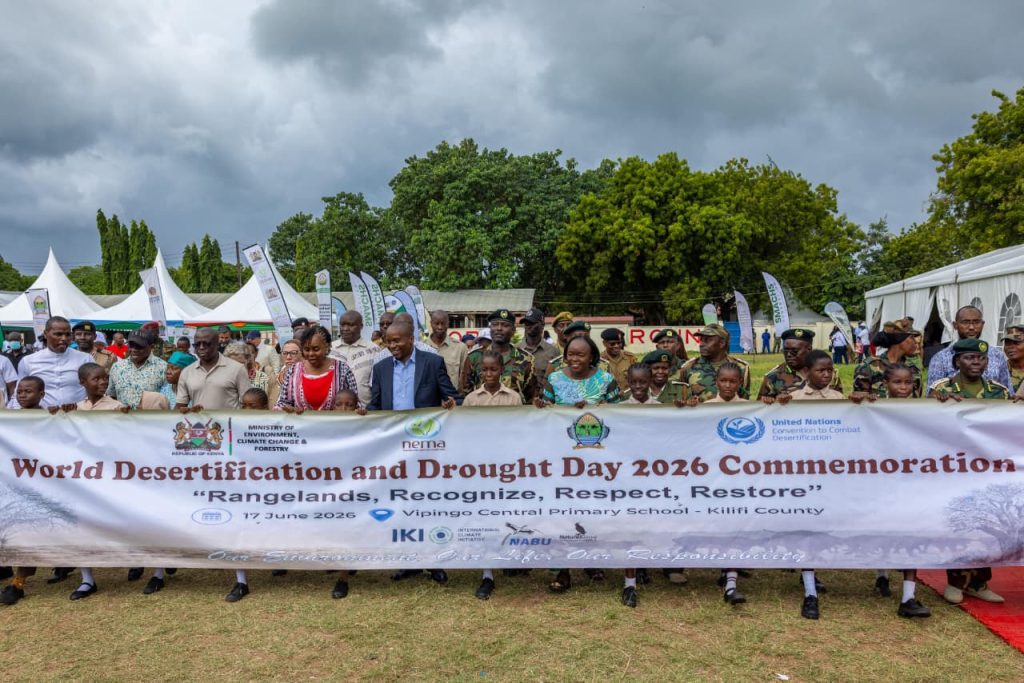
Prof. Kindiki emphasized that wetlands and rangelands play a critical role in supporting agriculture, water availability and ecological balance. He also underscored the need for intergenerational responsibility, urging present leaders and citizens to safeguard natural resources for future generations.
“We have not inherited this land from our ancestors; we have only borrowed it from our children,” he said.
He added that environmental restoration requires clear targets, timelines and accountability mechanisms to ensure measurable progress, noting that Kenya is strengthening partnerships with international organizations such as the United Nations Environment Programme (UNEP) and the United Nations Convention to Combat Desertification (UNCCD).
The Deputy President highlighted that Kenya’s 15 billion tree programme will prioritize locally suitable species, including mangroves, coconut, mango and cashew nut trees, especially in coastal counties like Kilifi. He said the initiative is designed not only to restore degraded landscapes but also to create economic opportunities for local communities.
“These trees do not only help conserve the environment; they also create wealth and put money in the pockets of the people of Kilifi and the entire coastal region,” he said.
He further directed that mangrove restoration efforts be intensified along the coast, noting that mangroves play a vital role in protecting shorelines, supporting fisheries and enhancing biodiversity.
“We must commit to increasing the number of mangroves planted here in Kilifi every month,” he said.
Prof. Kindiki also stressed the importance of integrating indigenous knowledge into conservation programmes, saying community participation is essential for sustainable environmental management.
“We must respect communities and their knowledge. We must also protect them, and we must support them,” he said.
The event was attended by Environment Cabinet Secretary Deborah Barasa, Environment Principal Secretary Festus Ngeno, Kilifi Deputy Governor Flora Mbetsa, senior UNEP officials, Members of Parliament and other stakeholders.
In a related address during the 11th Our Ocean Conference in Mombasa, the Deputy President reiterated Kenya’s commitment to protecting marine ecosystems and advancing the blue economy as a key driver of national development.
Speaking on behalf of President William Ruto, Prof. Kindiki said Kenya is taking deliberate steps to preserve its ocean resources by addressing threats such as climate change, plastic pollution, illegal fishing and degradation of marine biodiversity.
“We have an obligation as the current generation to return the ocean to our children cleaner, richer and more resilient than we found it. That is how profound our obligation is,” he said.
President Ruto, in a video address to the conference—the first of its kind held in Africa—emphasized Kenya’s active role in ocean conservation through mangrove restoration, fisheries reforms, improved ocean governance and investment in blue finance, science and innovation.
Prof. Kindiki noted that the establishment of the Ministry of Blue Economy and Maritime Affairs demonstrates Kenya’s long-term commitment to sustainable management of ocean resources and economic transformation through marine industries.
“The creation of a special ministry responsible for the Blue Economy and Maritime Affairs is not an accident nor an afterthought, but a continuation of a long journey that this country has travelled,” he said.
He added that protecting marine ecosystems is not only an environmental responsibility but also an economic necessity, given the ocean’s role in supporting industries, livelihoods and food systems.
The conference, themed “Our Ocean, Our Heritage, Our Future,” brought together global leaders, policymakers and environmental experts, including former US Secretary of State John Kerry, alongside Cabinet Secretaries, governors and international delegates.
Prof. Kindiki concluded by reaffirming Kenya’s commitment to safeguarding both land and ocean ecosystems, saying the country is determined to ensure environmental conservation goes hand in hand with economic growth, community empowerment and global climate action.
Similar Posts by The Mt Kenya Times:
- Mt Kenya Times ePAPER October 13, 2026
- Ruto commissions Uasin Gishu dam to boost year-round farming
- Ruto calls Kenyatta a conman as Kenya’s 2027 battle begins in earnest
- Electricity access must lead to local opportunity
- God had to break your marriage to save your mother’s house
About the Author