Literature as a Catalyst for Change: Confronting Gender-Based Violence in Southern Africa
 The Mt Kenya Times
The Girl Who Chased Dragonflies
- When did you start writing?

I have been writing for as long as I can remember. People often tell me that I live in my head, and I suppose that is true. Long before I put pen to paper, I am constantly creating scenarios, characters, conversations, and stories in my mind. Writing has always been a natural extension of the way I see and process the world.
Even during my primary school years, I showed a strong interest in creative writing. I remember my compositions being used in class as examples for other learners, which gave me confidence and encouraged me to continue developing my craft. Looking back, I realize that storytelling has always been a part of who I am. What began as a childhood passion has grown into a lifelong commitment to telling stories that entertain, educate, and inspire meaningful conversations.
- What inspired you to write?
One of my greatest sources of inspiration came from my childhood when I lived with my grandparents in the village. My grandmother played a significant role in nurturing my love for words. She would often encourage me to write letters to my mother and insisted that I make them as descriptive and engaging as possible. She taught me that writing is not simply about conveying information; it is about making people feel as though they are experiencing the story alongside you.
The village itself was also a place of discovery. My uncles and aunts who had moved to the city had left behind collections of books, and I spent countless hours reading them. Those books opened up new worlds and introduced me to the power of storytelling. Through reading, I realized that stories could entertain, heal, educate, and challenge society. It was during those years that I first dreamed of writing stories of my own.
- Do you see growth in book sales?
I believe book sales are closely linked to visibility and marketing. No matter how good a book may be, readers cannot buy what they do not know exists. In today’s environment, authors must recognize that writing the book is only half the journey. The other half is ensuring that the book reaches its intended audience.
Book marketing is not linear. It cannot rely solely on traditional book launches or bookstore placements. A successful book should be able to tell its story across multiple platforms, whether through workshops, speaking engagements, community outreach programs, social media, interviews, or educational forums. Readers engage with books differently today, and authors must be willing to meet them where they are. As awareness of local literature continues to grow, I believe there is tremendous potential for increased book sales across Botswana and the region.
- What are your plans for marketing the book?
I have developed a marketing strategy that targets different audiences through a variety of platforms. Social media has already proven to be a powerful tool for increasing visibility, generating conversations around the book, and securing pre-orders. Platforms such as Facebook, TikTok, and other digital spaces allow authors to engage directly with readers and create communities around their work.
Beyond social media, I intend to participate in podcasts, radio interviews, literary discussions, school visits, and community engagements. I have already been featured in educational newsletters, which has helped introduce the book to educators and parents. My goal is to ensure that the conversation around the book extends beyond the pages and reaches people who may benefit from its message.
- Advocacy: Will you partner with others to speak out, or does the message end with the book?
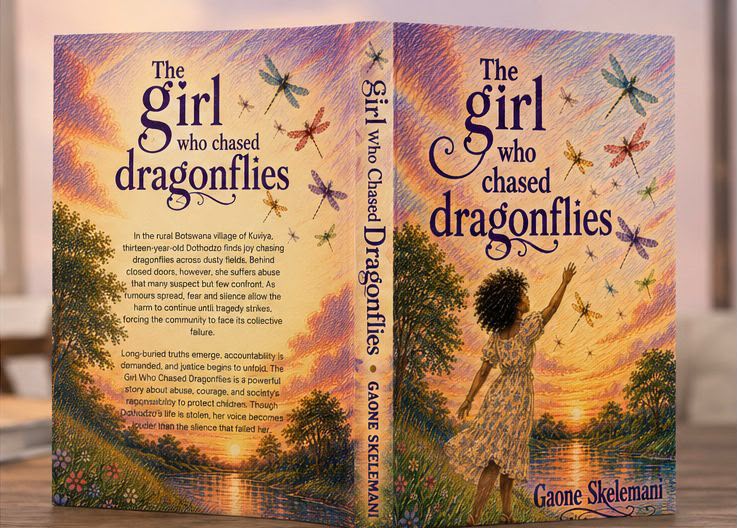
For me, advocacy can never end on ink. Writing a book is only one part of creating awareness. A book can start a conversation, but meaningful change requires continuous engagement with communities, institutions, and policymakers.
I look forward to partnering with like-minded organizations, advocates, educators, and individuals who are committed to addressing gender-based violence and child protection issues. My hope is that The Girl Who Chased Dragonflies will serve as a catalyst for broader conversations and action.
We are currently exploring initiatives, including a cycling awareness event during the annual 16 Days of Activism Against Gender-Based Violence campaign. I welcome opportunities to collaborate with partners both within Botswana and internationally because gender-based violence is not confined to one country. It is a global challenge that requires collective action and shared responsibility.
- Gender-Based Violence is rife in Southern Africa. What do you think is the cause, and can literature make a difference?
Gender-based violence is a complex issue with no single cause. It is influenced by a combination of factors, including family dynamics, economic pressures, substance abuse, social norms, trauma, and the growing challenges surrounding mental health. These factors often intersect and create environments where violence can thrive.
I also believe that while significant efforts have been made to empower girls and women, we must ensure that boys and men are not left behind in the conversation. We need to raise boys who understand respect, emotional intelligence, healthy relationships, and accountability. When we focus on one side of the equation and neglect the other, we risk missing opportunities to address the root causes of violence.
- Can literature make a difference?
Absolutely. Literature has the power to humanize statistics and put faces to issues that might otherwise feel distant. Stories allow readers to walk in someone else’s shoes, develop empathy, and confront uncomfortable truths. While a book alone cannot end gender-based violence, it can challenge perceptions, inspire dialogue, and encourage people to take action. Social change often begins with awareness, and literature remains one of the most powerful tools for creating that awareness.
- What word of encouragement would you give to a young woman facing Gender-Based Violence?
My message extends not only to women but to anyone experiencing abuse. While women are disproportionately affected by gender-based violence, we must also acknowledge that men can be victims. Unfortunately, societal expectations often discourage men from speaking out, leaving many to suffer in silence.
To anyone experiencing abuse, I want you to know that your life, your safety, and your dignity are more valuable than any relationship. No one has the right to harm you physically, emotionally, financially, or psychologically.
Do not suffer in silence. Reach out to trusted family members, friends, community leaders, support organizations, or the relevant authorities. Seeking help is not a sign of weakness; it is an act of courage. You deserve to live free from fear and violence.
Above all, choose yourself. Protect your well-being and remember that love should never come at the cost of your safety. Your story does not have to end in pain. There is hope, there is support, and there is a future beyond abuse.
Similar Posts by The Mt Kenya Times:
- When parliament becomes a symbol of despotism, resistance becomes a duty
- Zeï Khauli – Canada’s inspiring queen of purpose and empowerment
- When the people’s house (parliament) becomes the people’s auction house in Kenya
- Regina Angarita: An unstoppable global icon
- Nationwide Nurses’ Strike Takes Effect as Kisii Union Urges Public to Seek Alternative Healthcare
About the Author