Mackenzie guilty: Court convicts cult leader of 191 murders at Shakahola
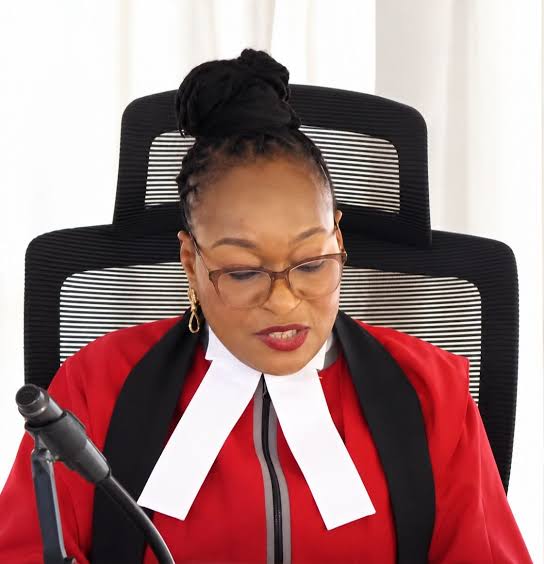
Justice Diana Kavedza
A landmark Mombasa verdict draws the curtain on Kenya’s darkest cult tragedy — but justice for hundreds more victims is still pending.
By Valentine Atieno and Jane Njeri
The High Court in Mombasa yesterday convicted self-proclaimed preacher Paul Nthenge Mackenzie and 28 co-accused of murdering 191 people — 190 of them children — in what is now confirmed as one of the worst cult-related atrocities in modern history.
Justice Diana Kavedza delivered the verdict at the Mombasa Law Courts, finding all 29 accused guilty on all counts of murder under Section 203 of the Penal Code. “I am satisfied that the prosecution has proved the case against all the 29 accused persons for the murder of 190 children and one adult,” she ruled. “I reject the defence by the accused persons that the victims, who were all below the age of 16 years, voluntarily fasted to death.”
The judgment brings to a close one chapter of a tragedy that has haunted Kenya since April 2023, when authorities first uncovered shallow graves on Mackenzie’s 325-hectare ranch in Shakahola Forest, Kilifi County. More than 400 bodies have since been recovered from the surrounding area, and investigations into the wider massacre continue.
The court heard how Mackenzie, founder of Good News International Ministries — a church he established in 2003 that eventually spread to 25 branches across Kenya — constructed an elaborate theology of death. Justice Kavedza identified six pillars of radicalisation at the heart of his doctrine: the denunciation of formal education and modern medicine, the rejection of government authority, the systematic isolation of followers, their forced relocation to the forest, and the enforcement of fatal fasting. The court noted that Mackenzie told followers that doctors were witches and that medicine was made by Satan, citing scripture to argue that believers should rely on prayer and anointing, not hospitals.
Prosecutors described a “structured hierarchy of death” under which children were to die first, followed by teenagers, women and then men. Child survivors testified they were denied food and water despite supplies being available, while armed guards were posted to prevent followers from leaving the compound. “Fasting was implemented sequentially, beginning with children, while guards controlled movement and prevented followers from escaping,” the Office of the Director of Public Prosecutions said in a statement. The prosecution called 120 witnesses and presented forensic DNA results, medical reports, digital records and evidence recovered from the mass graves.
The defence had maintained throughout that the case was “largely founded on circumstantial evidence, hearsay accounts and inconclusive forensic findings.” Mackenzie’s lawyer, Lawrence Obonyo, was defiant after the ruling. He called the verdict “perplexing,” said his clients were “surprised and disappointed,” and announced his intention to appeal, adding: “We have so much confidence that the verdict will be overturned.”
The most pointed legal criticism of the judgment came from Senior Counsel Charles Kanjama, President of the Law Society of Kenya, who raised substantive concerns about the jurisprudential approach taken by the court. Writing on social media yesterday, Kanjama said the judge had ventured beyond her proper legal domain. “Here the judge ventured into Christian theology, and even scriptural hermeneutics, and became a preacher, which is a legally-shaky approach to jurisprudence,” Kanjama wrote. He questioned what the ruling meant for the more than half of the global Christian population that accepts the Books of Maccabees as part of the scriptural canon, and challenged whether a court of law should be judicially affirming the Protestant doctrine of sola scriptura — the principle that scripture alone is the source of religious authority — while failing to account for the diversity of views on revelation within Christianity. “The Constitution and the Penal Code should suffice in determining whether the Shakahola tragedy amounted to criminal acts,” Kanjama said, drawing a clear line between what he regarded as the proper tools of jurisprudence and the theological territory into which the judgment had strayed.
His commentary does not challenge the facts of the massacre, nor the guilt of those convicted. It raises a narrower but constitutionally significant question: whether a court can ground a criminal conviction in a contestable interpretation of religious scripture without undermining both the separation of church and state and the right to freedom of conscience guaranteed under the Constitution of Kenya.
Director of Public Prosecutions Renson Ingonga described the verdict as “momentous.” For the families who had travelled from coastal communities to Mombasa to hear the ruling, the day carried a weight that no legal term could adequately contain. Francis Wanje, 62, who lost eight family members including his daughter and two grandchildren, said before the session: “We are expecting a ruling that will be a lesson to the whole public, so that such kinds of things will not happen again.” After the verdict, he expressed relief, though his grief remained raw and visible.
Not everyone in the courtroom received the outcome the same way. At least one woman was heard saying of Mackenzie: “I still love him and he is still my pastor” — a sobering reminder that the psychological hold of the cult endures for some survivors even now, three years on.
Sentencing is set for November 6, when all convicts will be physically produced in court. Pre-sentence reports are due on October 30, after which the defence will make mitigation submissions before Justice Kavedza hands down her sentence. The court will determine whether to impose the death penalty — which, given Kenya’s effective moratorium on executions, would in practice mean life imprisonment — or another sentence under Kenyan law.
Yesterday’s 191 convictions, however, represent only a fraction of the full Shakahola death toll. In January this year, Mackenzie faced fresh charges linked to the discovery of another 52 bodies in a nearby village, and he continues to face separate proceedings on charges of terrorism, radicalisation and child cruelty.
The case has prompted renewed calls for the government to impose tighter regulations on religious organisations, particularly given that Mackenzie had been arrested twice previously and released on both occasions before the full scale of the Shakahola tragedy came to light. The question of state failure — of how a man whose activities drew police attention as far back as 2017 was able to oversee the deaths of hundreds of children on a forest ranch — remains unanswered and unlikely to be settled by this verdict alone.
What the court did settle yesterday, with unambiguous authority, is this: 191 people did not choose to die. They were killed. And the men and women responsible have been found, named and convicted.
Similar Posts by The Mt Kenya Times:
- Mashujaa Day: Honouring Kenya’s heroes and heroines
- Preparing for the long holidays: Are parents ready?
- The best time to plant a tree was 30 years ago. The second best time is now
- Mashujaa Day 2026: The nation awaits
- Uganda’s healthcare crisis: A nation that buries its people at the theatre door
About the Author