
 The Mt Kenya Times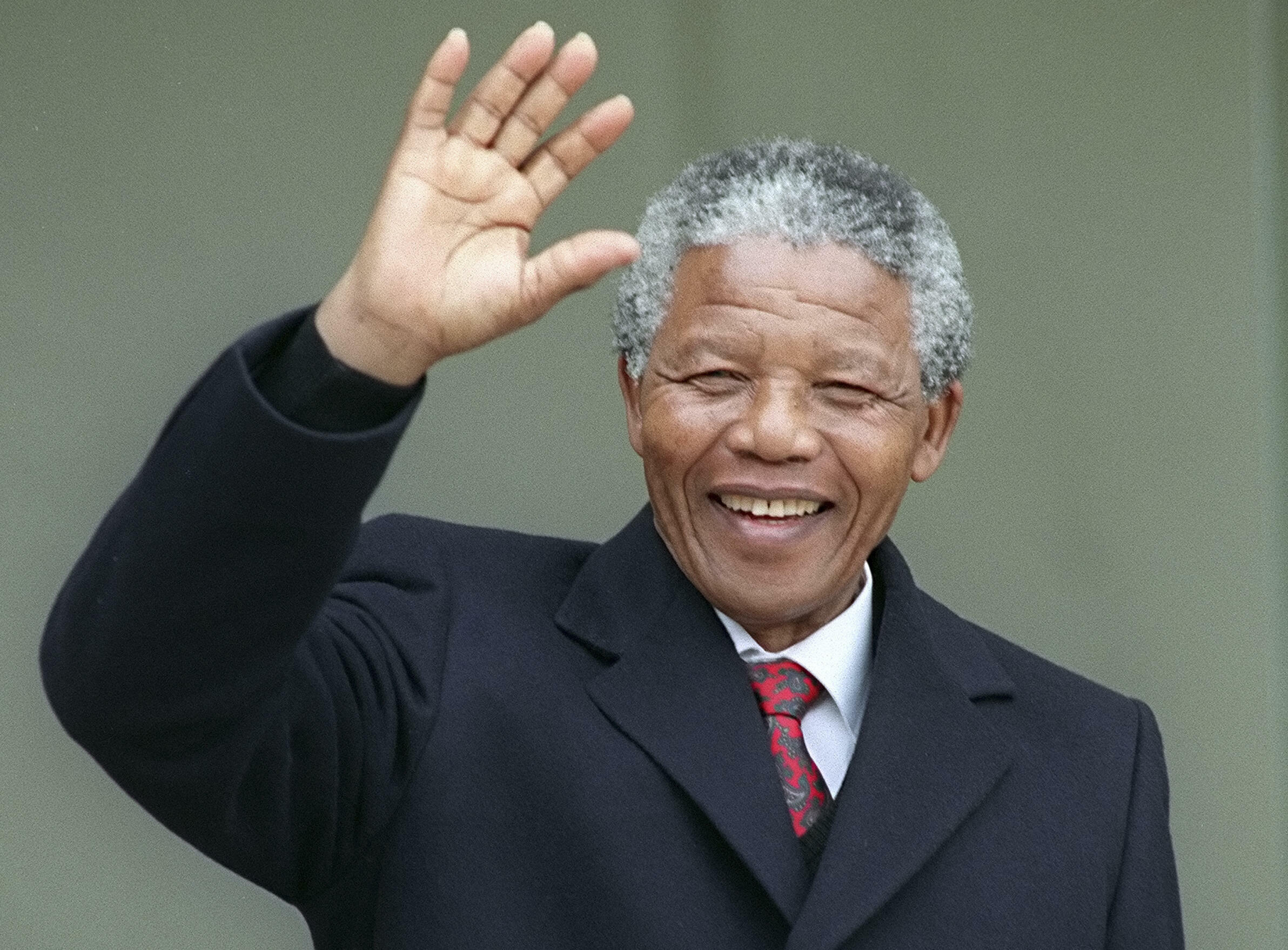
Nelson Mandela
By Njonjo Mue
Worth Noting:
- At first, I did not see the South African President and so I thought that she must have been mistaking someone else for him. In any case, I thought, what would Mandela be doing at the Arrivals lobby of the airport with the rest of the members of the public?
- But just as I was about to tell Tanya that she was imagining things, I saw the tall graceful figure of the world’s most famous statesman of his generation freely mingling with the excited crowd.
- Without signaling to each other, Tanya and I half walked briskly, half ran towards the growing crowd.
- When we got there, we saw Mandela clearly as he stood over six feet tall, towering over most of those who gathered around him.
Tanya Barman, my colleague from the ARTICLE 19 head office in London, was visiting Johannesburg for a workshop that ARTICLE 19 was hosting, bringing together human rights activists from Kenya, Nigeria, and South Africa.
On 7 December 1997 the day before the workshop opened, she and I drove to Jan Smuts (now Oliver Tambo) International Airport to meet some of the activists who were arriving in South Africa for the workshop.
As we waited for our guests at the Arrivals lobby, we saw a small but quickly growing crowd gathering about thirty or so metres away from where we were standing.
“Look,” Tanya exclaimed excitedly, pointing in the direction of the crowd. “It’s Mandela!”
At first, I did not see the South African President and so I thought that she must have been mistaking someone else for him. In any case, I thought, what would Mandela be doing at the Arrivals lobby of the airport with the rest of the members of the public?
But just as I was about to tell Tanya that she was imagining things, I saw the tall graceful figure of the world’s most famous statesman of his generation freely mingling with the excited crowd.
Without signaling to each other, Tanya and I half walked briskly, half ran towards the growing crowd.
When we got there, we saw Mandela clearly as he stood over six feet tall, towering over most of those who gathered around him.
He had a small security detail surrounding him but he was casually mingling with the people, shaking hands as he walked slowly towards an entrance into the private area of International Arrivals.
“Would you like to shake the President’s hand?” the voice was coming from close to me on my right but I did not think the question was directed at me.
It was actually one of Mandela’s security personnel. I couldn’t believe she was actually speaking to me. She must have noticed my confusion because she repeated the question while looking straight at me, our eyes locking.
“Yes, of course,” I stammered, thinking that she must have been joking.
“Just go up ahead towards that entrance and stand there and wait,” she said. “He will soon be there and he will shake your hand.”
“Are …are you sure?” I stuttered incredulously.
“Yes, I am,” she answered. “It pisses us off but we can never make him stop. He is a man of the people.”
Without waiting to hear the lady complete her last sentence I rushed ahead of the crowd feeling like Zaccheus when he climbed the sycamore tree in order to see Jesus.
By this time, Tanya and I had gotten separated but I did not have time to worry about that at that moment.
I placed myself strategically on the President’s way as advised.
As surely as I had been assured, a few moments later, I found myself staring up into the kind face of Madiba as we stood together shaking hands.
“How are you?” he asked, his left hand resting gently on my shoulder as he shook my hand with his right.
For a few moments, I had the undivided attention of the world’s most admired political leader.
To be completely honest, I was speechless and he must have noticed it because just as I managed to say I was fine, he asked, “Are you South African or are you just visiting?”
It was not an unreasonable question to ask as we were having this conversation at an international airport.
“I am from Kenya,” I managed to say. “But I live and work in Johannesburg.”
“Good,” he said. “We need young people from the rest of the continent to mentor and share skills with our own young people to help them to take charge of their country and their own destiny”
I wish I had more time to tell him that I agreed with him, or how much I admired him and wished him well as he and his ANC government steered the Rainbow Nation towards its destiny.
But the impatient security people were already gently pushing me away and pushing him forward towards the door.
I was to learn later that he had come to the airport to meet his then companion Madam Graça Machel who was arriving from a trip abroad.
The two freedom fighters from neighbouring countries had famously fallen in love and were often to be seen together, holding hands and giggling like star-struck teenagers, and it was no wonder that President Mandela had come personally to the airport to meet his sweetheart.
Shortly after the sliding doors opened and swallowed Madiba and his entourage, Tanya and I found each other and made our way back to the public arrivals lobby chatting excitedly about having seen (in her case) and met (in my case) President Nelson Mandela.
Soon, our own entourage walked out from inside the airport into the public place where we were waiting to receive them. I greeted them rather mechanically because my mind was still on the good fortune I had had to meet Mandela.
As I processed what had just happened I thought about what I might have told him had I had more time or if the meeting had been an unrushed one-on-one appointment between the two of us rather than the rushed few moments we had shared exchanging pleasantries.
I recalled that in April 1994, South Africa had become the last country in Africa to regain her freedom after a long and sometimes bloody struggle led by the African National Congress from four fronts:
First, there were those like Mandela, Walter Sisulu, Ahmed Kathrada, Govan Mbeki, Jacob Zuma and Tokyo Sexwale who had been incarcerated at Robben Island and other apartheid prisons.
Second, there were those such as Oliver Tambo, Thabo Mbeki, Zanele Dlamini, Joe Modise, Albie Sachs, Nkosazana Dlamini, and Joe Slovo, who had fled into exile and had worked hard to mobilize international public opinion against the brutal apartheid regime as well as organise a campaign of sabotage led by the armed wing of the ANC, uMkhonto we Sizwe.
Third, there were those who were fighting against apartheid ‘on the ground’ in the townships and rural areas of South Africa. The iconic Winnie Mandela, Archbishop Desmond Tutu, Reverend Allan Boesak, Cheryl Carolus, Mkhuseli Jack, and Cyril Ramaphosa belonged to this latter category of those who kept the flame burning from within South Africa while their comrades were either in prison or in exile.
Fourth and finally, there were those who had been murdered by the apartheid regime, paying the ultimate price for freedom, including Bantu Stephen Biko, Ruth First, Solomon Mahlangu, Dulcie September, the Craddock Four, and Chris Hani.
1994 had been a key milestone in Africa’s struggle for freedom and justice with majority rule finally being achieved in South Africa, the last country to achieve ‘independence’.
However, anyone who cared to follow the continent’s politics and economics clearly understood that though we had attained independence, we were not yet free.
All the fifty three countries had now attained a flag and an anthem, but not much more. For they were now part of an international order that was still dominated by their former colonial masters, or as we liked to say when exchanging views over drinks after work, all over the continent, blacks were now in government but not in power.
That Sunday afternoon, I let my mind wander, prompted by the stirring the meeting with Mandela had caused in my heart. I imagined our handshake that day as a symbolic passing on of the torch.
For as Franz Fanon wrote, “Each generation must, out of relative obscurity, discover its mission, fulfill it or betray it.”
Mandela and his colleagues had clearly identified the mission of their generation – the dismantling of apartheid – and fulfilled it.
It now behooved us to identify the mission of our own generation and, having done so, to follow the inspiration and example of Nelson Mandela in order to fulfill it.
And the mission of our generation had to be the consolidation of democracy, the expansion of the bounds of freedom and the safeguarding of the dignity of all our people.
It was a burden I personally intended to bear with pride and determination.
******
POST-SCRIPT:
WINNIE MADIKIZELA MANDELA
All commentators on the struggle against apartheid agree that there would have been no Mandela without Winnie, and any story that shines the spotlight on Nelson Mandela alone is incomplete. I am therefore including a brief tribute to Winnie that I penned on the day she transitioned to join the ancestors on 2 April 2018:
OLD SOLDIERS NEVER DIE: FAREWELL WINNIE MADIKIZELA MANDELA
By Njonjo Mue
One of the unfulfilled items on my bucket list is to meet Winnie Madikizela Mandela. It will now remain unfulfilled this side of eternity. Somehow, our paths just never crossed when I had the privilege of living in Johannesburg for the last four years of the last Century and the first year of the new one.
I, however, remember fondly the day I met President Nelson Mandela on 7th December 1997. The meeting was by accident at Johannesburg (now Oliver Tambo) International Airport. Towering a head and shoulders over me, he warmly shook my hand and asked me whether I was South African or just visiting.
When I told him I was Kenyan but working at the time in SA, he told me that he hoped I felt welcome and that South Africa needed young people from the rest of the continent to encourage their South African brothers and sisters as they took their first steps as citizens of a free country.
As I walked away from my brief encounter with the most admired statesman in the world, I couldn’t help thinking that liberation hardly ever comes all at once. It happens in cycles. The generation of Mandela, Kenyatta, Nkrumah, Nyerere and Kaunda had, through acts of great sacrifice, won political independence for us.
But it was my generation that now had to pick up the baton and fight for economic and cultural emancipation of the African people.
I also thought of Winnie, who was no longer by Mandela’s side, and the role she had played in keeping the Mandela name alive when the apartheid government would not even permit a photograph of him on Robben Island to be published.
I thought of the huge personal sacrifice that she had made as the state targeted her and her young family for harassment, incarceration, torture, and banishment in Brandfort. And I thought how quickly she had been banished by the same movement whose fire she had kept burning when victory appeared in sight.
Winnie, like the rest of us, was a flesh and blood human being, with her share of flaws and foibles. But she was also a soldier. And as David Rubadiri reminds us in his famous ode to Yatuta Chisiza, ‘Old soldiers never die, they just fade away’.
Farewell, Mother of the Nation, fade thee away slowly, that generations yet to be born may also be blessed to bask in the reflected glow of your unmatched sheroism.
And may the cause for which you lived, suffered and sacrificed so much for, never fade away.
Nkosi sikelel i’Afrika.
(To be continued…/)
[Previously in our on-going series on the life and times of lawyer activist Njonjo Mue:
In Episode One , we sat with Njonjo at Uhuru Park in August 2010 as he joined a multitude of excited Kenyans in celebrating the promulgation of the new Constitution of Kenya. In Episode Two, Njonjo took us to a time before the beginning of his lifelong journey advocating for democracy and social justice, where we met his parents and grandparents, the rocks from which he was hewn.
In Episode Three , we were transported to Njonjo’s hometown of Thika where he enjoyed a magical childhood that laid the foundation of the man he was destined to become. In Episode Four , Njonjo spoke of the early years when he began to hear echoes of injustice that he found impossible to ignore and that would eventually transform him from a curious child into a restless activist.
In Episode Five , Njonjo explained that despite his Alma Mater, Alliance High School having a mixed record as far as its contribution to the fortunes and foibles of Kenya is concerned, he was proud to have been counted among a short list of those alumni who have pushed back against dictatorship and oppression, and advocated for democracy, good governance and social justice in independent Kenya. After six years at Alliance, Njonjo joined the University of Nairobi’s Law School for his LL.B degree. In Episode Six , Njonjo took us back to 1989, a momentous year when the world was engulfed in revolutions that toppled autocratic communist rule in Eastern Europe and threatened despotic one-party dictatorships in Africa. It was also a momentous year for Njonjo as he attended an exchange programme with American students, travelled abroad for the first time, and engaged in his own personal act of resistance against empire by working in London without a work permit.
In Episode Seven , Njonjo took us back to February 1990, a time when he took part in the first of many peaceful demonstrations when he joined other university students in condemning the gruesome assassination of Foreign Minister Robert Ouko. In Episode Eight , Njonjo spoke about his upbringing in a Christian home, attending a Christian school and his own journey towards finding faith.
In Episode Nine , as the world marked the thirtieth anniversary of the first assassination of an elected leader in post-colonial Africa, Patrice Lumumba of Congo, and as allied armies gathered for the mother of all battles against Saddam Hussein in the Persian Gulf, Njonjo’s love for music drew him in to a church meeting where, in spite of his best laid out plans for that warm Thursday evening, God finally caught up with him and he surrendered his life to the saving power of Jesus Christ. In Episode Ten Njonjo shared his pilgrimage from a purely personal faith to embracing the wholistic salvation of the true gospel of Jesus Christ who is King and Lord of all and who presides not just over individual lives, but also reigns over everything from galaxies and governments.
In Episode Eleven , after graduating with an LL.B degree from the University of Nairobi, Njonjo is awarded the prestigious Rhodes Scholarship and is full of high expectations of conquering the world as he leaves for Oxford University for his further studies, but his hopes are quickly dashed when he gets there only to realize that, in the opinion of the academic powers that be, he may be good, but not good enough. In Episode Twelve , after one and a half years out of residence, Njonjo returned to Oxford to begin a season that turned out to be as different from his earlier sojourn as day is from night, as he embraced a life of scholarship balanced with co-curricular activities, maintained a busy travel schedule that took him to Israel, Europe, Scandinavia and America, and as he found himself hopelessly drawn to a passionate cross-Atlantic love interest.
In Episode Thirteen , Njonjo zoomed in on the time when he returned to Oxford where in addition to working hard, he decided to seize the day and to suck all the marrow out of the bone of life and narrated how the end of his Oxford years was marked by the anticlimax of failing his final exams in the shadow of battling ill-health. In Episode Fourteen , we accompanied Njonjo as he escaped the dullness of his early career in legal practice to join Civil Society and as he sought to join those who used their training and expertise to help amplify the voice of Wanjiku in the contested process of constitution making. In Episode Fourteen, Njonjo answers the call to duty in the service human rights in the continent of Africa as he relocates to Johannesburg to head the regional office of the Freedom of Expression Watchdog, ARTICLE 19
In This Episode , Njonjo shares his reflections on the historic mission of his generation that are inspired by a chance but cherished meeting with President Nelson Mandela as he also pays tribute to Mama Winnie Madikizela Mandela.]
Similar Posts by The Mt Kenya Times:
- Mt Kenya Times ePAPER October 1, 2026
- Museveni backs Lamu but keeps Uganda’s money at home
- Sifuna’s party wins its name — and Kenya’s opposition race begins in earnest
- Lamu’s $16B gamble: Africa’s biggest refinery divides the region
- Ruto launches KSh2.2 trillion Lamu refinery in East Africa’s biggest energy bet
About the Author


