Of Centralization Of State Power Being An Incumbent Reality In Kenya: The Constitution Must Be Weeping
 The Mt Kenya Times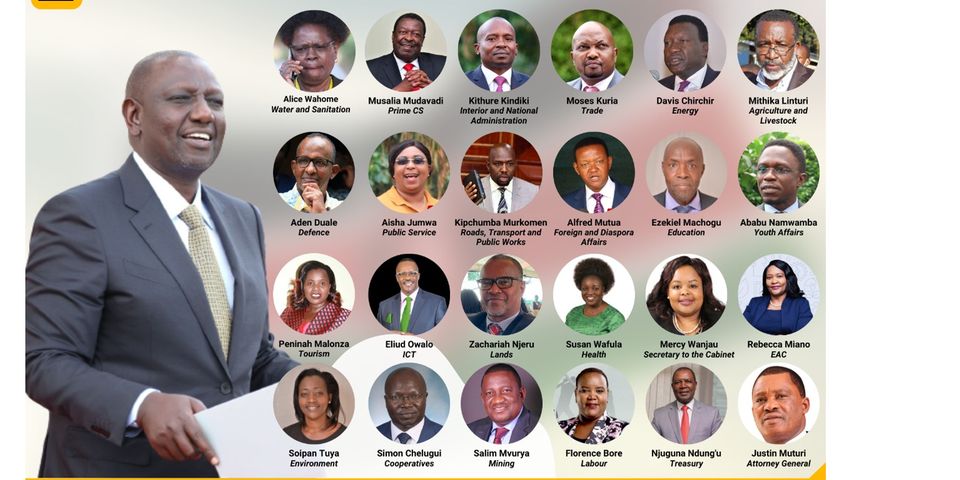
President William Ruto's Cabinet
By Jerameel Kevins Owuor Odhiambo
Worth Noting:
- Thirteen years down the line since the promulgation of the Constitution of Kenya, we are back to the same state we were as a nation. Why is this so? The office holders still centralize state powers. We have county governments that are indisputable. But are they functioning seamlessly? How many times have heard that the counties haven’t received disbursement from the ex-chequer? Is it once or twice or right now it is chorus?
- Why do we still have the urge the come up with delegations to meet the President at State House? Oh yes I know, the President still has to be appeased for he wields immense powers. The Constitution remains to be the President’s doormat.
Early last week I got hold of a book titled “Tensions and Reversals in Democratic Transitions: The Kenya 2007 General Elections” edited by legendary Professor Karuti Kanyinga and Duncan Okello. The first chapter of the book was penned by the above cited luminaries and Akoko Akech. The Chapter’s heading is as follows: ‘Contradictions of Transition to Democracy in Fragmented Societies: the Kenya 2007 General Elections in Perspective.’ The three authors contend that the scheme of power and the electoral system rank top as the source of tensions and reversals within the Kenyan democratic space. As if that is not enough, the learned authors were of the view that centralization of power, to be specific, state power, in the presidency has led to the said office being dominated by specific political elites and folks from specific regions.
In their words: “The presidency has inelastic abilities to punish and reward, command and control and in a poor and fragmented society such as Kenya, electoral contests then tend to have polarizing effects. Similarly, the majoritarian system or the first post electoral system results in a zero sum game. Because competing individuals are interlinked with regional interests, the gains of political elites are considered as community gains; the same applies to losers. We take the view that whereas Kenya is an ethnically conscious country, ethnicity perse is not the cause of Kenya’s democratic regression, problematic as it may seem. It is the result of centralized powers of the state, reinforced by a majoritarian electoral system. Simply put, ethnicity and how it is expressed in Kenya’s electoral politics is the toxic waste from a political economy of inequality, centralized state power and a majoritarian electoral system. Political elites mobilize ethnic groups because the electoral system privileges numbers rather than representation. The losers have no other ways of being represented or accessing state power.”
It is imperative to note that the book was published before the advent of the current Constitution. The History of Kenya has several instances where the winners of elections control state resources perhaps for their own benefit or benefitting those who are from their ethnic backgrounds. Look around, you might notice that, the same thing shows up its ugly head post 2010 constitutional dispensation.
So as to remedy, centralization of power, Kenyans in their numbers through a referendum passed the 2010 Constitution. It was meant, inter alia, to remedy a myriad of past social evils. A Constitution maybe deemed as a social charter of a particular nation or society. Kenya’s Constitution is a reflection of Kenya’s history and that is a fact. The Constitution was meant as well to transform Kenya. Various provisions of the Constitution attest to this from Chapter Four to the other various constitutional imperatives not forgetting devolution.
To some extent, it has been argued that devolution was meant to combat centralization of state power to the Executive arm of government. How is this so? One may wisely ask. The Constitution indirectly makes a mention of this and perhaps it is left for the wise to decipher the same. Article 174 of the 2010 Constitution outlines the objects of devolution which include but not limited to: fostering national unity by recognizing diversity; giving powers of self-governance to the people and enhance their participation in making decisions affecting them; promoting social and economic development and the provision of proximate, easily accessible services throughout Kenya; ensuring equitable sharing of natural and local resources throughout Kenya; to facilitate the decentralization of state organs, their functions and services from the capital of Kenya.
Thirteen years down the line since the promulgation of the Constitution of Kenya, we are back to the same state we were as a nation. Why is this so? The office holders still centralize state powers. We have county governments that is indisputable. But are they functioning seamlessly? How many times have heard that the counties haven’t received disbursement from the ex-chequer? Is it once or twice or right now it is chorus?
Why do we still have the urge the come up with delegations to meet the President at State House? Oh yes I know, the President still has to be appeased for he wields immense powers. The Constitution remains to be the President’s doormat. I have argued overtime, any constitution is as good or as bad as the implementation thereof. The Constitution of Kenya 2010 by all means has good proposals, unfortunately those meant to implement it are big time jokers.
Another evidence that centralization of state power is real just look at budget of Kenya since 2011 to date and tell me what is the ratio that the Executive arm of government controls vis-à-vis money given to counties. It is really perplexing and transfixing by all means. Counties have functions within the province of law, but can those functions be realized with inadequate funding? Maybe yes in the land of fantasy.
Kenyans as well have ingrained their respective brains on the doctrine of centralization of state power. Maybe you should listen to them talk during campaigns. They support the various candidates based on where they hail from or from what their community leader states. They are sure that if one of their own ascends to power resources will trickle to them immensely. When will Kenyans let go of this idea?
Despite all these, the Constitution is weeping. For the various provisions on centralization of state power remain a mirage and chimera in equal measure. From my honest perspective the Constitution is innocent, those at wrong are the office holders. I live to see the day, Kenyans will be more interested in who is their Governor than who is their President; the day when resources will be disbursed in a timely manner. May that day dawn soon. Till them let me remain a faithful member of Observers Club of Kenya.
Jerameel Kevins Owuor Odhiambo is a finalist law student at University of Nairobi, Parklands Campus.
Similar Posts by The Mt Kenya Times:
- Mt Kenya Times ePAPER September 19-20, 2026
- Kenya joins US and UK to put citizens on the terrorism frontline
- Kenya’s parliament races to tame the AI frontier
- Kalonzo calls Ruto to order over Uhuru attacks
- Gachagua takes his 2027 campaign to America
About the Author