The unexamined yoke: The repugnancy clause as colonial epistemic violence that still subordinates African customary law in Kenya
 The Mt Kenya Times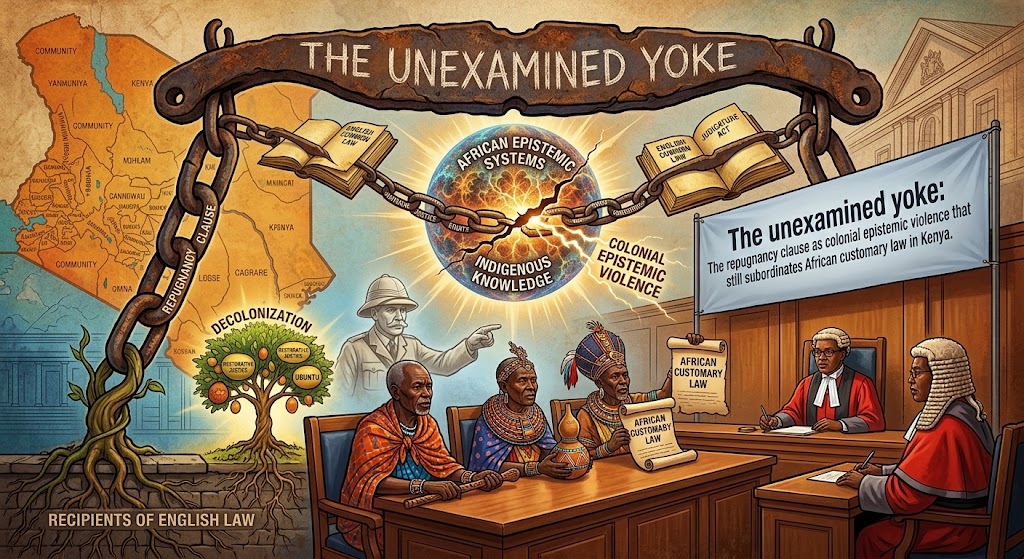
By Jerameel Kevins Owuor Odhiambo
In 1967, four years after independence, Kenya’s Parliament enacted the Judicature Act. Section 3(2) still declares that the courts “shall be guided by African customary law in civil cases in which one or more of the parties is subject to it or affected by it, so far as it is applicable and is not repugnant to justice and morality or inconsistent with any written law.” That single, bland sentence is not a neutral filter. It is the legal residue of an empire that decided African ways of knowing, living, marrying, inheriting, and repairing harm must first pass through the unexamined sieve of British conscience before they could count as law. The clause remains on the statute books today. It is not a historical curiosity. It is an active instrument of epistemic violence.
The violence began long before 1967. The East Africa Order-in-Council of 1897 and its successors already subordinated “native law and custom” to the requirement that it not be repugnant to justice and morality. Colonial judges were candid about whose morality mattered. In 1938 one of them stated without apology: “I have no doubt whatsoever that the only standard of justice and morality which a British court in Africa can apply is its own British standard.” The standard was never examined; it was simply imposed. African polygyny became “wife purchase.” Bridewealth, a complex system of alliance and obligation, was reduced to commercial transaction. Compensation for homicide under Maasai custom was struck down. Practices that had ordered social life for generations were declared, by fiat, outside the pale of civilisation.
This was never merely the rejection of particular customs. It was the systematic demotion of an entire epistemology. African communities possessed sophisticated bodies of knowledge about kinship, land, conflict, and responsibility. These knowledge systems were oral, contextual, relational, and evolving. Colonial law treated them as primitive raw material that required purification by the superior solvent of English equity and Christian-influenced morality. The result was a hierarchy of knowing: the colonizer’s categories sat at the apex; African categories survived only by permission. That hierarchy is the classic signature of epistemic violence the refusal to recognise another people’s capacity to generate valid knowledge about justice.
The phrase “justice and morality” is itself a masterpiece of colonial sleight of hand. It pretends to universality while remaining stubbornly particular. Whose justice? Whose morality? The clause never defined the terms. It left the definition to the discretion of judges trained in the Inns of Court, men who had absorbed the civilizing mission as common sense. The same discretion was later inherited by post-independence Kenyan judges. The result is a continuing pattern in which African customary law enters the courtroom already on probation. It must prove it is not “repugnant.” English common law and statutes of general application need prove nothing of the sort. The asymmetry is structural and deliberate.
Consider the emotional and material cost. For generations, families have watched courts dismiss the very norms that ordered their marriages, their succession, their dispute resolution. A widow who relies on customary mechanisms of support may find those mechanisms declared invalid. A community that seeks restorative justice according to its own logic is told that only the adversarial, individualist model of the common law qualifies as true justice. The message is clear and wounding: your ancestors’ wisdom is provisional; the colonizer’s is presumptively permanent. That message does not vanish because the flag has changed colour. It settles in the consciousness of the society as a quiet, corrosive doubt about the legitimacy of its own past.
The 2010 Constitution offered a chance to break the yoke. Article 2(4) subjects all law, including customary law, to the Constitution itself. Article 11 recognises culture. Article 159 encourages the use of traditional dispute resolution mechanisms. Yet the Judicature Act’s repugnancy clause continues to sit in the hierarchy of norms, a colonial ghost that still demands African law justify itself against an undefined external standard. The Constitution’s supremacy is real, but the residual language of repugnancy keeps the old hierarchy psychologically and procedurally alive. Courts continue to reach for it. Scholars continue to debate it. Communities continue to live under its shadow.
This is not a call for the uncritical romanticization of every custom. Some practices have caused and continue to cause harm, particularly to women and children. The answer to that harm is not the colonial filter. The answer is internal critique, democratic deliberation, and the Constitution’s own bill of rights applied on equal terms. To keep the repugnancy clause is to insist that African societies remain perpetual pupils, forever requiring an external examiner. It is to deny the possibility that African moral and legal thought can generate its own standards of justice and refine them over time.
The deeper insight is this: the clause is not merely a technical rule of conflict of laws. It is a technology of epistemic subordination that has outlived the formal empire. It trains the legal mind to treat African customary law as suspect until proven otherwise. It trains the citizen to regard indigenous knowledge as second-class. It preserves, in the most intimate sphere of law family, land, succession, conflict the colonial ranking of civilizations. That ranking was always a lie. It remains a lie. Nevertheless, the statute still speaks it.
Parliament must act. The Judicature Act should be amended to remove the repugnancy language entirely. Customary law, like every other source of law, should stand or fall by consistency with the Constitution and with written statutes enacted by a sovereign people. The judiciary must stop treating “justice and morality” as a free-floating, unexamined British inheritance and begin to articulate Kenyan standards grounded in the lived experience and evolving values of Kenyan communities. Legal educators must teach the history of the clause not as neutral legal technique but as an instrument of epistemic conquest. Civil society, elders’ councils, and community organisations must reclaim the authority to debate and reform their own customs without first seeking the approval of a colonial ghost.
The words themselves matter. “Repugnant” is a visceral term. It suggests something that causes physical disgust, something that offends the senses of the civilized observer. Applied to the legal traditions of an entire continent’s peoples, it is an insult that has been allowed to harden into doctrine. Enough. The time for polite coexistence with this language has passed. Kenya cannot claim intellectual and moral sovereignty while its courts still measure African justice against an unexamined foreign yardstick. The yoke is visible. The hand that can lift it is Kenyan. The only remaining question is whether the will exists to do so.
The writer is a social commentator.
Similar Posts by The Mt Kenya Times:
- Dr. Ekrah Ndung’u wins TVET advocacy award after 12 years
- Mt Kenya Times ePAPER October 17-18, 2026
- Ruto bets billions on Kerio Valley — with one eye on 2027
- Ruto’s health ministry kills Murang’a’s digital hospitals
- Kenya bets on Mount Kenya to drive a billion-shilling tourism revival
About the Author