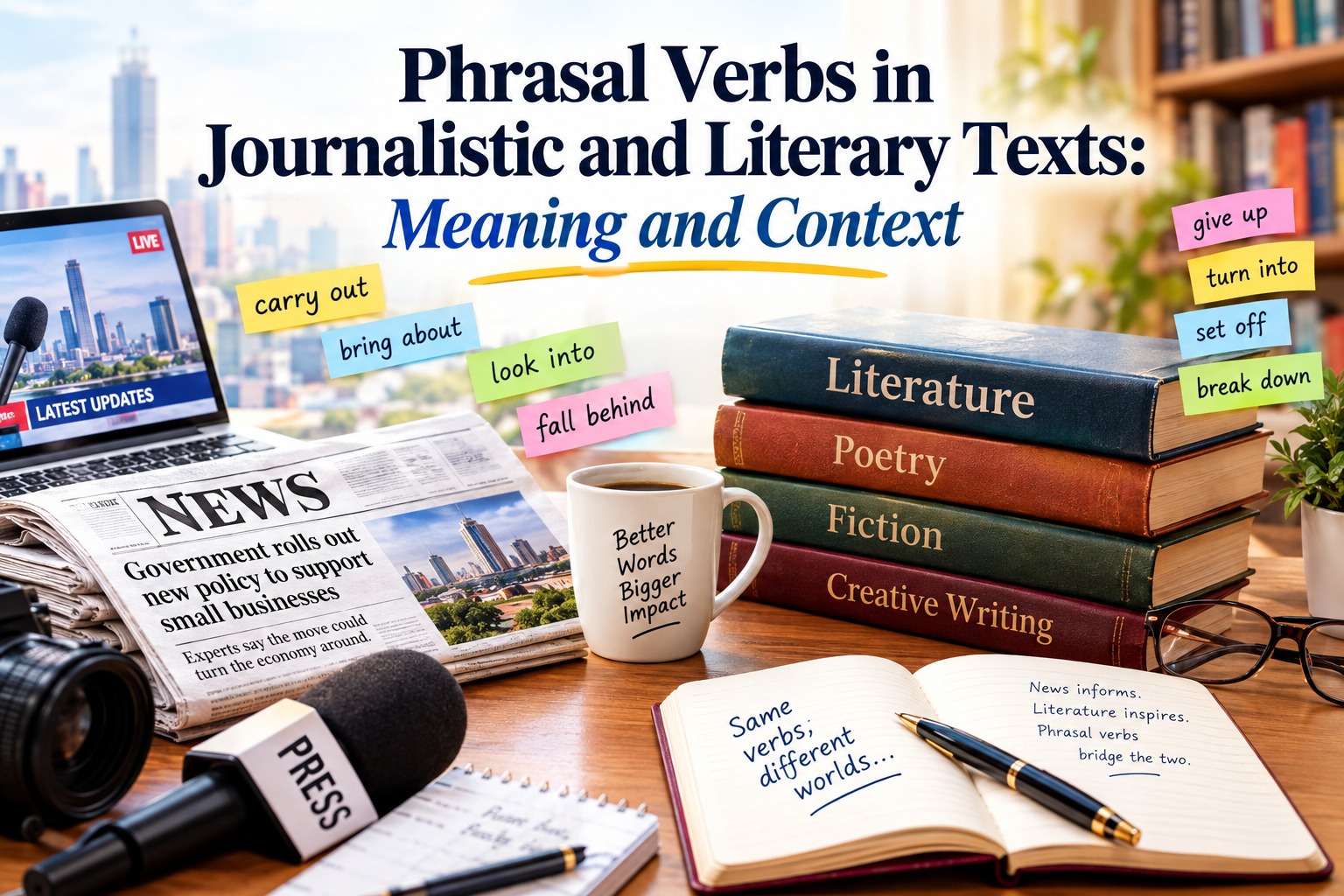
Phrasal Verbs in Journalistic and Literary Texts: Meaning and Context

By: Elbekova Dilafruz Oybek qizi
2nd-year Master’s student, Namangan State University
This article explores phrasal verbs (verb + particle combinations) and how their meanings differ in literary and journalistic English. A 12,207-word sample of Matt Haig’s novel The Midnight Library is compared with ten Guardian texts (10,262 words). Literal meanings dominate narration in the novel, while news narration favours semi-idiomatic ones.
INTRODUCTION
Phrasal verbs are everywhere in English: about 5% of all lexical verbs in the British National Corpus are used in this way (Gardner & Davies, 2007). They are hard for learners because the meaning of the whole often cannot be worked out from its parts: compare sit down with give up.
As J. R. Firth put it, we know a word “by the company it keeps”. For phrasal verbs this means that the text type, and its context, decides which meaning is active.
CHAPTER 1. THEORETICAL FOUNDATIONS
Transparency. Phrasal verbs lie on a scale. Literal ones keep the meanings of both parts (sit down); semi-idiomatic ones are partly motivated (speed up, break down); idiomatic ones must be learned as units (give up, fall out).
Polysemy. The 100 most frequent phrasal verbs have 559 meanings, about 5.6 each (Gardner & Davies, 2007). For example, look up can mean ‘raise one’s eyes’, ‘search for information’ or ‘improve’.
Bolinger (1971) showed that particles carry meaning of their own, and Darwin and Gray (1999) suggested treating every verb + particle combination as a potential phrasal verb.
CHAPTER 2. STAGES OF THE ANALYSIS
The study followed three stages:
- Data stage. A 12,207-word sample of the novel and ten Guardian texts (news reports, an interview, a profile and features) were collected.
- Classification stage. Candidate phrasal verbs were extracted, free combinations excluded, and each token labelled literal, semi-idiomatic or idiomatic, in narration or in speech.
- Comparison stage. Frequencies per 10,000 words and the shares of the three types were compared (chi-square test).
CHAPTER 3. RESULTS
The novel sample has 150 phrasal verb tokens (122.9 per 10,000 words); the news sample has 63 (61.4 per 10,000 words). Share of each type:
Novel (n = 150)
| 43.3% | 27.3% | 29.3% |
Guardian texts (n = 63)
| 15.9% | 52.4% | 31.7% |
■ Literal ■ Semi-idiomatic ■ Idiomatic
The difference lies in narration: 51.8% of the novel’s tokens are literal against 15.2% in the news texts. In speech the two samples are alike: about half of the tokens are idiomatic (50.0% and 46.7%). The sample is small and was annotated by one person, so the results are preliminary.
CONCLUSION
Phrasal verbs behave differently in fiction and in news. Fiction narration describes physical action with literal verbs, while news reporting prefers semi-idiomatic verbs of change and result. Idiomatic verbs gather in speech in both. Teaching should therefore present phrasal verbs together with their typical contexts.
Author: Elbekova Dilafruz Oybek qizi is a 2nd-year Master’s student at Namangan State University.
Sources: Bolinger (1971) The Phrasal Verb in English; Darwin & Gray (1999) TESOL Quarterly 33(1); Firth (1957) Studies in Linguistic Analysis; Gardner & Davies (2007) TESOL Quarterly 41(2); Haig (2020) The Midnight Library.
Similar Posts by The Mt Kenya Times:
- Students pay the price as lecturers’ strike drags on
- Como dismantle Manchester United 4-1 to deepen Carrick’s crisis
- Kvaratskhelia ruled out for months after ACL injury in PSG win
- Beyond the banter: Uganda’s university rivalry should be about impact
- KWS launches KSh160B conservation programme in Tsavo
About the Author