PP2 graduation: When school ceremonies become a burden on parents
PP2 graduation
What should be a simple childhood milestone has quietly become a commercial exercise that costs families money while delivering little of educational value.
By Ashford Kimani
PP2 graduation ceremonies have increasingly become commercial ventures that impose unnecessary financial burdens on parents while adding little or no academic value to the children they are meant to honour. What should be a straightforward transition from pre-primary education to Grade One has been transformed into an elaborate production — graduation gowns, caps, certificates, photography, entertainment and compulsory contributions — that serves schools and service providers far more than it serves children.
Behind the colourful ceremonies and carefully staged photographs lies a question that parents, teachers and education stakeholders must honestly confront: are these ceremonies organised for the benefit of children, or have they become convenient opportunities to make money?
The completion of pre-primary education is a genuine milestone. Children have spent years acquiring foundational skills in communication, numeracy, social interaction and creativity. They deserve encouragement as they prepare to enter Grade One. But recognising that progress does not require a ceremony modelled on a university convocation. The danger arises when schools confuse a child’s developmental transition with an academic qualification that demands expensive ritual.
At this age, children are largely unaware of the commercial interests surrounding their graduation. They are excited by colourful gowns, music and the attention of adults. There is nothing wrong with making a child feel special. The problem is when that happiness becomes a justification for extracting money from families who can ill afford it.
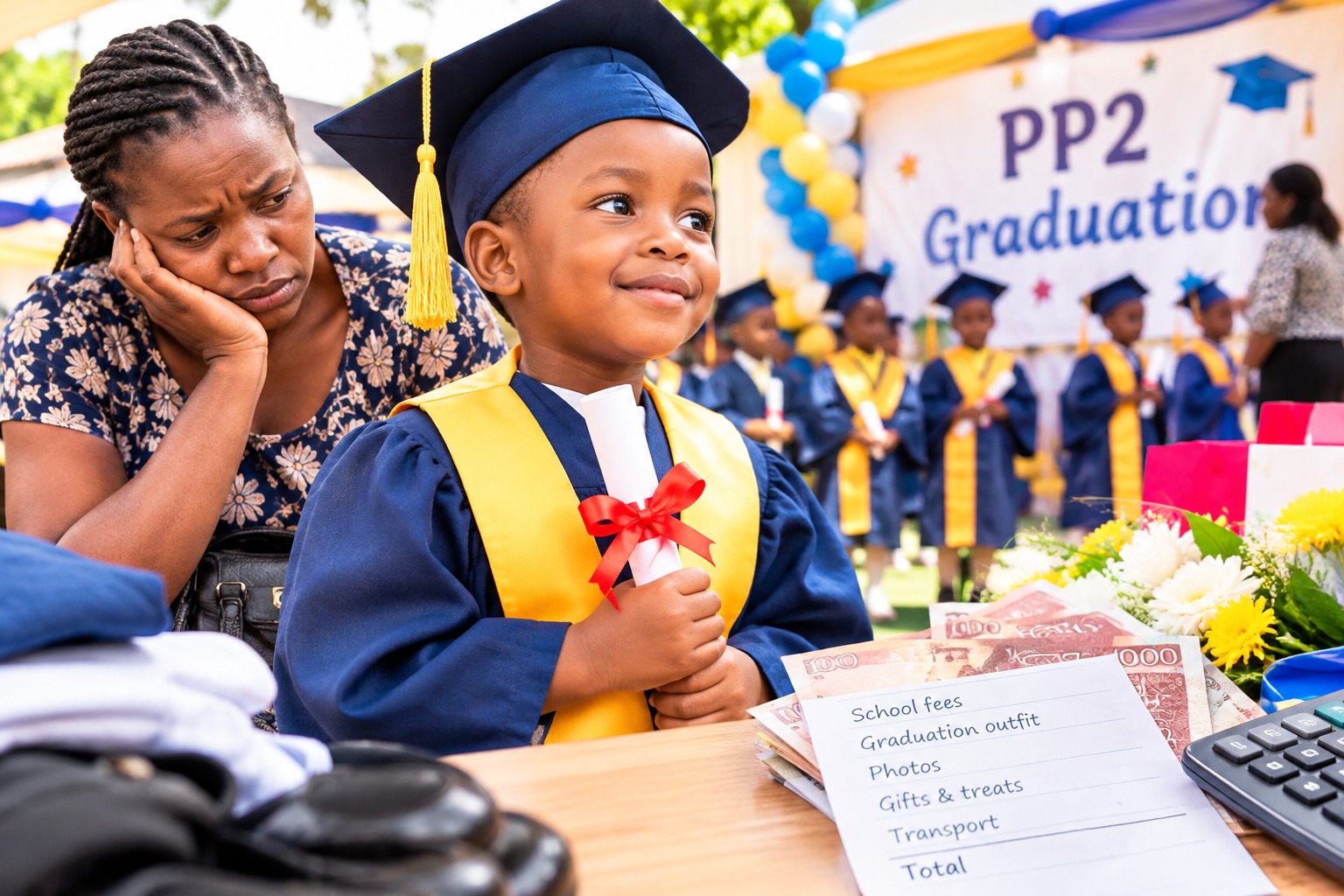
For many Kenyan families, educating a child is already a significant financial undertaking. School fees, uniforms, learning materials and transport consume household budgets that leave little room for extras. When parents are asked to pay additionally for gowns, caps, photographs, certificates and refreshments, the cumulative cost can become a serious burden. It worsens when participation appears compulsory, or when parents fear that declining to contribute will leave their child feeling excluded on the day.
The commercialisation of these ceremonies thrives on social pressure. Once a school announces a graduation, most parents feel they cannot opt out without their child missing what every classmate will experience. Some struggle financially but say nothing, afraid of appearing unable to support their child’s education. Others borrow money to meet the demands. A voluntary celebration quietly becomes an indirect financial obligation.
Schools must reflect honestly on their motivations. Is the ceremony about recognising the children, or about enhancing the institution’s public image? In an increasingly competitive education market, photographs of young children in graduation regalia — shared on social media and used in school advertising — project an image of prestige and excellence that may have little connection to the quality of teaching actually taking place inside the classrooms.
This is precisely where the distinction between educational quality and educational packaging matters. A school can stage a magnificent ceremony while failing to maintain adequate teacher-to-learner ratios or provide sufficient learning materials. Conversely, a school with modest resources may deliver outstanding early childhood education without ever staging a graduation event. Parents should resist the temptation to judge an institution by the grandeur of its celebrations.
The certificates awarded at these ceremonies also deserve scrutiny. They may mark completion of a stage, but they should not be mistaken for nationally recognised qualifications or independent proof of academic mastery. Children develop at different rates, and early childhood education should focus on nurturing individual potential rather than manufacturing hierarchies of achievement among five- and six-year-olds.
There is also a subtler risk. When children encounter elaborate ceremonies at every educational transition, they may begin to associate achievement with costumes, applause and material rewards rather than with curiosity, effort and the quiet accumulation of knowledge. Celebrations have their place, but they should complement learning — not overshadow it.
School administrators have a moral obligation to protect families from unnecessary financial pressure. Where celebrations are held, they should be simple, affordable and genuinely inclusive. No child should be excluded or treated differently because their parents cannot pay for a gown or a photograph. Participation must never become a test of a family’s financial standing.
Parents, too, must feel free to ask questions: what educational purpose does this expenditure serve, is it voluntary, and how much will it cost? Responsible parenting includes protecting the family budget from demands made in the name of schooling. Children must also learn, through their parents’ example, that meaningful achievement does not always require elaborate public ceremony.
Education authorities should provide clear guidance on school-organised events. The objective is not to ban every celebration but to discourage practices that commercialise children’s milestones or place avoidable financial pressure on families. Schools can meaningfully recognise PP2 learners through classroom activities, storytelling, songs and simple gatherings that emphasise development, confidence and readiness for the year ahead — at no significant cost to anyone.
The question is not whether PP2 learners deserve recognition. They certainly do. The question is whether that recognition must be packaged into expensive ceremonies that generate revenue without delivering educational benefit. A child does not become more capable by wearing a graduation gown. The greatest gift a school can offer a PP2 leaver is a strong educational foundation. The greatest relief it can give parents is responsible stewardship of the limited resources they have entrusted to it.
PP2 graduation should celebrate children’s development, not commercialise their innocence. Education is a developmental process and a public good, not a marketplace where every transition becomes a revenue event. Let the focus remain where it belongs: on learning, growth and a successful start to Grade One.
Similar Posts by The Mt Kenya Times:
- Obaga Momanyi hosts free medical camp for Persons with Disabilities in Bonchari
- How Kenya’s economic titans feast while competition law serves as courteous footnote
- 89 junior golfers chase glory at NCBA Lisle Shaw Championship
- Scaloni set to stay: Argentina coach to sign 2030 World Cup deal
- Mt Kenya Times ePAPER October 22, 2026
About the Author