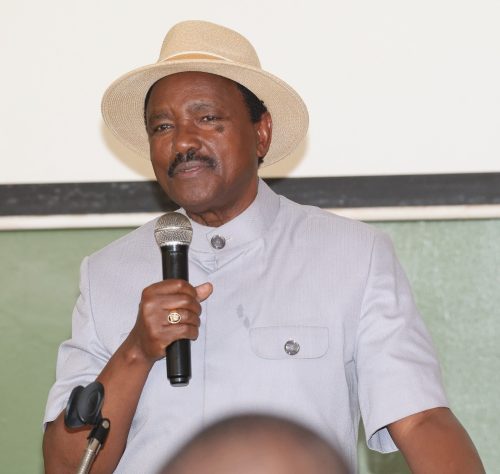
Deputy Controller of Budget, Stephen Masha

By Dyan Kwamboka and Fatma Said
Kenya’s Current Public debt has reached an alarming level, surpassing 67 percent of the Gross Domestic Product (GDP) and exceeding the authorized limit of 55 percent.
The Office of the Controller of Budget represented by the Deputy Controller of Budget, Stephen Masha, issued a warning during the National Assembly’s Budget and Appropriations Committee meeting, held at the English Point Marina, Mombasa, highlighting the growing debt as a significant threat to the nation’s economic stability.
According to the Report, Masha stated that the Country’s debt stands at Sh10.79 trillion, with Sh5.19 trillion attributed to external debt and Sh5.6 trillion to internal debt.
He noted that this surge is primarily due to infrastructure projects, managing exchange rates, meeting debt servicing obligations, and continuous borrowing to finance budget deficits.
“The rapid accumulation of debt is a cause for concern, as it increases repayment pressure and limits the government’s ability to fund essential services,” Masha stated. The Report further revealed that interest payments on the debt have eaten into development funds, forcing the government to rely on more borrowing.
Members of the National Assembly’s Budget and Appropriations Committee, warn that if the trend continues, the country could face difficulties in meeting its repayment obligations, leading to potential credit downgrades and a weakening local currency.
Masha has urged the government to adopt stringent fiscal policies, including reducing recurrent expenditures, enhancing domestic revenue collection, and prioritizing concessional loans over expensive commercial borrowing.
He recommended reducing budget deficit financing through fiscal consolidation to contain the increase in public debt.
“I do not see this going down. The debt will continue rising with time if we do not take necessary measures,” Lesuuda Naisula, Member of Parliament, warned.
The Report was prepared to address the status of the implementation of the budget for FY 2024/2025, including the Revenue performance against targets, Current and Capital exchequer releases, the overview of absorption of development expenditures and the performance of the donor- funded programmes.
The Committee was also going to address the major challenges in implementing the budget and the proposed measures to address them, including donor-funded programs.
“However, the Report does not include the challenges in implementing donor-funded programs, in the first three months of FY 2024/ 2025, emerging opportunities, or the performance of the donor-funded programs,” Masha Concluded.
Similar Posts by The Mt Kenya Times:
- Mt Kenya Times ePAPER August 27, 2026
- Opposition will have a candidate by April, says Gachagua
- Kalonzo takes his campaign to the people across three counties
- Kenya’s election technology tender: A KSh10B procurement under fire
- The goon question: What Ruto’s vow to act personally really means for Kenya
About the Author