Ruto: Why are some African leaders hesitating on the Lamu refinery?
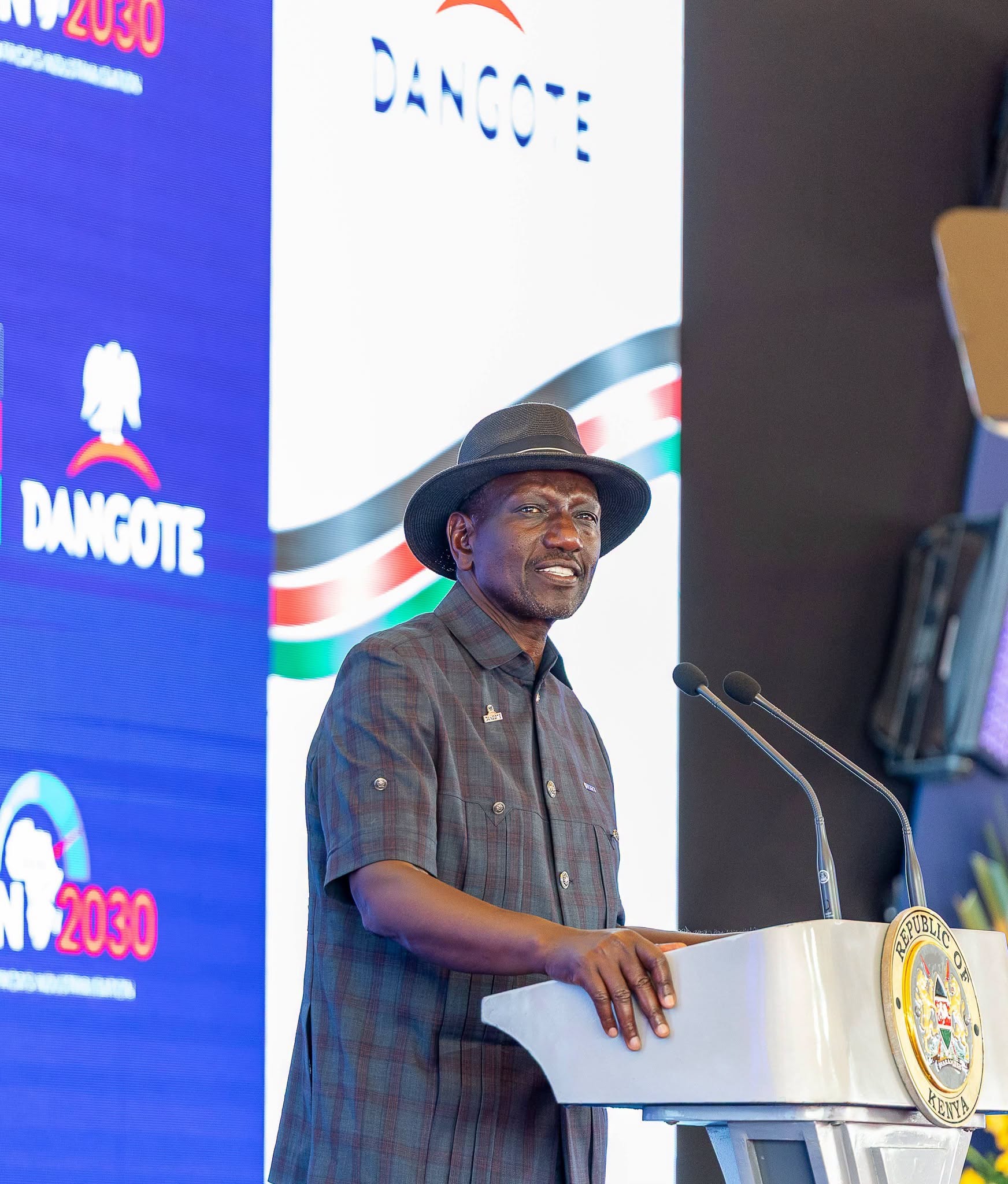
President William Ruto
The groundbreaking was celebrated, but the harder task — convincing neighbours the economics work for them too — has only just begun
By Collins Kibet
Kenya’s ambitious plan to establish a major petroleum refinery in Lamu has entered a critical phase following the official launch of the Dangote East Africa Petroleum Refinery project. Presented as a potential game-changer for Kenya’s energy sector and the wider East African economy, the multibillion-shilling project generated considerable excitement at its groundbreaking. Yet behind the fanfare lies a question that will ultimately determine the project’s fate: why are some African countries still hesitant to commit financially?
President William Ruto has been at pains to clarify that the absence of several African leaders from the Lamu ceremony should not be read as opposition. Some had scheduling conflicts, others sent senior representatives. Tanzania’s President Samia Suluhu Hassan could not attend due to a bereavement. Rwanda’s President Paul Kagame was reportedly unable to make it owing to technical difficulties. Diplomatic absence, Ruto argued, does not equal economic rejection.
That is a fair point. But investment is a different matter from attendance.
Uganda’s President Yoweri Museveni was present at the ceremony yet indicated his country was not immediately committing to the project. Uganda has its own refinery ambitions and has also sought clarification on an earlier regional refinery proposal linked to Tanzania’s Tanga port. This illustrates one of the central tensions in large regional infrastructure projects: a country can support economic integration in principle while simultaneously protecting its own national interests in practice.
For Kenya, Lamu represents far more than another industrial development. It is being positioned as a project capable of strengthening energy security, generating employment, attracting international capital and establishing Lamu as a significant petroleum hub for the region. If completed at the proposed scale, the refinery could reshape the economic profile of the coastal region and supply refined petroleum products to markets well beyond Kenya’s borders.
But governments do not commit public resources on the basis of political speeches. They examine costs, projected returns, infrastructure capacity, market demand, energy policy alignment and the long-term credibility of a project before signing anything. For countries such as Uganda, which are already pursuing their own petroleum development strategies, investing in a neighbouring country’s refinery requires a clear and demonstrable economic justification.
Regional competition adds another layer of complexity. East Africa hosts several overlapping ambitions involving ports, pipelines, oil infrastructure and refineries. Kenya’s Lamu project enters an environment where neighbouring states are themselves jostling to become energy and logistics hubs. Uganda’s oil development plans, Tanzania’s infrastructure agenda and other regional petroleum projects could all influence whether governments view Lamu as complementary infrastructure or as a rival.
Environmental and land concerns cannot be brushed aside either. Large-scale industrial development in Lamu has historically generated serious anxiety among local communities and environmental groups over land rights, livelihoods and ecological impact. For investors, such concerns raise additional questions about regulatory certainty, community relations and the project’s long-term sustainability — questions that demand clear, credible answers.
Ruto therefore faces a genuinely delicate task. Kenya must persuade its neighbours that Lamu is not simply a Kenyan venture seeking regional money, but shared infrastructure capable of delivering tangible benefits to all participating economies. That requires transparency — on financing, ownership structures, expected returns, environmental safeguards and how the gains will be distributed among partner countries.
The question, ultimately, is not whether African leaders believe in Lamu. The more important question is whether they believe the economic model works for their own countries. Regional cooperation becomes meaningful when governments can point to concrete benefits for their citizens, not when they participate simply because of diplomatic goodwill or political pressure.
Kenya also has an opportunity — and an obligation — to demonstrate that major infrastructure projects can deliver for ordinary people. The residents of Lamu will want to know what the refinery means for jobs, local businesses, roads, housing and access to services. Kenyan taxpayers will equally want clarity on the country’s financial exposure and realistic projections for economic return.
The Lamu refinery deserves scrutiny that goes well beyond the spectacle of a groundbreaking. Its success will not be measured by how many African heads of state attended the launch. It will be measured by whether it attracts sustainable investment, creates meaningful employment, strengthens energy security and delivers verifiable benefits to communities and the broader region.
Africa needs transformative infrastructure capable of connecting its economies and expanding industrial capacity. But successful regional projects require more than declarations and ceremony. They require confidence, transparent financing, sound economics, environmental responsibility and genuine trust among participating nations.
For Kenya, Lamu could become a significant pillar of its energy and industrial future. But convincing neighbours to invest will depend on demonstrating, in practical and credible terms, why the project works for them too.
The real test has moved well beyond the groundbreaking. It is now about whether Kenya can turn the promise of Lamu into a proposition that the region actually believes in.
Similar Posts by The Mt Kenya Times:
- Keep off politics from teachers – West Mugirango MP tells off sponsors at Kiangungu Prayers Day
- Seven women’s rights organisations in Africa launch coalition for gender equality and media sustainability
- Carrying babies while studying: The real struggles of student parents on Kenyan campuses
- Your certificate has no power of its own: It borrows power from the brand you are killing
- Kinoti Marete backs Samburu security operation, rallies Meru aspirants to PPK
About the Author