The Mt Kenya Times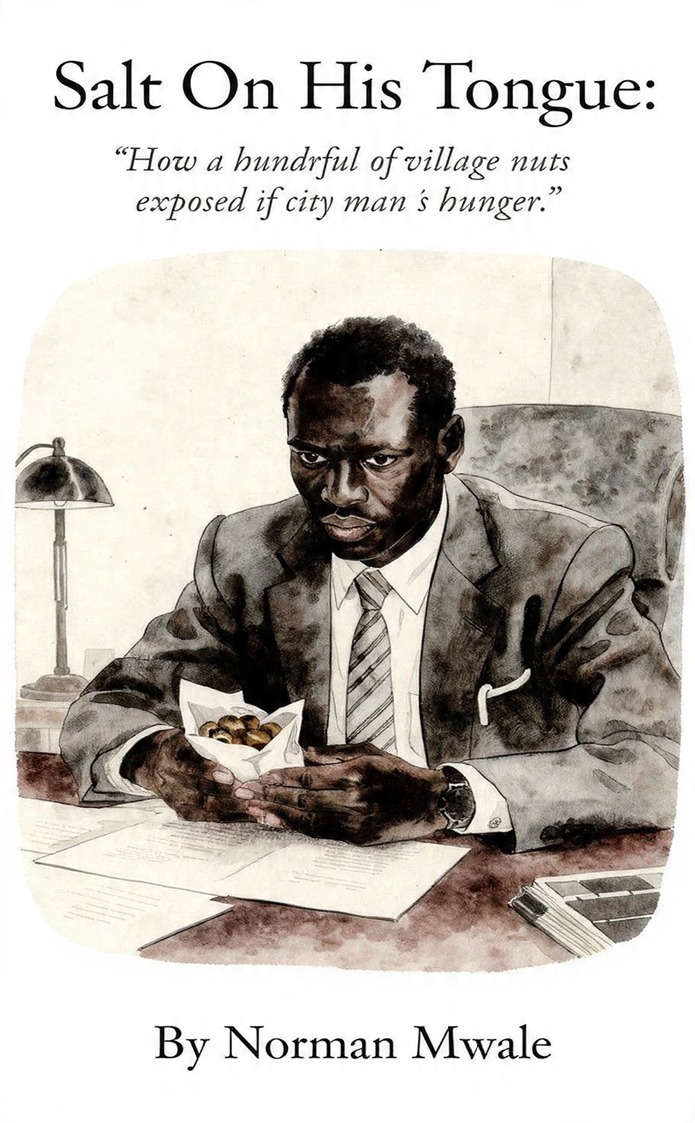
A city manager steals his village aunt’s gift of roasted groundnuts — and finds the cost of forgetting where you come from.
By Norman Mwale
The bus from Macheke wheezed into Harare at first light, its sides dusted the colour of dried clay. Gogo Maidei stepped down with both hands gripping a plastic carrier bag smaller than a loaf of bread. Inside, tied with a strip of brown twine, was a parcel of roasted groundnuts. The skins were still warm with the memory of her clay stove. They smelled of smoke, salt, and the farmland behind her rondavel.
Her nephew, Tafadzwa Mlambo, was a company manager now. Glass tower, seventh floor, name on a door. That was what the neighbour’s son had said on WhatsApp. “Uncle Tafadzwa is big, Gogo. You cannot just walk in.” So she did what people from the village had done for a hundred years when the city grew teeth: she left the thing at the gate.
The security guard was young, his uniform starched to a knife edge. He took the parcel without looking at it. “Name?” She told him. He wrote it in a dog-eared book, slid the parcel into a cardboard box with other deliveries, and nodded toward the lift. “Deputy Manager will take it up.”
The deputy manager’s name was Lunga. He was thirty-two, with a watch that caught light and a calendar that never had empty squares. At 10:17 he remembered the box at reception. He lifted the parcel, felt the oil seeping through the paper, and caught the scent. Roasted. Nutty. It made his mouth water in a way that felt almost indecent at work. He carried it to his office, meaning to deliver it before lunch.
But his phone rang. A supplier. Then a meeting ran over. Then Tafadzwa was called out to a site visit in Msasa. By the time Lunga looked up, the parcel sat on the corner of his desk like a small, guilty animal. He told himself he would give it to Tafadzwa first thing in the morning. He placed it in the top drawer, shut it, and the day swallowed him.
Morning came with emails. The drawer stayed closed.
Tafadzwa returned the next day to a desk stacked with reports and a mind full of figures. He did not ask about parcels. He did not ask about Gogo Maidei. The city had taught him that family was something you phoned on Sundays, if you remembered.
Forty-eight hours later, he needed a contract file he was certain Lunga had signed. Lunga was at lunch. The deputy’s office smelled faintly of polish and aftershave, and beneath that, something else. Warm. Earthy. Tafadzwa’s nose twitched. He had not eaten since seven. Stress did that to him. It hollowed him out.
He opened the drawer looking for the file. His hand found paper instead. The parcel. The twine was loose. The scent rose like a small fire. He told himself he was only checking what it was. He lifted the paper edge. The groundnuts were amber, blistered from the pan, each one holding a little crater of salt. Without deciding to, he took a handful. They were still warm from the city’s heat. He closed the drawer, slid the nuts into his jacket pocket, and walked back to his own office as if he had only gone to fetch a pen.
He ate them one by one over his keyboard. The crunch was louder than it should have been. The salt sat on his tongue and then disappeared. He told himself he would mention it to Lunga later. “Some snacks in your drawer, my man.” But the emails came, and the thought slid away.
The next afternoon he did it again. The drawer was unlocked. The parcel was still there, lighter now. He took another handful. This time he did not pause at the door. He went straight to his chair, sat down, and let the nuts dissolve. The taste was specific. It was not supermarket. It was village. It was his childhood. It was his mother’s hands. For ten minutes he was nine years old again, sitting on a sack in a granary, cracking shells between his teeth while the hens scratched outside.
He began to time it. He would wait until Lunga was in a meeting. He would walk past the open-plan desks with his phone to his ear, turn into the deputy’s office, and open the drawer as if it were his own. The parcel shrank. The paper grew translucent with oil. He did not count how many times. He only knew that when the work was bad, the nuts were good.
Lunga never remembered. His days were a blur of targets and traffic. If he noticed the parcel was lighter, he assumed he had eaten more than he thought on that first day. He was tired. He was human.
Three weeks passed. The parcel died quietly. The last handful Tafadzwa ate standing up, with the drawer open and the city roaring below. He folded the empty paper, put it back, and shut the drawer. He felt nothing. Or rather, he felt only the absence of hunger.
On Thursday, Gogo Maidei came back.
She wore the same cloth on her head. The bus had taken her money again. She stood at the gate with her hands empty this time. The young guard remembered her. “You’re back for the parcel,” he said.
“Yes, my child,” she said. “I wanted to ask the manager if it reached him. It was from the village. Roasted nuts. For his tea.”
The guard called upstairs. Lunga took the call, frowned, and walked to Tafadzwa’s office. He stood in the doorway, uncertain. “Gogo Maidei is at reception. She left a parcel weeks ago. Roasted groundnuts. Did you get it?”
Tafadzwa looked up from his screen. The question did not make sense at first. Parcel. Groundnuts. Gogo. The words moved slowly, like furniture being dragged across a polished floor.
“No,” he said. Then, because the guard was still on the line, he said it louder. “No. I haven’t seen any parcel.”
The lie was automatic. It came out clean.
Gogo Maidei was brought up in the lift. She stood before his desk with the same straight back she used when carrying water. Her eyes were not angry. They were just open. She looked at his desk, at his hands, at the faint sheen on his lips that could have been coffee or could have been oil.
“You don’t remember me, Mwana,” she said softly. “I am your father’s sister. I sat with you when you were learning to walk. I roasted those nuts myself. I saved the best ones for you, because you used to say they tasted like home.”
Tafadzwa’s throat closed. The office air, which was always cold, turned heavy. He could still taste salt. He could still hear the crunch. The memory of his hand in the drawer was sudden and physical, as if someone had pulled the drawer open inside his chest.
He wanted to say something clever. Something managerial. He wanted to ask her to sit, to offer water, to make it a process. But the room would not let him.
“I… I’m sorry,” he said. “There was no parcel on my desk.”
The words hung there, thin and bright as glass.
Gogo Maidei nodded once. She did not argue. She did not cry. She reached into her cloth and took out a small piece of folded paper. It was the end of the twine from the parcel, tied in a neat knot. She placed it on his desk.
“I kept this,” she said. “In case the bag broke. So I would know it was mine.”
She turned and walked out. The guard held the lift for her. The city took her back.
Lunga stayed in the doorway a second too long. Then he left too, closing the door without a sound.
Tafadzwa sat. The office was the same size it had been five minutes ago, but it felt smaller. The glass looked harder. He opened his drawer. There was nothing inside except pens and a charger. He opened Lunga’s drawer in his mind and saw the empty paper, translucent, with a ghost of oil. He put his hand to his mouth. His fingers smelled of nothing. He scrubbed them on his trousers anyway.
Shame came late, and all at once. It was not the shame of being caught. No one had seen him. It was the shame of recognition. He had stolen from his own blood, and he had done it with the manners of a thief who tells himself he is only borrowing. He had eaten his childhood in handfuls and called it a snack.
He thought of the groundnuts. How they had looked. How they had tasted. How they had been meant for tea on a Sunday, with his aunt watching him eat and saying: Eat, Mwana. You are working hard in the city. He had taken that love and chewed it.
He stood up. He walked to the window. Harare was below him, bright and indifferent. Taxis hooted. Vendors called. The tower was full of people moving parcels from one desk to another, signing things, forgetting things.
He pressed his forehead to the cool glass. The cold did not help.
At half past five he left early. He did not take the lift to the basement car park. He walked down the seven flights. Each landing smelled of paint and cleaning fluid. On the ground floor he bought a packet of roasted nuts from a woman outside the gate. They were pale and dusty compared to Gogo’s. He paid too much. He carried them in his hand all the way to the bus rank.
He found her at Mbare, waiting under a tree with other women from the buses. She was sitting on her carrier bag, her feet dusty. When she saw him, she did not stand.
“Gogo,” he said. He knelt on the concrete without thinking about his trousers. He held out the new packet. “I’m sorry. I ate your nuts.”
People turned to look. A child stopped sucking a sweet.
Gogo Maidei looked at the packet. Then at him. Her face did not soften immediately. It was not a film scene. It was a woman who had travelled four hours for nothing.
“You ate them,” she said. It was not a question.
“Yes.” His voice broke on the word. “Every time I opened that drawer I told myself I would stop. I didn’t. I stole from you. From myself.”
She took the packet. She did not open it. She held it as if it were light.
“Why?” she asked.
He had no answer that would fit on a street corner. “Because I was hungry,” he said finally. “Not for food. For something that tasted like home.”
She studied him. The sun was going down behind the buildings, turning the dust gold. “Home is not in a drawer, Mwana,” she said. “Home is when you remember who sent it.”
He nodded. He could not speak again.
She stood slowly, her knees clicking. She tucked the packet into her bag. “Come,” she said. “I will buy you tea. And I will roast you more nuts. But this time you will sit with me while you eat them.”
They walked to a small stall. She ordered two cups of tea and sat on a bench that wobbled. She broke the seal on the new packet, took a nut, and put it in his palm. It was warm from her hand.
“Eat,” she said.
He did. It tasted different. It tasted like apology. It tasted like being seen.
He sat there until the buses started to leave, until the sky went the colour of a bruise. He told her about the office, about the drawer, about the way the city makes you forget your own name. She listened without advice. She only nodded, as if she had heard the story before, in a different voice.
When it was time, she boarded her bus back to Macheke. He stood at the window and watched her go. She did not wave. She just looked at him, once, and then the bus moved.
He walked back to his car alone. The tower was lit up behind him, all those windows full of light and no one in them. He thought about the drawer. He thought about the twine. He thought about the way a handful of nuts can carry the weight of a life.
That night he did not eat dinner. He sat at his kitchen counter with a glass of water and looked at his hands. They were clean. They were also the hands that had taken.
The next morning he went to work early. He asked Lunga to come to his office. He told him the truth, without names, without blame. “There was a parcel. I took it. It belonged to family. I am going to make it right.”
Lunga listened. He did not smile. He did not frown. He just nodded, as men do when they have seen enough to know that confession is not performance.
Tafadzwa wrote a memo to himself and pinned it inside his drawer. It said only one word: Remember.
In the weeks that followed, he changed small things. He left his door open after lunch. He walked to reception himself when deliveries came. He phoned Gogo Maidei on Sundays, and when she laughed, the sound was not polite. It was real.
A month later, another parcel arrived. Bigger this time. Dried fish, beans, and a smaller bag of roasted groundnuts, tied with new twine. He carried it to his office himself. He did not open it at his desk. He took it home. He sat on his balcony with the city noise below and ate slowly, one nut at a time, with a cup of tea cooling beside him.
He thought of Gogo on her bench. He thought of the drawer. He thought of the boy he had been, cracking shells in a granary, believing that the world would always send you what you needed, and that you would always know how to receive it.
The nuts were salted. They were smoky. They were his.
And for the first time in a long time, he did not feel hungry.
Similar Posts by The Mt Kenya Times:
- Museveni backs Lamu but keeps Uganda’s money at home
- Sifuna’s party wins its name — and Kenya’s opposition race begins in earnest
- Lamu’s $16B gamble: Africa’s biggest refinery divides the region
- Ruto launches KSh2.2 trillion Lamu refinery in East Africa’s biggest energy bet
- Keep off politics from teachers – West Mugirango MP tells off sponsors at Kiangungu Prayers Day
About the Author