
Secrets behind the runway: The invisible dimensions of the fashion industry
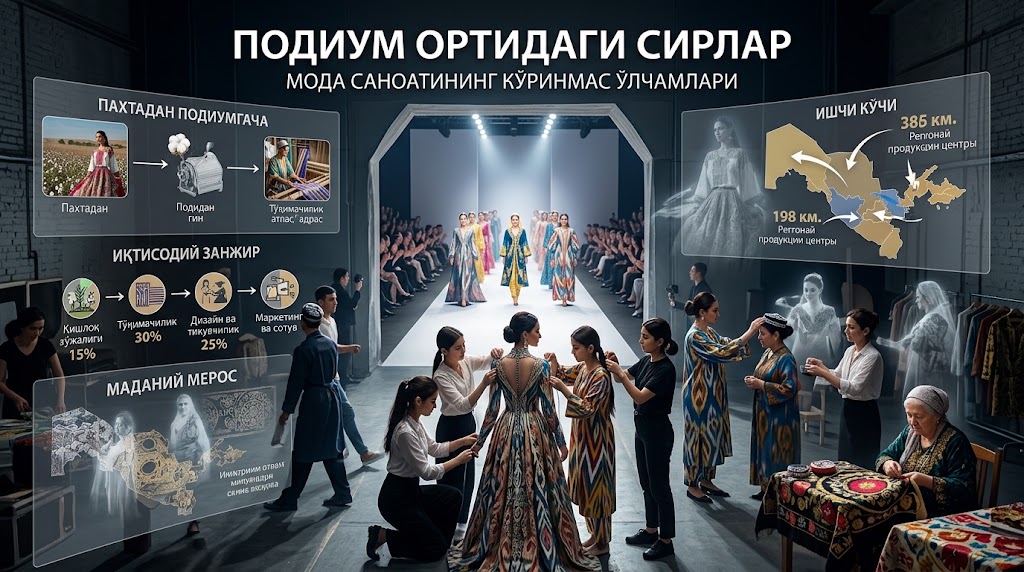

By: Xalilova Dilafruz
Abstract—This paper explores the intricate, backstage mechanisms of the fashion industry that remain invisible to the general audience yet constitute its operational and creative backbone. While public perception often limits fashion to aesthetic garments and runway models, the industry functions as a multifaceted system driven by historical development, creative and predictive design, rigorous backstage logistics, strategic branding, psychological demands, and cutting-edge digital integration. This study examines the evolutionary trajectory of runway spectacles, the integration of trend forecasting methodologies and artificial intelligence, the backstage dynamics of high-stakes productions, and the imperative shift toward sustainable practices and technological innovation.
Keywords: Runway dynamics, fashion forecasting, sustainable fashion, artificial intelligence in design, fashion marketing, backstage logistics.
Introduction
The contemporary fashion show is widely perceived as an effortless convergence of glamour, artistic expression, and supermodels. However, beneath the polished exterior presented under the runway spotlights lies a deeply layered, highly demanding global ecosystem. The runway is not merely a platform for displaying seasonal garments; it serves as a live theatrical stage where months of market research, industrial engineering, creative craftsmanship, and strategic marketing materialize in a matter of minutes. Understanding the true mechanics of the fashion industry requires examining the unseen processes—from sociological trend analysis to the intense psychological and operational pressures of backstage management.
The Evolution and Historical Context of the Runway
Historically, contemporary fashion weeks are synonymous with Paris, Milan, and New York. However, the genesis of structured runway presentations traces back to early 20th-century London, where intimate mannequin parades first introduced commercial structure to haute couture presentations. Over decades, these exclusive, invite-only salon showcases—originally tailored strictly for high-society aristocrats—democratized into globally broadcast multi-million-dollar spectacles.
The transformation of the catwalk into narrative theater gained profound momentum through visionary couturiers such as Christian Dior, whose post-war presentations elevated the runway from functional garment display to immersive emotional storytelling. Modern runways synthesize dramaturgy, acoustic design, spatial architecture, and visual aesthetics, turning the presentation into a holistic sensory experience that shapes cultural dialogue well beyond the immediate audience.
Design Conceptualization, Predictive Analytics, and Inspiration
Garment design extends far beyond sketchpad illustrations. Modern fashion production relies heavily on extensive market analytics, sociological surveys, and macroeconomic forecasting to predict consumer sentiment years in advance. Leading trend forecasting agencies, such as WGSN, utilize data science, color psychology, and textile research to map global cultural shifts, while color standardization authorities such as Pantone determine annual palettes that guide global manufacturing.
Concurrently, systemic environmental concerns have made sustainability an indispensable facet of modern design. The industry faces structural pressure to pivot from hyper-accelerated production cycles toward the circular economy and ‘slow fashion.’ Designers increasingly integrate certified organic cotton, recycled synthetic fibers, and biodegradable textiles, aligning creative vision with ecological responsibility and resource stewardship.
Backstage Operations, Logistical Demands, and AI Integration
The seamless minutes observed by audiences on the catwalk mask hundreds of hours of backstage operational rigor. Each presentation demands exhaustive coordination across multidisciplinary teams: casting directors aligning specific model personas to individual garments, master tailors conducting emergency adjustments, and technical crews orchestrating acoustic, lighting, and environmental effects. A single collection frequently involves the labor of hundreds of skilled professionals operating under strict time constraints.
Digital transformation has fundamentally reshaped these preparatory phases. Artificial intelligence (AI) and machine learning tools increasingly optimize casting assessments, pattern layout, and photoshoot logistics. Advanced algorithms analyze textile texture, silhouette proportions, and lighting contrast, recommending optimal staging configurations and reducing human error during rapid turnaround cycles.
Strategic Branding and Digital Marketing Ecosystems
A fashion brand represents an intangible universe of identity and lifestyle aspiration rather than physical fabric alone. Legacy houses build differentiated brand equity: Dior projects classical luxury and refined heritage, while Gucci fosters bold experimentation and avant-garde subversion.
The migration of marketing expenditure from conventional print editorial to digital channels—predominantly Instagram, TikTok, and emerging social platforms—has decentralized fashion authority. Influencer marketing and real-time runway livestreams allow brands to bypass traditional press gatekeepers, driving immediate consumer engagement and facilitating instant purchasing decisions through digital point-of-sale integration.
Backstage Psychological Pressure and Crisis Management
The pursuit of perfection on the runway generates intense psychological stress across all participants. From model styling and fit alterations to precise cues for scenic lighting, every detail must execute flawlessly. Because live footage is instantly distributed and scrutinized across social media networks, the margin for error is essentially zero.
Live productions routinely encounter technical anomalies, including wardrobe failures, audio interruptions, and stage mechanism stalls. To mitigate these risks, fashion houses increasingly implement 3D computer-aided design (CAD) and digital prototyping software (such as CLO 3D and Browzwear) to test garment physics and simulate movement prior to physical fabrication. These pre-visualization technologies allow design teams to anticipate fit complications and resolve potential errors before the garment ever reaches the physical runway.
Trend Generation and Socio-Cultural Resonance
Trend forecasting operates at the intersection of commercial data, street-level culture, and digital engagement. Recent decades have demonstrated that trends no longer flow strictly downward from elite couture salons; instead, bottom-up movements such as streetwear, vintage upcycling, and digital aesthetic subcultures exert massive influence on global luxury conglomerates. Fashion acts as a sensitive barometer for sociopolitical sentiment, identity politics, and generational values.
Future Trajectories: Scientific and Technological Integration
The forthcoming era of the fashion industry will be defined by the convergence of aesthetics, computing, and material science. Predictive AI models will further refine demand planning, directly addressing the systemic crisis of overproduction. Virtual garment prototyping and 3D modeling significantly reduce material waste during sampling stages, lowering overhead while enhancing environmental compliance.
Furthermore, virtual showrooms and augmented reality (AR) fitting solutions are redefining consumer engagement, enabling clients to evaluate garments within digital environments before physical production commences. Future fashion systems will require an integrated approach where aesthetic mastery, empirical scientific analysis, and ecological integrity are interdependent.
Conclusion
The allure of the runway represents only the final layer of a sophisticated, highly structured global ecosystem. Beneath the transient spectacle of fashion shows lies an intensive matrix of creative labor, market research, logistical precision, and digital innovation.
Far from being a superficial enterprise, fashion is an intricate, multi-disciplinary science combining artistic heritage with technological evolution—a dynamic sector poised to redefine sustainable manufacturing, digital expression, and cultural dialogue in the years ahead.
Xalilova Dilafruz
Master’s Student, Namangan Branch of Kimyo International University in Tashkent
Scientific Advisor: Dilshodbek Yusupov, PhD, Associate Professor
Similar Posts by The Mt Kenya Times:
- Owono breaks silence after De Miguel tragedy: ‘The most difficult days of my life’
- Nyamira High Court acquits four accused in murder of couple
- ACK Clergy in Kisii call for peaceful 2027 elections, reject political violence
- The enlightened republic of closed minds: Where ballots bloom and reason withers
- The final whistle for number 7: Ronaldo’s Portugal story ends
About the Author


