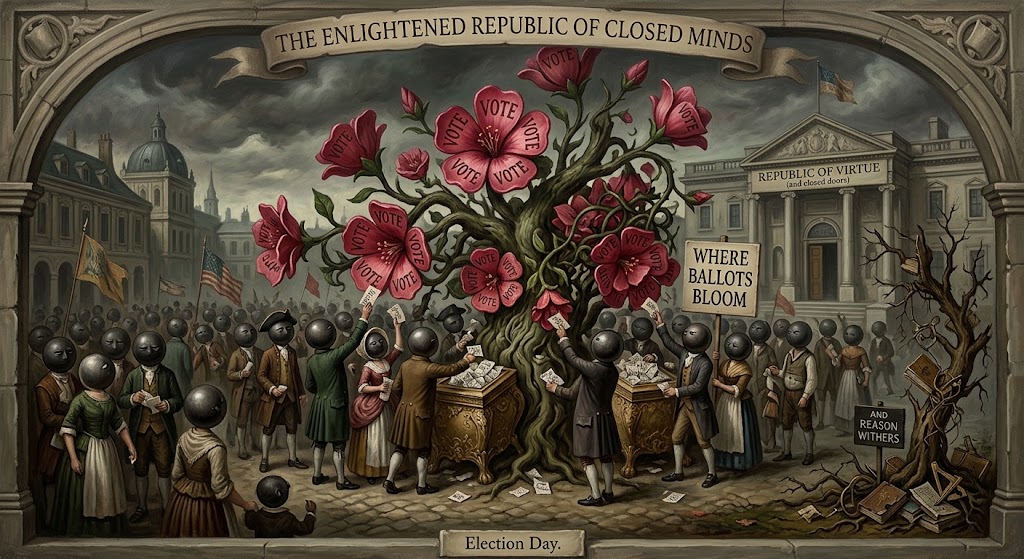
The enlightened republic of closed minds: Where ballots bloom and reason withers
 The Mt Kenya Times
By Jerameel Kevins Owuor Odhiambo
Seventy-nine percent of Kenyan children at late primary age cannot read proficiently. That single, brutal number from recent learning assessments stands as the opening indictment. It is not a statistic about schools alone. It is the measurable face of a deeper national condition: the death of rational thought among the majority of Kenyans, a profound poverty of conscience when matters of genuine governance arise, and an intellectual barrenness that borders on the surreal. We celebrate independence anniversaries and constitutional milestones while the capacity to interrogate power, weigh evidence, and demand accountability atrophies in plain sight.
This intellectual poverty is not abstract. It walks the streets in the form of citizens who cheer tribal arithmetic over policy coherence, who treat public office as ethnic inheritance rather than public trust, and who confuse noise with argument. Corruption Perceptions Index scores hover around thirty out of one hundred, among the lower ranks globally. The World Bank estimates that graft drains roughly two percent of GDP every year through distorted procurement, bribery, and fiscal leakage. Motorcycle riders surrender five to twenty percent of daily earnings to roadblock demands. Police, land offices, and licensing agencies top the bribery tables. These are not distant scandals. They are the daily tax levied on a population that too often shrugs, shrugs again, and then votes the same patterns into another cycle.
History supplies the long shadow. Colonial administration perfected the art of rule through division and limited literacy. Independence in 1963 promised rupture. Instead, the early years recycled patronage networks under new flags. The single-party era rewarded loyalty over competence. Multiparty politics in the 1990s expanded the franchise without expanding the franchise of critical thought. The 2010 Constitution, born of blood and reformist energy after the post-election violence of 2007–08, remains one of the most progressive documents on the continent. It enshrines devolution, rights, and checks. Implementation, however, collides with a citizenry whose analytical muscles have wasted. We inherited institutions and then starved the minds required to operate them.
Consider the classroom as both cause and symptom. Foundational literacy and numeracy assessments reveal that large shares of learners in Grade 4 and Grade 9 still struggle with texts and calculations expected years earlier. International assessments place Kenyan fifteen-year-olds far below global averages in reading, mathematics, and science; more than eighty percent fall below minimum proficiency in key domains. Private schools pull further ahead while public one’s lag, widening the very inequality that rational governance ought to narrow. When children leave school unable to parse a budget statement or a procurement report, they enter adulthood equipped mainly for slogans. The correlation is stark: weak foundational skills feed weak civic reasoning, which in turn feeds the tolerance of mediocrity in high office.
Poverty of conscience compounds the intellectual deficit. Conscience here means the internal demand that public resources serve public ends. Too many Kenyans treat governance as a distant soap opera rather than a shared responsibility. When leaders loot, the response is often ethnic defense rather than moral outrage. When county governments fail to deliver water or drugs, the complaint stays local and tribal rather than systemic. Voter registration data and turnout patterns show youth, who form the demographic majority, lagging in both registration and consistent participation relative to their numbers. Education levels correlate with political engagement, yet the quality of that education leaves vast numbers without the tools to convert schooling into scrutiny.
The ironies multiply. We host vibrant media, universities, and civil society organisations, and still the public square fills with rumor, conspiracy, and personality cults. Social media amplifies volume over verification. Political rallies reward the loudest grievance rather than the clearest diagnosis. Leaders exploit the vacuum: they promise miracles while delivering inflated contracts; they invoke history while repeating its worst chapters. Citizens, starved of rigorous public education and honest discourse, become accomplices through indifference or selective blindness. The result is a polity that can mobilise for football or ethnic solidarity far more readily than for transparent budgeting or independent institutions.
This is not a blanket condemnation of every Kenyan. Islands of excellence exist—teachers who still teach against the odds, journalists who dig, judges who rule against power, young professionals who organise around data rather than tribe. Yet the dominant current runs the other way. The majority condition is one of suspended disbelief: we know the system is broken and still participate in its rituals as if repetition will somehow produce different outcomes. That suspension is the true poverty. It is the refusal to connect the dots between a stolen public hospital budget and the empty pharmacy shelf, between an unaccountable police service and the daily humiliation of ordinary citizens, between unexamined voting and the perpetual postponement of dignity.
The historical parallel cuts deep. Societies that emerge from colonial or authoritarian pasts either cultivate the habits of self-rule or recreate new forms of dependency. Kenya chose the language of democracy while retaining many of the mental habits of subjects. We demand rights while neglecting the reciprocal duties of informed citizenship. We celebrate the vote while treating the period between elections as a spectator sport. The cost is generational. Children raised in an atmosphere where reason is optional grow into adults for whom reason is alien. The cycle tightens.
What then must be done? The call is categorical and directed at every actor who still possesses residual agency.
Citizens must reclaim the primary duty: to think before they cheer, to verify before they share, to measure leaders by delivery rather than by blood or rhetoric. This requires deliberate cultivation of critical habits reading budgets, attending county assemblies, demanding evidence. Intellectual poverty ends only when individuals refuse to outsource their judgment.
Educators and the Ministry of Education must treat foundational literacy and numeracy as non-negotiable national security issues. Curriculum must prioritise reasoning, evidence evaluation, and civic competence alongside technical skills. Teacher training, instructional materials, and accountability for learning outcomes cannot remain secondary to enrollment numbers. The seventy-nine percent figure is an emergency, not a footnote.
Political leaders and parties must stop treating the electorate as a permanent underclass of emotion. Those who seek office should be forced by organised public pressure to present coherent programmes, publish asset declarations that withstand scrutiny, and accept independent oversight. The culture of impunity thrives only where citizens grant it oxygen.
Media and civil society must abandon the comfort of reactive outrage and invest in sustained public education. Fact-checking is necessary but insufficient; the deeper task is to model and demand sequential reasoning in public debate. Universities should produce not only degree-holders but citizens capable of interrogating power.
The youth, who will inherit the accumulated deficits, carry a particular burden and opportunity. Their demographic weight is real. Their under-participation in structured politics is a choice that can be reversed through organised, issue-based mobilisation rather than personality fandom. Digital tools can serve analysis as readily as they serve distraction.
Religious and cultural leaders must confront the convenient theology that spiritualizes suffering while ignoring the structural theft that produces it. Moral authority unused against systemic wrong is authority squandered.
None of these demands is new. The novelty lies only in the urgency of finally treating intellectual and moral poverty as the binding constraint on every other reform. Roads, hospitals, and factories matter. They cannot be sustained by a population that cannot or will not think clearly about the systems that build and maintain them. Data on learning poverty, corruption costs, and persistent economic exclusion form a single story: a nation rich in potential that systematically under-invests in the minds required to realize it.
The desert of rational thought will not green itself. Rain falls when people decide that the alternative continued intellectual drought, continued moral shallowing, continued recycling of failure is no longer tolerable. The facts are already written in the assessments, the indices, and the daily experience of ordinary Kenyans. The remaining question is whether enough of us still possess the residual capacity to read them, to feel their weight, and to act as if our collective future depends on the answer. It does.
The writer is a social commentator
Similar Posts by The Mt Kenya Times:
- Owono breaks silence after De Miguel tragedy: ‘The most difficult days of my life’
- Nyamira High Court acquits four accused in murder of couple
- ACK Clergy in Kisii call for peaceful 2027 elections, reject political violence
- The final whistle for number 7: Ronaldo’s Portugal story ends
- Secrets behind the runway: The invisible dimensions of the fashion industry
About the Author