Talanta Stadium under scrutiny as Kenyans question cost of Bayern-Ajax clash
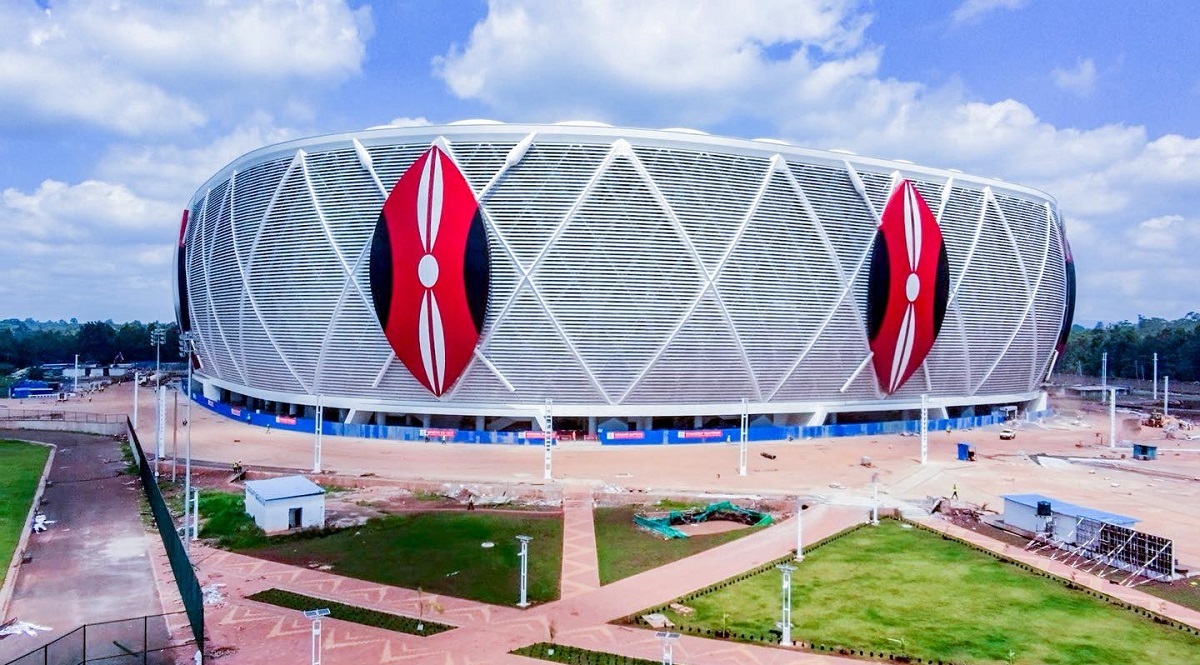
Raila Odinga International Stadium
A court petition demanding financial transparency over Kenya’s planned international football friendly has turned the Talanta Stadium’s grand opening into a test of public accountability.
By Yvonne Wambui
The newly constructed Talanta Stadium — now officially named the Raila Odinga International Stadium — has become the centre of a widening public debate following plans to host an international football friendly between German giants Bayern Munich and Dutch side AFC Ajax on 5 January 2027.
President William Ruto announced the fixture yesterday, describing it as an opportunity to showcase Kenya’s sporting ambitions and attract global attention to the country’s football industry. For many Kenyans, the prospect of two of Europe’s most storied clubs arriving on home soil is genuinely exciting. But alongside the excitement, a sharper question has emerged: who is paying for it, and how much?
A group of six citizens has moved to Milimani High Court seeking orders to prevent the government from committing public funds to the event unless the expenditure can be shown to comply with the Constitution and applicable financial laws. The petitioners are demanding that all sponsorship agreements, contracts, and financial commitments involving the two clubs or their representatives be made public. They want to know the identities of corporate sponsors, what each is contributing, and precisely what financial obligations, if any, fall to the state.
Their concerns extend well beyond any appearance fee. Hosting two of Europe’s biggest clubs involves substantial logistical costs — player travel, accommodation, security, insurance, hospitality, and transport among them. Of particular concern is a reported appearance fee of five million euros, equivalent to approximately KSh724.6 million, allegedly associated with the fixture. The petitioners have been careful to note the figure has not been independently verified and are seeking official clarification.
Ruto had indicated the event would be delivered through corporate partnerships and a self-sustaining commercial model. The petitioners do not dispute that framing outright, but argue that describing something as privately sponsored does not automatically shield taxpayers from direct or indirect financial exposure. State resources — security personnel, transport services, government guarantees — can represent real public cost even when no cheque is written from the Treasury. They want that confirmed or ruled out clearly and on the record.
The applicants have anchored their case in Articles 35 and 201 of the Constitution, which enshrine the right of access to information held by the state and the principles of openness, accountability, and prudent management of public resources. They have also asked the court to preserve all financial records, procurement documents, and correspondence relating to the match pending the case’s determination.
The High Court, however, declined yesterday to certify the application as urgent. Justice Roselyne Aburili observed that the remedies sought in the application were substantially similar to those already contained in the main petition, and directed the petitioners to serve all respondents and interested parties, who were given ten days to file responses. The matter is scheduled for mention on 25 November 2026 for further directions. That ruling is not a determination on the merits of the petition, nor a verdict on whether public money should or should not be spent on the match.
Named as respondents are the Attorney-General, the Sports Cabinet Secretary, the National Treasury Cabinet Secretary, and Sports Kenya. The Law Society of Kenya and Katiba Institute have been listed as interested parties — a signal that the legal and constitutional dimensions of the case are being watched beyond the immediate circle of petitioners.
The controversy has opened a broader conversation about Kenya’s priorities in sports development and what large-scale infrastructure investment should deliver. The Talanta Stadium represents a significant national commitment to improving Kenya’s capacity to host international competition. It is also central to the country’s preparations for co-hosting the 2027 Africa Cup of Nations alongside Uganda and Tanzania.
The potential benefits of the Bayern-Ajax fixture are not trivial. Local players, coaches, and administrators would gain rare exposure to world-class football standards. International visitors would generate revenue for hotels, restaurants, and transport operators. Kenya’s global sporting profile would receive a meaningful boost. These are legitimate gains and should be part of the conversation.
But so should the questions being asked by the petitioners. Kenya faces acute competing demands in education, healthcare, employment, and infrastructure. In that context, any commitment of public resources to a single sporting event — however prestigious — requires clear and credible justification. The government’s silence on the precise financial arrangements has not helped its position.
As the 5 January fixture approaches, the pressure on the government and event organisers to provide straightforward answers will only intensify. Transparency about who is bearing which costs, and what lasting benefits the event will deliver to Kenyan football at the grassroots level, is not an unreasonable expectation. It is, in fact, the minimum that public accountability demands.
The debate surrounding Talanta Stadium has therefore moved well beyond football. It has become a question about the relationship between national ambition and responsible spending — and whether a government confident enough to announce a fixture of this scale is equally confident in explaining, openly and in detail, exactly how it intends to pay for it.
With the court due to give further directions on 25 November, Kenyans will be watching. The success of this international friendly will ultimately be measured not only by the quality of football on display, but by the transparency of its organisation and the tangible, lasting benefits it delivers to the sport and the wider economy.
Similar Posts by The Mt Kenya Times:
- Kenya’s economy in 2026: Growing faster, but under pressure
- Our culture, our heritage: A legacy worth protecting
- Liverpool suffer Istanbul heartbreak in 3-2 collapse
- Under Old Trafford lights, dreams refuse to die
- Koome and DCI Amin trade blame over rising political goonism ahead of 2027 polls
About the Author